

Your parking lot’s maintenance strategy depends on property type. If you run a retail lot, you’ll need sealcoating every two to three years, plus safety signage and mid-week scheduling. Office parks stretch that cycle to three or four years, cutting costs. Industrial sites demand crack filling, pothole repair, and structural work. Healthcare facilities prioritize ADA compliance, markings, and sectioned work. Budget $3,000, $7,000 annually per 100 spaces. Each type carries specific priorities worth knowing.
Key Takeaways
- Retail: Prioritizes frequent sealcoating every two to three years, safety signage, and mid-week scheduling to minimize customer disruption.
- Office: Requires sealcoating every three to four years, tenant notifications, ADA re-striping reviews, and lighting inspections for evening safety.
- Industrial: Emphasizes frequent crack filling, immediate pothole repair, structural fixes, and documenting jobs with photos and invoices for warranties.
- Healthcare: Focuses on strict ADA compliance, pavement markings, signage, and sectioned work to preserve patient access and emergency navigation.
- All types: Match plans to traffic and climate, book contractors by April, and seal only after completing crack repairs.
How does parking lot maintenance differ by property type
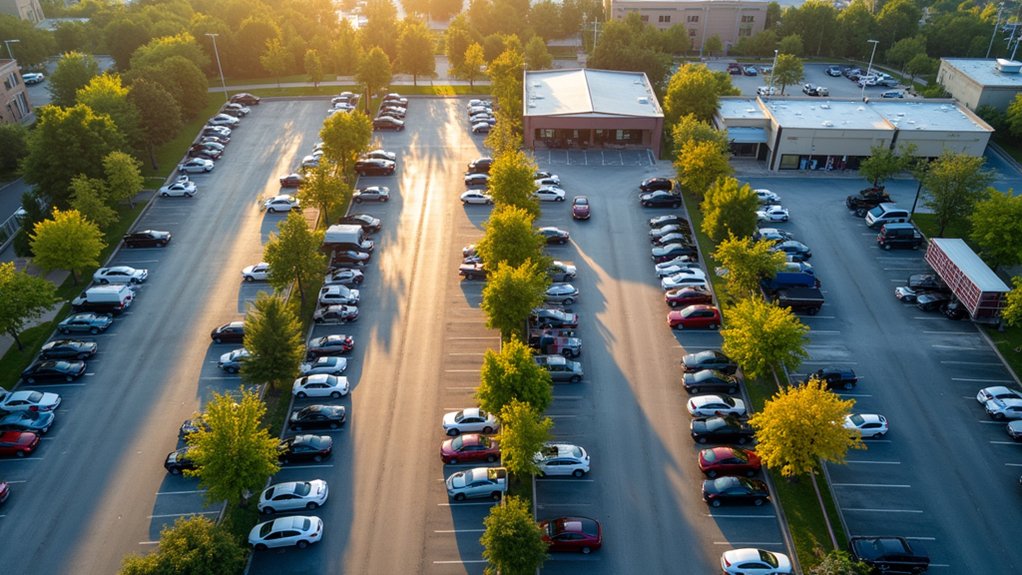
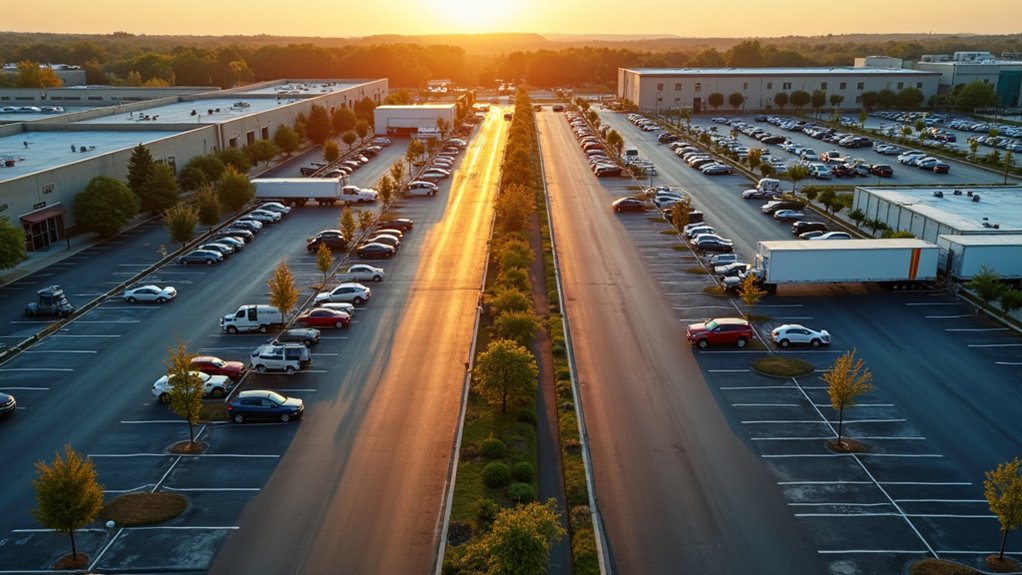
Parking lot maintenance differs by property type because each carries distinct traffic loads, compliance demands, and scheduling constraints, so your maintenance strategy can’t follow a one-size-fits-all template. Parking lot maintenance by property type starts with traffic analysis. Retail parking lot maintenance demands sealcoating every 2 to 3 years due to high-traffic volumes, with mid-week scheduling to protect foot traffic and budgets running $3,000 to $7,000 annually per 100-space lot. Office lots, seeing lower traffic, stretch sealcoating to every 3 to 4 years. Industrial parking lot maintenance prioritizes structural repairs and crack filling, since heavy vehicle loads accelerate deterioration and require immediate pothole repair. Healthcare sites emphasize ADA compliance, pavement markings, and sectioned work to preserve emergency navigation. You’ll match frequency, timing, and repair intensity to each property’s specific operational and structural needs.
What does retail parking lot maintenance prioritize
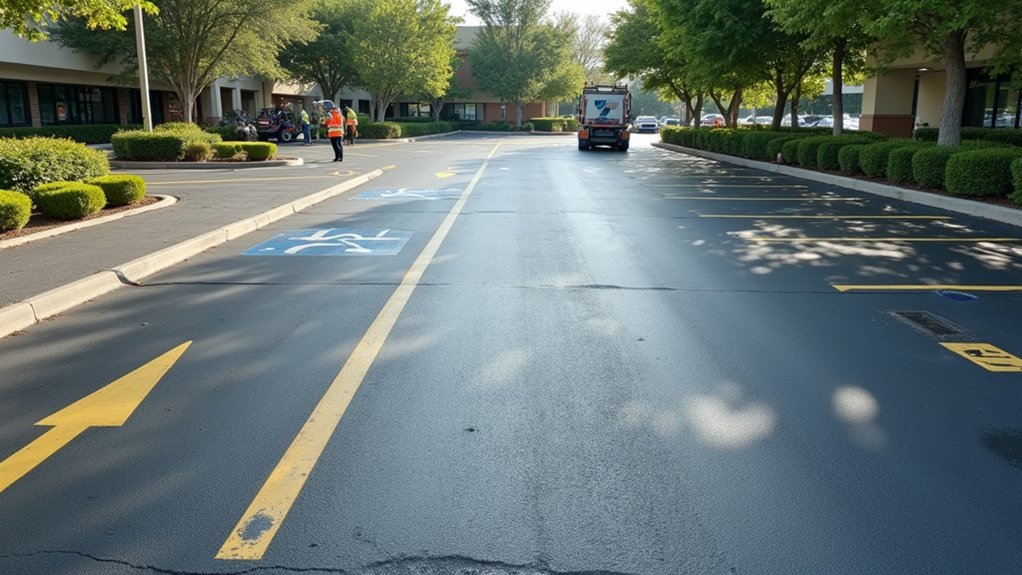
Retail parking lot maintenance prioritizes frequent sealcoating, customer-conscious scheduling, and safety signage to handle the highest traffic volumes of any property type. In climates like Oregon’s Willamette Valley, you’ll need sealcoating every two to three years, always following crack filling and patching to protect a stable surface. Schedule this major work mid-week to minimize customer disruption and maintain foot traffic. Before sealcoating, power wash lots to remove oil stains and organic growth that interfere with adhesion. For effective commercial property pavement maintenance, budget $3,000 to $7,000 annually on a 100-space lot, covering crack filling, cleaning, and minor repairs. Round out your parking area maintenance by installing or replacing ADA vertical signs, speed limit markers, and directional signage to keep customers safe.
What do office and business parks require
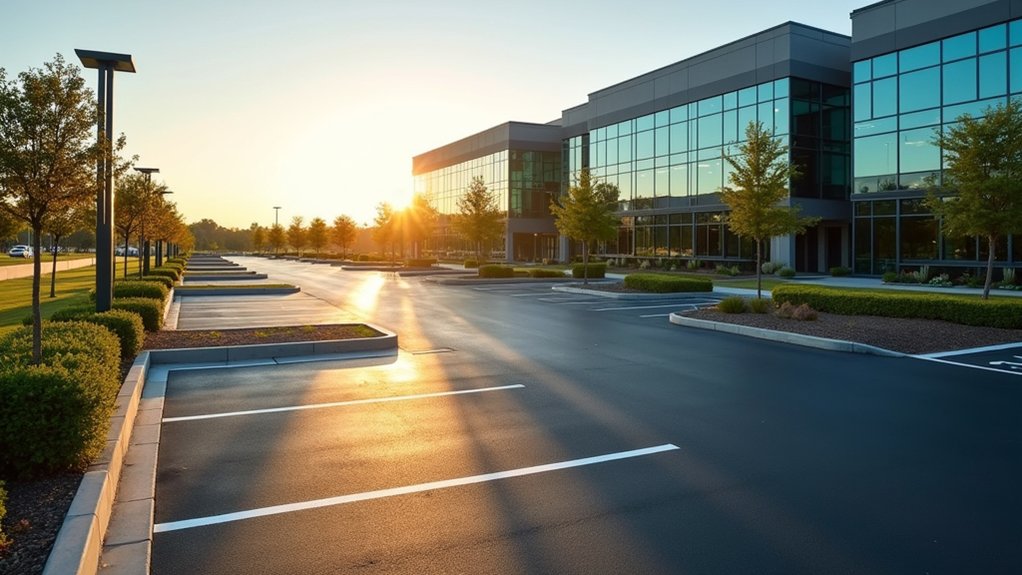
Office and business parks require sealcoating only every three to four years, depending on usage, because they see lower traffic than retail sites. This extended cycle lowers your annual maintenance costs, but you’ll still need to plan carefully. Notify tenants early about planned summer maintenance closures so they can manage their business operations around the work. During re-stripe seasons, review your ADA compliance elements and correct any accessible parking deficiencies before they become liabilities. Don’t overlook lighting: inspect and repair fixtures, replace burned-out units, and clean lenses to maintain evening safety for staff working late. Finally, trim vegetation encroaching on parking spaces to preserve clear sight lines for drivers and pedestrians. These targeted, lower-frequency tasks keep your lot safe, compliant, and cost-effective year-round.
How do maintenance priorities compare across property types
Maintenance priorities differ across property types based on traffic volume, vehicle loads, and safety demands. High-traffic retail lots need sealcoating every 2 to 3 years, while lower-traffic office lots stretch to 3 or 4. Industrial sites prioritize structural repairs and immediate pothole fixes due to heavy commercial loads. Healthcare facilities demand rigorous ADA compliance and clear markings for emergency navigation.
| Property Type | Sealcoating Frequency | Top Priority |
|---|---|---|
| Retail | 2, 3 years | Signage & ADA |
| Office | 3, 4 years | Lighting & vegetation |
| Industrial | As needed | Structural repairs |
You’ll allocate budget differently too. Retail lots run $3,000 to $7,000 annually per 100 spaces, while industrial zones fund preventative services to avoid costly emergencies.
What does industrial parking lot maintenance demand

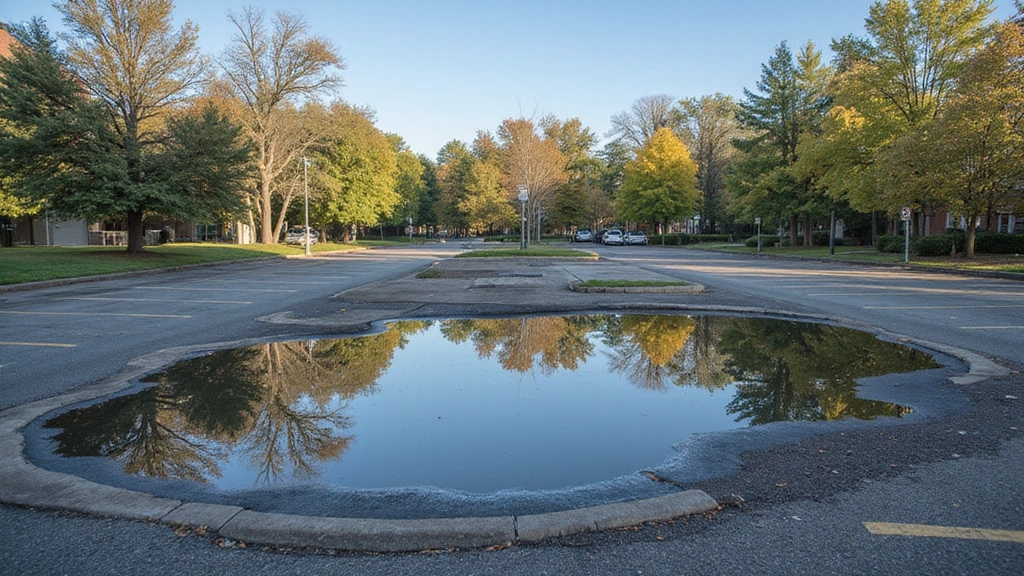
Industrial parking lot maintenance demands more frequent crack filling and structural repairs than other property types, because heavy vehicle loads and constant commercial traffic accelerate structural deterioration. Industrial lots take a beating that retail and office surfaces never see. Prioritize immediate pothole repair to block water intrusion and stop deterioration before it spreads beneath the surface. Partner with contractors experienced in industrial sites, since they understand specific traffic loads and drainage demands your lot requires. Allocate annual funds for preventative services, this reduces your risk of costly emergency repairs down the line. Document every completed job with photographs and contractor invoices to protect your warranty coverage and maintain liability records. That paper trail matters when heavy-use damage triggers disputes or when you’re justifying maintenance budgets to stakeholders.
What do healthcare facilities prioritize
Healthcare facilities prioritize pavement markings, signage, and strict ADA compliance above all else, because patients needing emergency service must navigate your lot efficiently and safely without obstruction. You can’t compromise on emergency navigation, so keep fire lanes, crosswalks, and directional markings sharp and legible year-round. Meet every ADA requirement rigorously, accessible spaces, van-accessible dimensions, proper vertical signs, and compliant slopes, to ensure maximum accessibility for patients and staff. Since you can’t shut down a hospital, perform maintenance in sections, minimizing the impact on patient access and staff operations. Schedule sectional work carefully, and re-stripe faded markings before they become safety hazards. Budget accordingly: the hospital segment’s anticipated to grow at the highest CAGR due to increasing infrastructure investment, so plan for expanding maintenance demands and rising compliance costs.
How does V&F Paving tailor maintenance by property
V&F Paving tailors maintenance by property type by matching each plan to your lot’s actual traffic loads, climate exposure, and compliance demands, because no two property types wear the same way. As a self-performing provider, we base every recommendation on real pavement condition, not speculation, and we schedule work to fit your operations:
- Retail: Sealcoat every 2, 3 years, power wash oil stains, and schedule mid-week to protect foot traffic.
- Office: Sealcoat every 3, 4 years, notify tenants early, and review ADA elements during re-stripe seasons.
- Industrial: Prioritize immediate pothole repair, increase crack filling for heavy loads, and document work for warranty records.
- Healthcare: Enforce strict ADA compliance, emphasize markings and signage, and work in sections to preserve patient access.
- All types: Book contractors by April, sealcoat only after crack repairs.
Maintenance Matched to How Your Property Actually Works
A retail plaza, a warehouse, a medical campus, and an office park don’t wear the same way, and they shouldn’t be maintained the same way. V&F Paving builds maintenance plans around your property’s real traffic, loads, compliance demands, and operating hours, then schedules the work to keep your business running. Serving Hamden, New Haven, Stamford, Danbury, and Fairfield County since 1994, our team self-performs crack sealing, patching, sealcoating, striping, and repairs, so one crew handles the whole plan in the right order. To get a plan built for your property type, call (203) 624-2449 for a free assessment.
Frequently Asked Questions
What about apartment complexes and multifamily properties? How does their maintenance differ?
Multifamily lots have their own profile. Traffic is steady rather than peak-heavy, but the lot is in use around the clock, which makes scheduling closures harder than at an office park. Resident safety and satisfaction matter a lot, since cracked pavement, potholes, and poor lighting show up in reviews and affect renewals. ADA compliance applies to the public-facing areas like leasing offices and visitor parking. The practical approach is usually sectioned work to keep residents’ access intact, clear advance notice to tenants, and steady preventive upkeep so the lot doesn’t degrade under constant use.
How is restaurant or drive-through parking different to maintain?
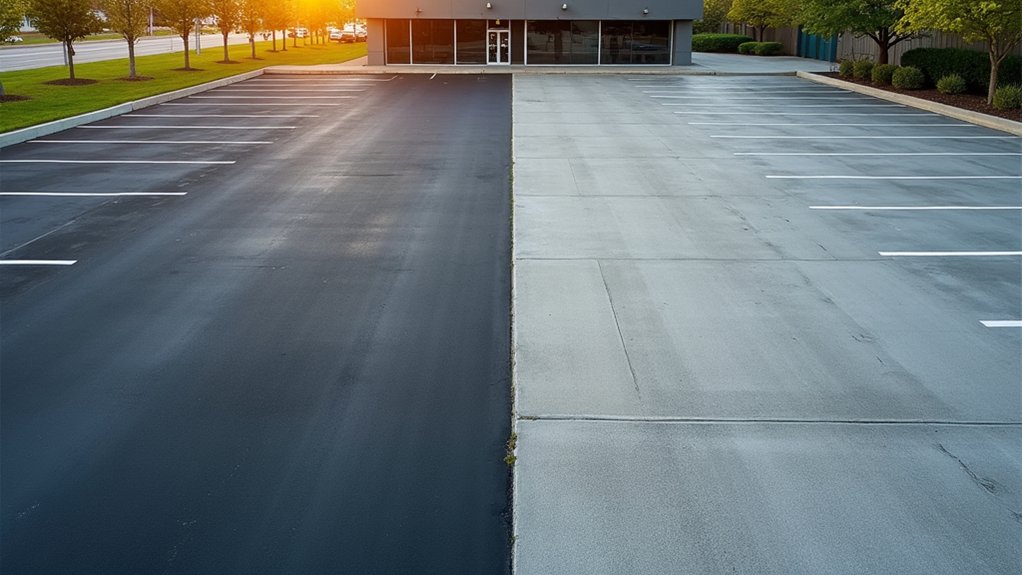
Restaurants and quick-service properties concentrate wear in specific spots, which changes the plan. Drive-through lanes take slow, constant, stop-and-go traffic that punishes asphalt and often makes concrete the smarter choice for just that lane. Entrances, order points, and pickup windows see the heaviest use and wear fastest. Oil and grease drips near dumpster pads and kitchens degrade asphalt and interfere with sealcoat adhesion, so cleaning and spot treatment matter more here. Because these lots run long hours seven days a week, work usually has to be phased or done overnight to avoid killing a day of business.
We’re a multi-tenant property. Who actually pays for the parking lot maintenance?
In most commercial leases, parking lot upkeep falls under Common Area Maintenance, or CAM, which is typically passed through to tenants, often proportional to the space they occupy. That’s why lease structure matters as much as the work itself. Larger repairs like resurfacing can show up as significant CAM reconciliation charges, so owners and managers benefit from planned, documented maintenance that spreads cost predictably rather than hitting tenants with a surprise emergency assessment. Exactly how it’s split depends on your leases, but keeping clear records of the work protects you if a tenant questions the charges.
My property has more than one use on it. How do I handle maintenance across a mixed-use site?
You apply the standard that fits each area rather than treating the whole site the same. A property with ground-floor retail, offices above, and a medical tenant may need the retail and drive areas maintained on a more frequent, high-visibility cycle, the healthcare-adjacent parking held to strict ADA and marking standards, and the lower-traffic zones on a longer interval. The scheduling also has to reconcile different operating hours. A good assessment maps the property zone by zone so each area gets what it actually needs, which is usually more cost-effective than a single blanket plan.
How do you schedule maintenance without disrupting my specific operation?
It’s tailored to how and when your property runs. Retail lots are usually worked mid-week to protect weekend foot traffic. Office and business parks often prefer weekends or summer slow periods, with advance notice to tenants. Facilities that can’t close, like hospitals and busy apartment complexes, get sectioned work so access and emergency navigation stay open throughout. Industrial sites are scheduled around shift changes and delivery windows. Larger jobs across any property type can be phased so part of the lot stays usable while another cures. The goal is keeping you operational while the work gets done right.