
Choosing between asphalt and concrete comes down to timing and budget. You’ll pay 30–40% less upfront with asphalt ($3–$7 per square foot), and it’s traffic-ready in 48–72 hours. But concrete lasts 30–50 years and can cost nearly 30% less over three decades thanks to minimal maintenance. Your climate matters too: asphalt handles cold freeze-thaw cycles, while concrete resists heat and heavy loads. Match the surface to your property’s real needs below.
Key Takeaways
- Upfront Cost: Asphalt costs $3–$7 per square foot, running 30–40% cheaper than concrete’s $4–$10 per square foot.
- Long-Term Value: Concrete can cost nearly 30% less over 30 years due to minimal maintenance versus asphalt’s recurring seal coating.
- Durability & Lifespan: Asphalt lasts 15–20 years, while concrete endures 30–50 years and better handles heavy truck and industrial loads.
- Climate Fit: Asphalt flexes well in cold, freeze-thaw regions, while concrete resists heat-related softening and rutting in hot climates.
- Downtime: Asphalt is traffic-ready in 48–72 hours, whereas concrete requires 7–10 days before full use.
Should you choose an asphalt or concrete parking lot
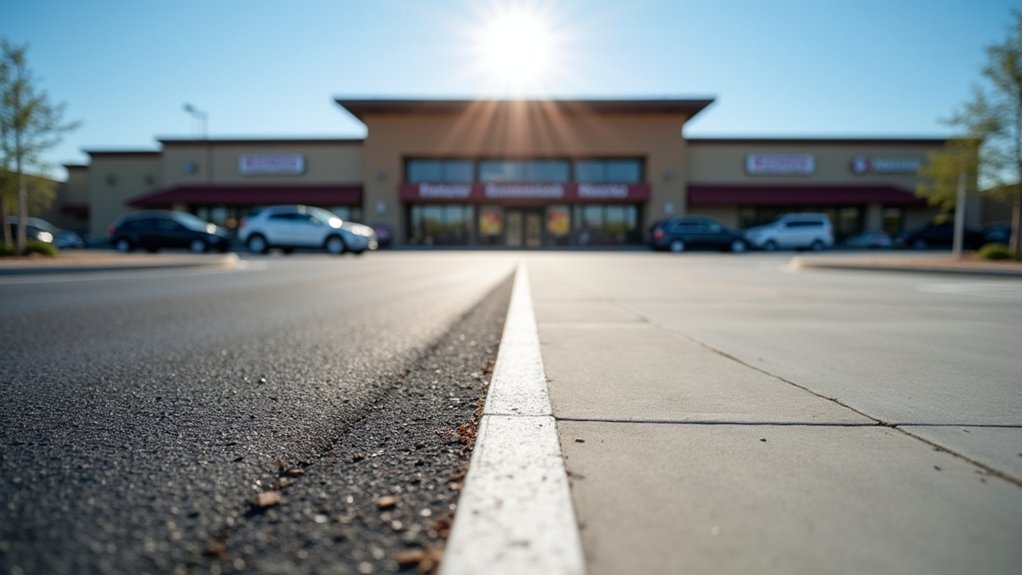
Choose asphalt for lower upfront cost and cold climates, or concrete for heavy traffic, hot regions, and long-term savings. The asphalt vs concrete parking lot decision starts with capital: asphalt runs $3–$7 per square foot versus concrete’s $4–$10, making asphalt 30–40% cheaper upfront. But over 30 years, concrete can cost nearly 30% less thanks to minimal maintenance. Asphalt demands seal coating every 2–5 years, adding $15,000–$25,000 on a 10,000-square-foot lot.
Traffic matters too. Heavy trucks and industrial loads favor concrete’s rigidity and 30–50 year lifespan. For cold, freeze-thaw climates, asphalt’s flexibility wins; hot regions favor concrete. If downtime hurts your revenue, asphalt cures in 2–3 days versus concrete’s 7–10. Match the material to your priorities.
What are the strengths of an asphalt parking lot
An asphalt parking lot’s biggest strength is cost efficiency at installation. You’ll spend $3 to $7 per square foot, making a 10,000-square-foot asphalt parking lot total $30,000–$70,000, roughly 30–40% cheaper upfront than concrete. If capital’s tight, that difference matters.
Speed delivers another ROI advantage. Asphalt cures for traffic within 48–72 hours, sometimes 1–2 days, versus concrete’s 7–10 day wait. When downtime costs money, you’re back to operational service fast.
Asphalt cures in 48–72 hours versus concrete’s 7–10 day wait—when downtime costs money, you’re operational fast.
Asphalt also performs better in cold climates. Its flexibility handles freeze-thaw cycles, expanding and contracting with temperature shifts and shifting ground without cracking as readily as rigid concrete.
For budget-conscious projects, quick turnarounds, or cold regions, asphalt’s lower initial investment and rapid installation make it the practical, financially sound choice for your property.
How does parking lot paving differ by material
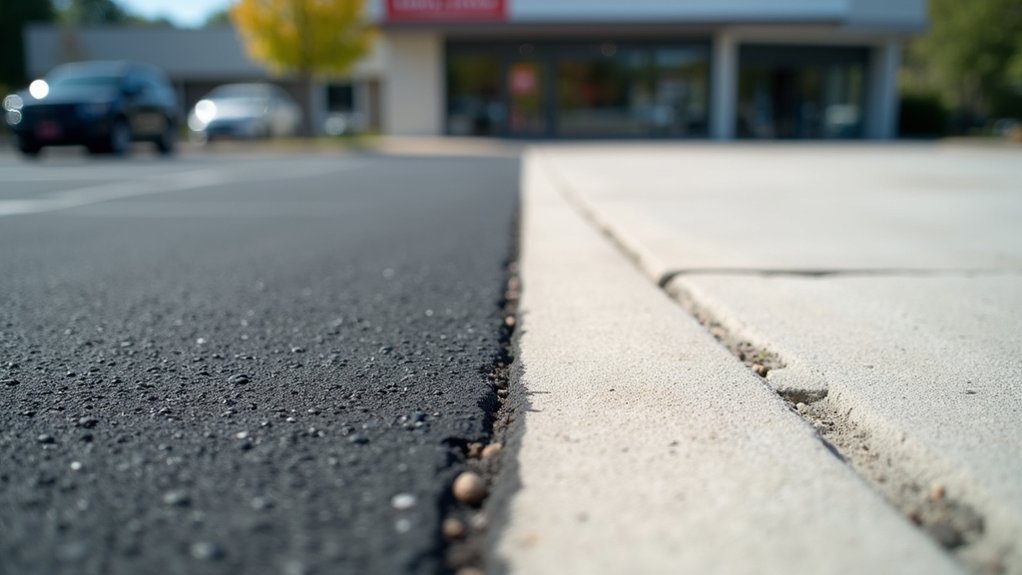
Parking lot paving differs by material because of composition and how each responds to load, temperature, and time. Asphalt parking lot paving relies on a flexible bitumen binder that expands and contracts with freeze-thaw cycles, cushioning ground movement but wearing faster under heavy trucks. You’ll get traffic-ready surfaces in 48–72 hours, minimizing downtime. Concrete cures rigid, distributing static loads across a stronger slab that resists heat and industrial-grade weight, but it needs 7–10 days before full use and cracks when the ground shifts.
Your ROI calculation changes accordingly. Asphalt cuts upfront costs 30–40% and speeds your return to service, while concrete’s rigidity delivers 30–50 years of durability. Match the material’s behavior to your traffic, climate, and timeline priorities.
How do the two materials compare on upkeep and durability
Asphalt and concrete diverge most sharply on upkeep and durability, which drive your total cost of ownership. Asphalt needs seal coating every 2–5 years at $0.15–$0.25 per square foot, adding $15,000–$25,000 over 30 years on a 10,000-square-foot lot. It’ll require repairs around year 16 and full replacement within 15–20 years. A concrete parking lot demands far less: occasional sealing and joint work near year 28, with a 30–50 year lifespan.
| Factor | Asphalt vs Concrete |
|---|---|
| Lifespan | 15–20 yrs vs 30–50 yrs |
| Repair interval | 16 yrs vs 28 yrs |
| Seal frequency | 2–5 yrs vs occasional |
| Heavy loads | Poor vs excellent |
| 30-yr maintenance | High vs low |
If you’re running heavy trucks, concrete’s rigidity delivers better long-term ROI.
How does climate affect which performs better
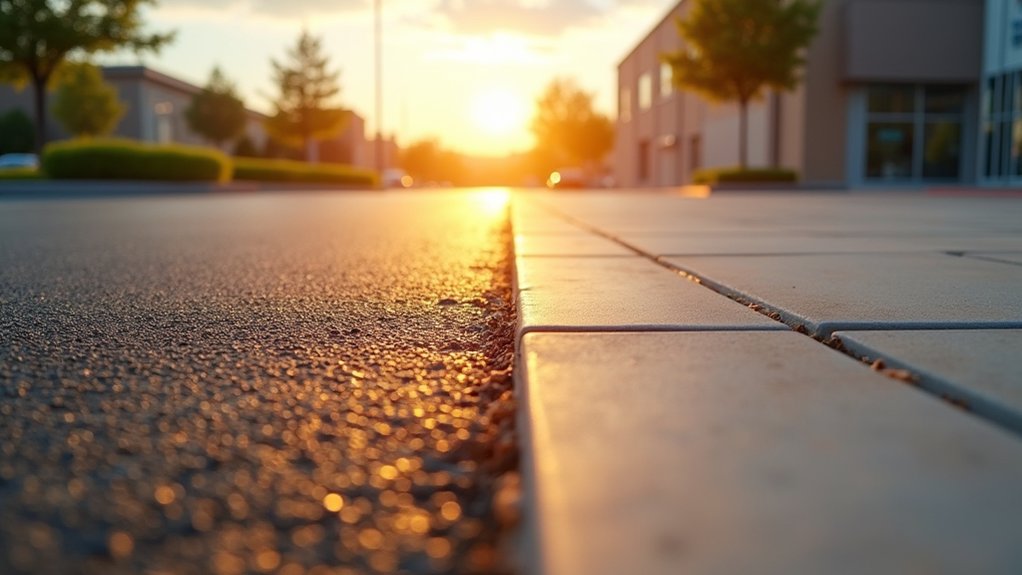
Climate determines which material performs better: asphalt wins in cold regions, while concrete wins in hot ones.
Match your material to your climate first—asphalt for the cold, concrete for the heat—and everything else follows.
Asphalt’s flexibility gives it the edge in harsh winters. It expands and contracts with freeze-thaw cycles, resisting the cracking that plagues rigid surfaces on shifting ground. In cold regions, this movement tolerance directly protects your investment and cuts repair frequency.
Concrete flips the equation in hot climates. It resists heat-related deterioration that softens and ruts asphalt under sustained high temperatures, holding up better where summers punish the surface. Concrete streets also require 30% less lighting, trimming your energy costs.
For commercial parking lot paving decisions, match the material to your climate before weighing anything else. Cold, freeze-thaw environments favor asphalt’s give; hot, sun-heavy locations favor concrete’s stability. Choosing wrong forces premature repairs, eroding the ROI you’re trying to protect.
How do you match the surface to your property
Match the surface to your property by mapping your traffic first. If heavy trucks and industrial vehicles cross your lot daily, concrete’s rigidity justifies the $50,000 to $100,000 upfront cost through 30 to 50 years of minimal maintenance. For lighter passenger traffic on tight capital, asphalt’s $30,000 to $70,000 installation wins.
Next, weigh downtime against budget. If closing your lot costs revenue, asphalt’s 2 to 3 day cure beats concrete’s 7 to 10 day wait. For long-term holds, concrete delivers roughly 30% lower 30-year costs despite higher installation.
Finally, calculate your maintenance tolerance. Asphalt demands seal coating every 2 to 5 years, adding $15,000 to $25,000 over three decades. If low upkeep matters most, concrete’s extended intervals protect your ROI.
How does V&F Paving pave both lot types
V&F Paving paves both lot types by matching the material to your specific needs after analyzing traffic load, budget, downtime tolerance, and climate. When your project needs fast installation and lower upfront costs, we lay asphalt that cures for traffic in 48–72 hours, getting you back to business in days. When you’re weighing 30-year value, heavy truck traffic, or hot-climate durability, our team functions as your concrete parking lot company, installing rigid surfaces built to last 30–50 years with minimal maintenance.
We don’t push one material. We run the numbers on your installation cost, projected seal-coating cycles, and downtime losses, then recommend the surface that delivers the strongest ROI for your property. You get a data-backed decision, professional installation, and a lot engineered for your specific operational demands.
Pick the Surface That Fits Your Property
The right material depends on your traffic, budget, timeline, and Connecticut’s freeze-thaw winters, not on which one a contractor would rather pour. V&F Paving installs both asphalt and concrete, and we start by running the actual numbers on your installation cost, maintenance cycles, and downtime so the recommendation fits your property. Serving Hamden, New Haven, Stamford, Danbury, and Fairfield County since 1994, our team builds lots engineered for real-world New England conditions and backs asphalt installs with a maintenance approach that helps them reach their full lifespan. For a straight answer on your project, call (203) 624-2449 for a free consultation.
Frequently Asked Questions
Which is better for Connecticut’s cold, freeze-thaw winters?
For most Connecticut properties, asphalt has the edge in cold climates. Its flexible binder expands and contracts with freeze-thaw cycles, so it resists the cracking that tends to affect rigid surfaces on shifting ground. Its dark color also helps snow and ice melt faster. Concrete can struggle here, since freeze-thaw cycles and the road salt used to de-ice can deteriorate the surface and cause frost heave over time. Concrete still makes sense for specific heavy-load areas, but for standard parking in a northern climate, asphalt is often the more durable and lower-maintenance choice.
Can I use both materials on the same property?
Yes, and it’s a smart approach many commercial properties overlook. A common strategy is asphalt for the main parking areas and drive lanes, paired with concrete in the spots that take concentrated or static loads, like dumpster pads, loading docks, and drive-through lanes. Those areas punish asphalt, since heavy, slow, or stationary weight causes rutting, while concrete’s rigidity handles it well. Combining the two lets you control upfront cost across the bulk of the lot while putting the more durable material only where it earns its higher price.
Is asphalt actually worth it long-term if I stay on top of maintenance?
Often, yes, and maintenance is the deciding factor. Asphalt’s shorter lifespan assumes it gets cared for. A lot kept on a regular sealcoat, crack-fill, and restripe cadence can reach the top of its expected life, while one that misses two or three sealcoat cycles oxidizes, cracks, and lets water reach the base, failing years early. So the real question isn’t just asphalt versus concrete, it’s whether you’ll reliably fund routine upkeep. If you will, asphalt’s lower upfront cost and easy repairs make it a strong value for standard commercial parking.
Which surface is easier to deal with for snow removal and plowing?
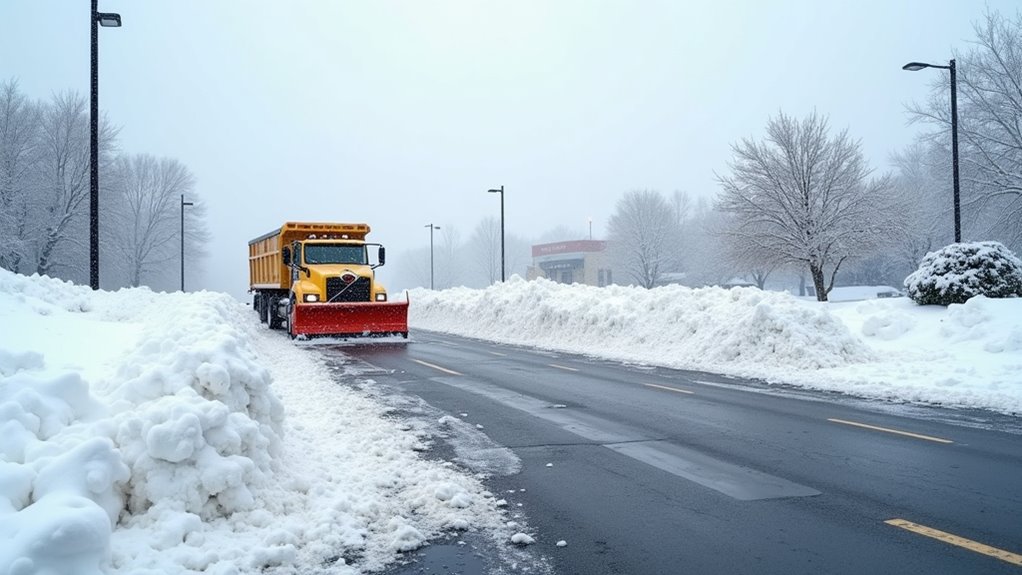
Both can be plowed, but there are practical differences in a snowy climate. Asphalt’s dark surface absorbs sunlight and helps snow and ice melt faster, which can reduce how much winter maintenance you need. On the concrete side, the road salt and de-icing chemicals used during plowing season are harder on concrete over time and can accelerate surface deterioration. Plow blades can catch on raised or heaved sections of either material, which is one more reason keeping the surface in good repair matters heading into winter.
If the lot gets damaged, which is easier and cheaper to repair?
Asphalt has a clear advantage on repairs. Damaged sections can be patched, and the surface can be resurfaced with an overlay relatively quickly and affordably, often blending in reasonably well. Concrete repairs are trickier and more expensive, since damaged slabs usually have to be removed and repoured, patches are more visible, and the cured surface takes longer before it’s usable again. If easy, low-cost repairs and minimal downtime matter to your operation, asphalt is generally the more forgiving material to maintain over the years.