




Yes, heated driveways work in heavy snow and cold weather when you size them correctly. Most embedded systems melt roughly 1 to 3 inches of snow per hour at 30 to 60 watts per square foot. You’ll want about 39 W/sq ft for moderate snowfall and 50 W/sq ft or more for heavier storms. Wind and low temperatures raise heat loss, so start the system early. Below, you’ll see how storm type, drainage, and sizing shape real-world performance.
Key Takeaways
- Heated driveways work in heavy snow and cold weather when system capacity is properly sized for the local climate.
- Most embedded systems melt roughly 1 to 3 inches of snow per hour, depending on design heat output.
- Heavy-snow designs typically need 30 to 60 watts per square foot, with about 50 W/sq ft recommended for heavier snowfall.
- Wind, extreme cold, and snowfall exceeding the design rate increase heat loss, allowing snow to accumulate faster than it melts.
- Early activation with automatic moisture sensors and proper drainage prevents buildup and stops meltwater from refreezing.
Do heated driveways work in heavy snow and cold weather

Yes, heated driveways work in heavy snow and cold weather, but only when the system’s design capacity matches your local snowfall and climate. Most embedded systems handle roughly 1 to 3 inches of snow per hour. Heavy-snow designs need about 30 to 60 watts per square foot. Electric examples run 39 W/sq ft for moderate conditions and 50 W/sq ft for heavier snowfall. If snow falls faster than your design rate, it’ll accumulate faster than it melts. Wind, low air temperatures, and heavy, wet snow increase heat loss and demand.
You’ll get the best driveway snow melt results by activating the system as snow begins, not after it piles up. Snow melting driveways need proper drainage, or meltwater can refreeze. Published melt rates aren’t guarantees for every storm.
How well does snow melt keep up in different storms
Most embedded snow melt for driveway systems keep up with light, steady snowfall and handle 1–3 inches per hour, but heavy, wet snow and intense, windy blizzards can push them behind. Your outcome depends on design output and how fast snow lands.
| Storm Type | Typical Output Needed | What You’ll See |
|---|---|---|
| Light, steady snowfall | 30 to 39 W/sq ft | Pavement stays clear |
| Heavy, wet snow | 50 W/sq ft | Slush may linger |
| Intense, windy blizzard | 50 to 60 W/sq ft | Snow can outpace melting |
Wind and cold raise heat loss, so a system sized for 20°F and 15-mph wind struggles when conditions turn harsher. Start heating as snow begins, since waiting lets accumulation build the load. Published melt rates aren’t guarantees, so plan supplemental removal when snowfall exceeds your system’s design rate. Watch drainage, because pooled meltwater refreezes.
How do systems handle heavy, fast-falling snow
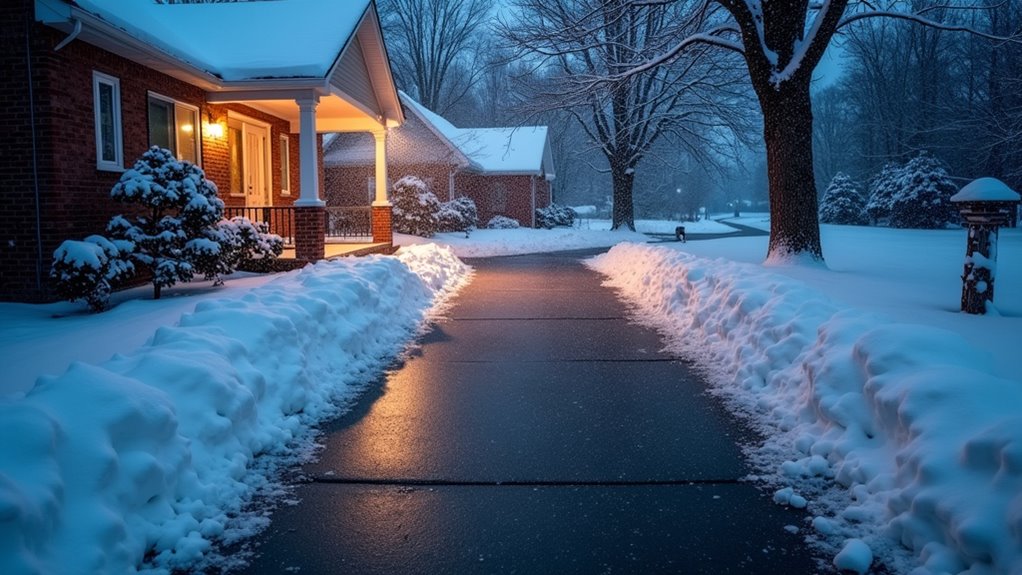
Systems handle heavy, fast-falling snow through higher heat output, early activation, and supplemental removal during extreme events. If snow falls faster than your system’s design rate, typically 1 to 3 inches per hour, accumulation outpaces melting and the surface won’t stay clear.
Heat output determines how much snowfall you can handle. Heavy-snow designs typically run 30 to 60 watts per square foot. Electric examples include 39 W/sq ft for moderate conditions and 50 W/sq ft for heavier snowfall. Heavy, wet snow and intense bursts can still overwhelm systems sized for lighter storms.
Activation timing matters. Starting heat as snow begins limits buildup. Waiting until several inches accumulate increases the clearing load. Automatic moisture and temperature sensors handle this for you.
Plan on supplemental removal during extreme events. Published melt rates aren’t guarantees. Wind, cold, and drainage reduce effective capacity.
How do they perform in extreme cold
A properly sized system keeps working in extreme cold, but it needs more heat output to keep pavement clear. Your system has to lift the surface from the air temperature to a melting target, and wind strips heat away faster. A conservative design scenario assumes 20°F air, 15-mph wind, and a 36°F pavement target. If your winters run colder or windier, you’ll need more capacity. Common design ranges span about 30 to 60 watts per square foot. Electric examples include 39 W/sq ft for moderate conditions and 50 W/sq ft for heavier snowfall. Exposure and pavement type also affect heat loss. Start the system as precipitation begins, since recovering frozen, snow-covered pavement takes longer and uses more energy. Confirm drainage too, because meltwater refreezes fast.
How fast does the surface clear once it starts

Most embedded systems melt roughly 1 to 3 inches of snow per hour, so your driveway clears as fast as its melt capacity allows relative to the snowfall rate. When snowfall stays below your system’s design rate, the surface keeps pace and stays clear. When snow falls faster, it accumulates faster than it melts, and clearing slows until the storm eases.
Output matters. Heavy-snow designs typically run 30 to 60 watts per square foot. Electric examples include 39 W/sq ft for moderate conditions and 50 W/sq ft for heavier snowfall. Wind, low air temperatures, and wet snow all increase heat loss and lengthen melt time.
Timing matters too. If you activate the system as snow begins, you limit buildup. If you wait, you’ll face a larger clearing load and longer runtime.
What are the limits of heated driveways
Heated driveways are limited by their design melt rate, which for most embedded systems is roughly 1 to 3 inches of snowfall per hour. If a storm exceeds that rate, snow accumulates faster than your slab can melt it. Three factors push you past that limit:
- Snowfall intensity: Heavy, wet snow and intense bursts can overwhelm systems sized at 39 W/sq ft for moderate conditions. Heavy-snow designs often need 50 to 60 W/sq ft.
- Heat loss: Wind and low air temperatures pull heat from the pavement, so you need more output just to keep the surface at 36°F.
- Delayed activation and poor drainage: If you start late, the clearing load climbs. If meltwater pools, it refreezes.
During extreme storms, you’ll still need supplemental snow removal.
How do you size a system for your climate
You size a system by matching heat output to your local climate, wind exposure, pavement type, and expected snowfall intensity. Two driveways with the same heating cable can perform differently in the same storm because sizing, exposure, and drainage differ.
Start with a design scenario. A conservative example assumes 20°F air, 15-mph wind, and a 36°F target pavement temperature. Wind strips heat from the surface, so exposed driveways need more output.
Next, pick a watt density. Common designs range from 30 to 60 watts per square foot. Electric examples include 39 W/sq ft for moderate conditions and 50 W/sq ft for heavier snowfall. Typical systems handle roughly 1 to 3 inches per hour. If your storms routinely exceed that, size up. Then add automatic moisture sensors.
Prepare Your Driveway for Connecticut Winters
Snow and freezing temperatures put the entire driveway system under stress, not just the heating components. V&F Paving provides residential paving designed for Connecticut’s freeze-thaw conditions, with asphalt and concrete options available. Call (203) 624-2449 or get in touch to plan a winter-ready driveway surface.
Frequently Asked Questions
How Much Does It Cost to Run a Heated Driveway Each Winter?
Your winter running cost depends on heated area, output, runtime, and your local electricity or fuel rate. For a 500-square-foot electric driveway in a moderate-snow climate, you’ll use 800 to 1,500 kWh per season; multiply that by your per-kWh rate. Another example shows 2,200 kWh for 100 operating hours. Sensor-based controls cut consumption versus timers, and heating only tire tracks uses less energy than full coverage. Preheating and drying cycles add runtime.
Can Heated Driveway Systems Be Installed Under Existing Asphalt or Pavers?
Yes, you can embed heating under asphalt or pavers, but you’ll have to place cables or tubing beneath the surface, which generally means lifting pavers or removing asphalt. Electric systems typically deliver 39 to 50 W/ft². Design drainage in, since pooled meltwater refreezes and causes underperformance. Remember repairs get difficult once cables or pipes sit under pavement. Expect to spend about $4,500 to $9,000 for a standard electric system, depending on size and installation.
What Maintenance Does an Electric or Hydronic Heated Driveway Require?
For an electric system, you’ll check ground-fault protection, temperature and moisture sensors, and controls. For a hydronic system, you’ll schedule periodic inspections. With either type, you should keep drainage clear, since pooled meltwater can refreeze and drainage problems are a common cause of underperformance. Don’t neglect these checks: if a cable or pipe beneath the surface gets damaged, you’ll find repairs difficult because they’re embedded under concrete, asphalt, or pavers.
How Much Does It Cost to Install a Heated Driveway?
You’ll typically pay about $4,500 to $9,000 for a standard electric heated driveway, based on one market estimate. Your final cost depends on driveway size, system type (electric cables or mats versus hydronic tubing), and installation complexity. If you’re installing under concrete, asphalt, or pavers, expect added labor. Heavy-snow designs need higher output, often 30 to 60 watts per square foot. Full-surface coverage also costs more than heating only tire tracks.
Do Automatic Sensors Save Energy Compared With Running the System on a Timer?
Yes, automatic sensors cut your energy use compared with timer-based operation. They combine temperature and moisture detection, so your system activates only when snow or freezing precipitation is present, and you won’t heat dry pavement. That matters because runtime drives cost. One 500-square-foot electric driveway uses 800 to 1,500 kWh per season, and another example hits 2,200 kWh in 100 hours. Preheating, melting, and drying cycles add runtime you’ll pay for.