



Heated sidewalks melt snow and ice from below, so it can’t bond to the pavement. Electric systems use resistance wires or mats embedded in the slab. Hydronic systems pump a heated water-and-glycol mixture through flexible pipes. Pavement temperature and moisture sensors switch heating on only when it’s cold and wet. An after-run period then dries the surface. You’ll still need drainage to prevent refreezing, and sizing, costs, and ideal locations determine whether one fits your site.
Key Takeaways
- Heated sidewalks melt snow and ice from below by generating heat beneath the pavement that rises to the walking surface.
- Electric systems use embedded resistance wires or heating mats that convert electricity directly into heat within the slab.
- Hydronic systems pump a heated water-and-glycol mixture through flexible pipes installed under the sidewalk surface.
- Controllers use pavement temperature probes and surface moisture sensors to start heating only when cold, wet conditions occur.
- Proper drainage carries meltwater away, while a brief after-run period dries the surface to reduce refreezing risk.
How do heated sidewalks work for snow and ice removal

Heated sidewalks melt snow and ice from below by turning energy into heat beneath the pavement. They use one of two system types. Electric systems run current through resistance wires or mats embedded in the slab, converting electricity directly into heat. Hydronic systems pump a heated water-and-glycol mixture through flexible pipes under the surface. In either design, heat moves up through your heated concrete sidewalk, warms the snow, melts it, and offsets losses to the air, base, and surrounding surfaces. Sensors detect moisture and pavement temperature, so your controller starts heating only when precipitation meets near-freezing conditions. An after-run period dries the surface, and proper drainage carries meltwater off the walk so it doesn’t refreeze.
How do heated sidewalk systems compare to shoveling and salt
A heated sidewalk system melts snow and ice in place during the storm, before they compact or bond to the pavement, whereas shoveling and salt only react to snow after it lands.
| Factor | Heated Sidewalk |
|---|---|
| Labor | Automatic sensors start and stop heating |
| Timing | Melts snow as it falls |
| Cost | Higher installation; ongoing energy use |
| Drainage | Meltwater must drain away |
You trade manual effort for upfront investment. Shoveling demands your time after every storm, and salt needs reapplication as conditions change. A heated sidewalk runs on moisture-and-temperature controls instead, activating only when pavement nears freezing and precipitation appears. Expect substantial operating costs with electric systems. Hydronic designs cost more to install but usually less to run. Plan drainage carefully so meltwater doesn’t refreeze nearby.
What goes under a heated concrete walkway
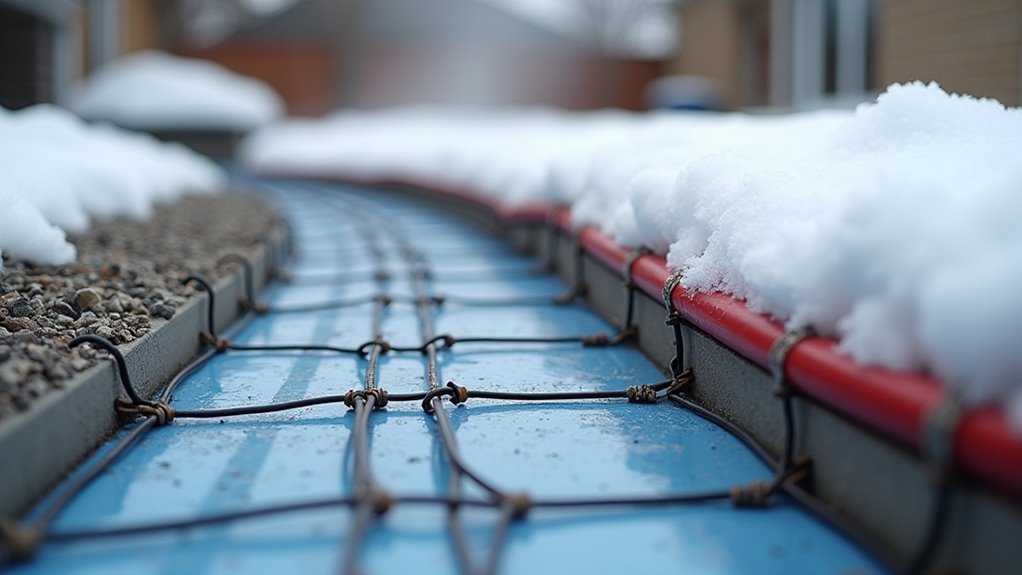
Under a heated concrete walkway is one of two heat sources: electric resistance wires or heating mats, or flexible pipes that carry a heated water-and-glycol mixture. Installers place these elements below the pavement so heat moves upward to melt snow and ice at the walking surface. Designers size the system for your site’s climate, expected snowfall, pavement exposure, and target performance.
- Electric components: Embedded wires or mats convert current into heat. Output is specified in watts per area.
- Hydronic components: Pipes connect to a heat source and circulating fluid. The design must address fluid temperature, flow, and freeze protection.
- Control hardware: Sensors measure pavement temperature and detect surface moisture. Some systems use a bedding thermostat instead.
You’ll also need drainage so meltwater flows away from the walkway.
How does the system clear ice automatically
The system clears ice automatically by switching on the heating cables or hydronic pump whenever a controller detects precipitation or surface moisture and the pavement is near or below freezing. The controller reads two inputs: surface moisture and pavement temperature. Exposed electrodes on the sensor detect moisture through electrical conductivity, and a temperature probe tracks the slab. If the surface is cold but dry, the system stays off, so you don’t waste energy heating bare concrete.
An after-run period keeps the system heating briefly after snowfall stops. This dries the surface and cuts refreezing risk. You can shorten after-run to save energy. On larger walkways, you can split the surface into zones and heat only the sections that need it. Some simpler systems use a pavement thermostat instead.
Where do they make the most sense

Heated sidewalks make the most sense where manual clearing is difficult, frequent, or risky, and where bare pavement matters during storms. Whether one is worth its installation and operating costs depends on your site’s snowfall, traffic, and energy options.
Heated sidewalks earn their cost where clearing is difficult, frequent, or risky, and where bare pavement matters during storms.
- High-traffic or high-liability walkways: Building entrances, ramps, and steps benefit from automatic controls that start heating when moisture appears and pavement nears freezing.
- Large or segmented areas: Hydronic systems cost more upfront but can lower operating costs, especially when you divide surfaces into independently controlled zones.
- Smaller residential paths: Electric systems usually cost less to install, but you’ll pay more to run them in harsh climates.
Confirm that your pavement design can drain meltwater and that your heat output matches local snowfall and wind exposure before committing.
What do they cost to install and run
A heated sidewalk’s installation and operating costs depend on two factors: the system type and how hard it has to work. No single price applies to every project. Electric systems usually cost less to install, but they can carry substantial operating costs. Hydronic systems cost more upfront because you need pipes, a heat source, and circulating fluid, yet they can run more cheaply.
Operating cost tracks heat output. If you want bare pavement during snowfall rather than allowing some accumulation, you’ll need a higher design output, within a range of 75–400 BTU per square foot per hour. Wind, wet snow, and pavement heat losses raise demand further. To control costs, use moisture-and-temperature sensors, zone large areas independently, and limit unnecessary after-run time.
What goes into a heated sidewalk installation
A heated sidewalk installation consists of electric heating wires or hydronic pipes embedded beneath the pavement, sized for the required heat output and placed within the pavement structure so heat travels upward instead of escaping into the base. Installation is where you set the system’s heat output and how efficiently it reaches the surface.
First, you’ll calculate required heat output based on:
- Climate and snowfall: Expected snow temperature, density, and moisture drive energy needs.
- Exposure: Wind and surrounding surfaces increase heat losses you must offset.
- Target performance: Allowing some accumulation needs less output than keeping pavement bare during snowfall.
You’ll specify electric output in watts per area and hydronic output in BTU per area per hour. Divide larger sites into independently controlled zones. Ensure meltwater drains away freely.
Start With a Properly Built Walkway
A heated walkway still depends on well-built concrete or paving around the snow-melting system. V&F Paving provides residential concrete, walkways, and hardscaping for properties across Connecticut. For a new walkway or related paving project, call (203) 624-2449 or contact V&F Paving.
Frequently Asked Questions
Can a Heated Sidewalk System Be Added to an Existing Concrete Walkway?
Usually not without replacing it. Since heating wires or hydronic pipes must sit beneath the pavement so heat reaches the surface, you’ll typically need to remove the existing slab and pour new concrete over the elements. You’ll also need a designer to calculate heat output for your climate, snowfall, and exposure, coordinate the system with the pavement base, add moisture-and-temperature controls, and make sure meltwater drains away from the walkway.
How Long Do Heated Sidewalk Systems Typically Last Before Needing Repairs?
What you can control are factors tied to sound operation: coordinate the elements or pipes with your pavement structure, provide drainage for meltwater, and, with hydronic systems, maintain fluid temperature, flow, and freeze protection. Also check your sensors and controllers, since they’re what start and stop automatic heating.
Will a Heated Sidewalk Crack or Damage the Concrete Over Time?
It shouldn’t if you design and install it correctly, though long-term durability data isn’t covered here. You’ll need to coordinate the heating elements or pipes with the pavement structure so heat reaches the surface. You should also make sure melted water fully drains away, since standing water can refreeze on the walkway. Use an after-run period to dry the surface. Moisture-and-temperature controls also help you avoid needlessly heating cold, dry pavement.
Can Heated Sidewalks Be Installed Under Pavers, Asphalt, or Stamped Concrete?
Yes, you can install heated systems under pavers, asphalt, or stamped concrete. Under pavers, you’ll typically embed heated mats or hydronic tubing in the mortar or sand-set bedding layer. With asphalt, you’ll need cables or tubing rated for hot-mix placement temperatures. Stamped concrete works like standard slabs. Whatever surface you choose, coordinate element depth with the pavement structure, size output for its heat losses, and ensure meltwater drains away properly.
What Happens to a Heated Sidewalk During a Power Outage?
Your heated sidewalk stops melting snow when the power goes out. Electric systems lose current to their embedded wires, and hydronic systems can’t run the controls and circulation that deliver heated fluid. Snow can accumulate on the cold pavement, and meltwater may refreeze because there’s no after-run to dry the surface. Shovel manually before snow compacts, and keep drains and channels clear. Once power returns, the sensors can restart heating automatically.