
Concrete pavers deliver exceptional value for your driveway through 8,000+ psi compressive strength, double that of poured concrete, while offering modular repairability that lets you replace individual units without disturbing the entire surface. You’ll invest $10–$30 per square foot versus $4–$15 for standard concrete, but you’re gaining 25–75+ years of service, superior freeze-thaw resistance, and design flexibility that can boost your property value by 10%. The technical specifications and performance data below reveal why this upfront investment pays long-term dividends.
Strength and Resistance to Heavy Loads
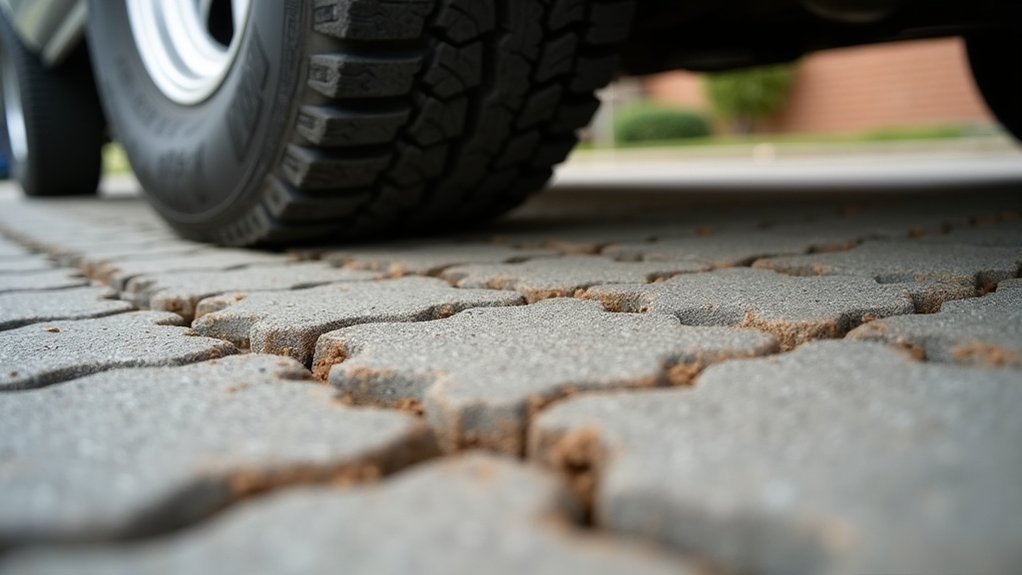
When selecting pavers for your driveway, compressive strength serves as the primary indicator of durability and load-bearing capability. ASTM C936 mandates a minimum 8,000 psi for concrete pavers, significantly exceeding the 2,500-4,000 psi typical in poured residential concrete. These durability metrics translate directly to superior crack resistance during freeze-thaw cycles and vehicular loading.
Your pavers’ load distribution efficiency depends on proper system design: a 12-inch compacted stone base spreads vehicle weight effectively, while 60-80mm thickness accommodates residential to commercial traffic. The interlocking design absorbs multi-directional forces, preventing point-load failures common in monolithic slabs. The joint sand between pavers creates a mechanical interlock that enhances the system’s ability to transfer and distribute loads across the surface. Aspect ratio guidelines recommend maintaining a length-to-thickness ratio not greater than 4:1 to ensure optimal structural performance under vehicular loads.
Premium permeable systems achieve 17,000+ psi, supporting heavy vehicles when paired with adequate base preparation. The high PSI rating ensures the pavers can endure environmental factors like temperature fluctuations and moisture exposure. This engineered approach delivers 20-50+ year lifespans while resisting compressive, shear, and flexural stresses.
Installation Process and Repair Simplicity
While compressive strength and load-bearing capacity determine your pavement’s longevity, the installation methodology directly impacts whether those engineered specifications translate into real-world performance. The versatile modular design of concrete pavers demands precision across multiple phases, excavation, multi-layered base compaction, edge restraints, and final plate compaction, but rewards you with unmatched repair simplicity.
Critical Installation and Maintenance Advantages:
- Precision-dependent longevity: Proper base preparation (compacted gravel layers, correct slope) and specialized equipment (10,000-lb plate compactor) guarantee load distribution meets design specifications. Installers must draw from multiple bundles during placement to ensure consistent color blending throughout the driveway surface.
- Skilled labor efficiency: Professional installation accelerates timeline and ensures regulatory compliance, particularly for permeable systems requiring specific base configurations. A professional crew typically completes installation within three days, depending on project size and complexity.
- Modular repair protocol: Individual pavers lift out for utility access or damage replacement without disturbing adjacent units, eliminating the cracking and patching cycles inherent to monolithic concrete slabs. Unlike poured concrete, pavers are less prone to cracking because individual units can shift and accommodate ground movement independently.
Ongoing Maintenance Requirements
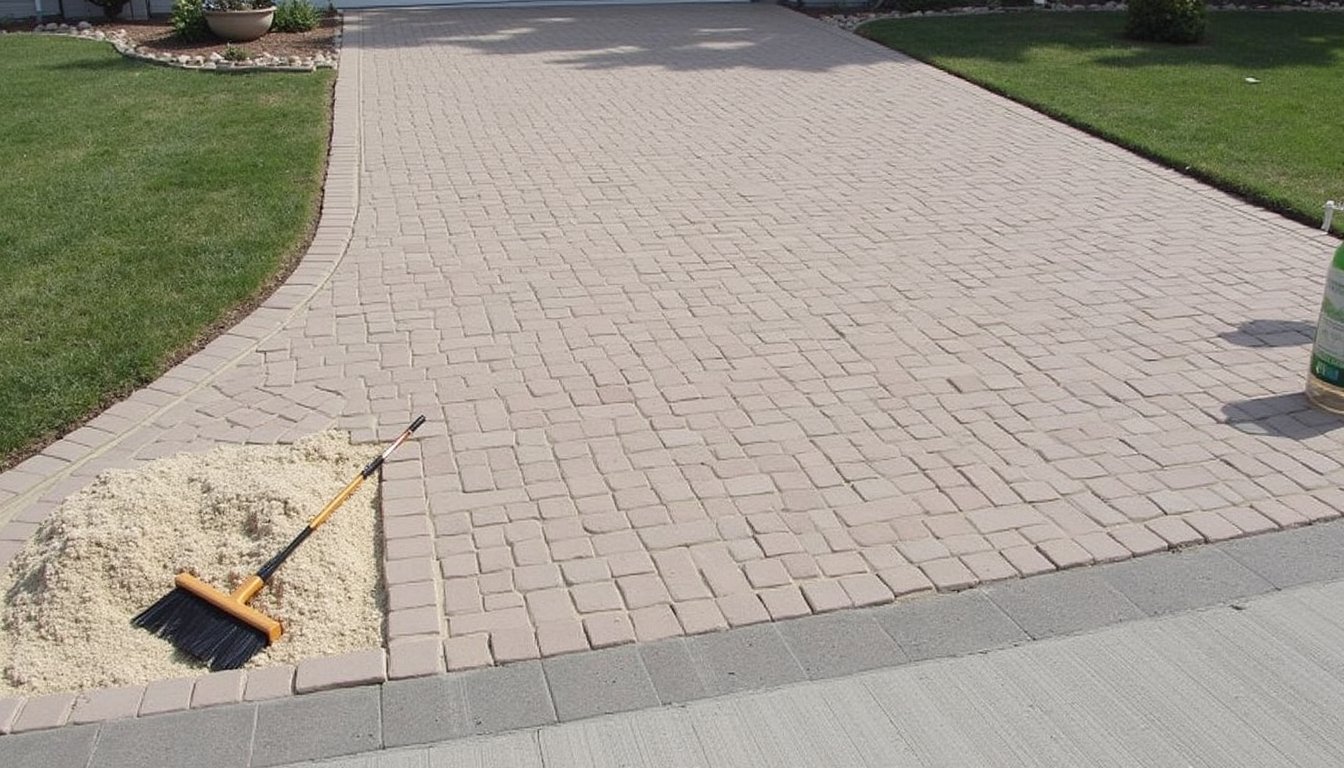
Though concrete pavers boast exceptional durability under vehicular loads, their long-term performance hinges on a systematic maintenance protocol that addresses five interdependent variables: surface contamination management, joint sand stability, protective sealant application, subsurface water migration, and localized structural corrections. Your cleaning regimen considerations should include routine sweeping, prompt stain intervention with appropriate solvents, and annual pressure washing calibrated to preserve joint integrity. Polymeric sand replenishment prevents structural displacement while inhibiting weed infiltration. Preventative maintenance strategies require sealant reapplication every 2–5 years to combat water penetration, frost damage, and UV degradation. You’ll need to monitor drainage performance and grading adequacy, as subsurface water compromise destabilizes the aggregate base. Individual paver replacement addresses isolated damage without system-wide disruption. Efflorescence treatment and targeted biocide application manage environmental staining. For stubborn stains, use a degreaser for oil marks or a diluted vinegar solution for moss or mildew accumulation. Annual sealant applications enhance color retention and provide additional protection against organic staining in high-traffic driveway environments. Each paver material possesses unique maintenance properties that determine optimal care protocols and long-term durability outcomes. This disciplined approach optimizes lifecycle performance and protects your infrastructure investment.
Design Flexibility and Visual Appeal
Beyond structural performance metrics, concrete pavers deliver unparalleled design latitude through their modular configuration and manufacturing versatility. You’ll access hundreds of color combinations, textures, and shapes that adapt to any architectural vision, from heritage cobblestone patterns to contemporary geometric abstractions. This flexibility enables property enhancement through distinctive curb appeal while maintaining functional integrity.
Key design advantages include:
- Color and texture diversity – Fade-resistant pigments span earth tones to bold hues, with surfaces mimicking natural stone, tumbled finishes, or smooth modernism
- Pattern versatility – Herringbone, basketweave, linear, and custom mosaics accommodate both traditional and avant-garde preferences
- Permeable integration – Eco-conscious designs address stormwater management without sacrificing artistic flair
Individual paver manipulation allows intricate borders, medallions, and site-specific adaptations that poured concrete can’t replicate. The uniform quality and shape of manufactured concrete pavers ensures consistent installation results and eliminates the irregularities common in natural materials. Well-designed paver driveways can boost home resale value by up to 10%, making them a strategic investment beyond their aesthetic contributions. Premium options like Nicolock’s Toscana Series combine multi-size rectangular shapes for custom patterns that achieve an old-world charm with contemporary durability.
Comparing Initial Investment and Long-Term Value
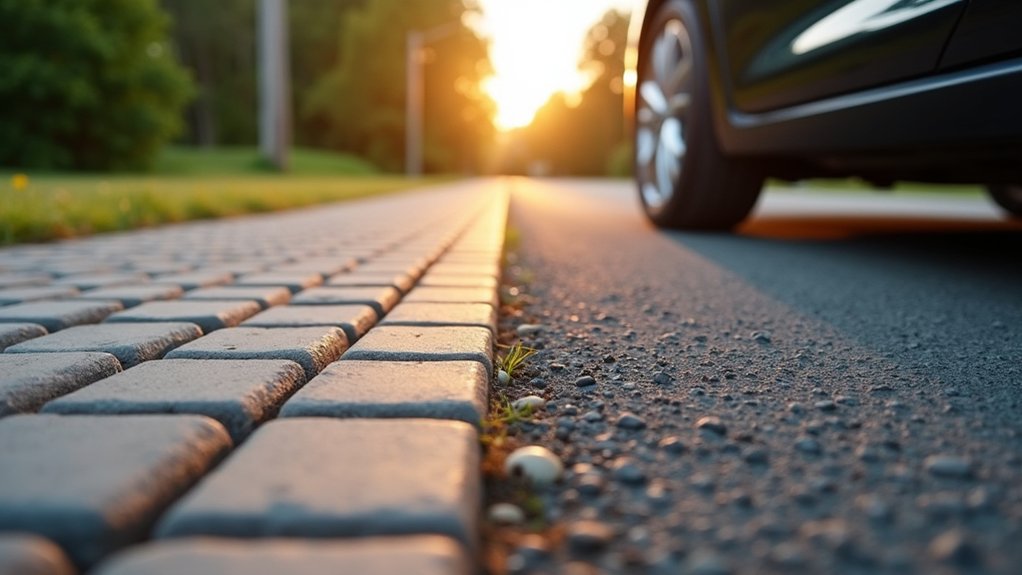
You’ll face a considerably higher initial investment with paver driveways, typically $10–$30 per square foot compared to concrete’s $4–$15 range, making standard concrete an appealing choice when working within tight project budgets. However, this upfront savings masks concrete’s vulnerability to temperature-induced cracking and ground movement, which can generate costly repairs or full-section replacements over its 30–50 year lifespan. Pavers’ modular design enables isolated unit replacement at $15–$125 per repair, potentially offsetting their premium installation cost through decades of lower maintenance expenditure. The labor-intensive installation of pavers, where labor represents 60-70% of total costs, contributes significantly to their higher upfront price compared to concrete’s more mechanized approach. Well-installed paver driveways can last 50+ years with minimal maintenance, significantly exceeding concrete’s typical 10–20 year lifespan before major repairs become necessary. Pavers also provide superior water drainage, reducing puddle formation and creating a more eco-friendly surface compared to traditional concrete driveways.
Higher Upfront Paver Costs
- Labor intensity – Installation accounts for roughly 50% of total project costs due to precise base preparation, individual unit placement, and edge restraint requirements
- Design complexity – Custom patterns, curves, borders, and site-specific challenges (slopes, access limitations) can escalate costs beyond $30 per square foot
- Material selection – Standard concrete pavers offer moderate pricing, while cobblestone and specialty stones command premium rates for luxury market positioning
Despite steeper upfront expenses, superior design flexibility and enhanced curb appeal justification often validate the investment for property value optimization. Homeowners should weigh the $10 to $30 per square foot installed cost of pavers against concrete’s more economical $4 to $15 range when establishing their project budget.
Concrete’s Budget-Friendly Appeal
When evaluating driveway materials through a cost-benefit lens, poured concrete emerges as the most economically accessible option for standard residential applications. You’ll spend $4–$15 per square foot compared to pavers’ $10–$20+ range, translating to $2,400–$8,600 for a typical two-car driveway versus $5,700–$17,200 for pavers.
| Feature | Poured Concrete |
|---|---|
| Initial Cost | $4–$15/sq ft |
| Lifespan | 30–50+ years |
| Design Options | Stamped/colored available |
| Labor Component | 40–60% of total |
While concrete offers limited visual customization options compared to pavers, stamped finishes ($12–$18/sq ft) deliver significant curb appeal benefits at lower cost. You’ll achieve faster installation times and reduced labor expenses, though long-term value depends heavily on climate conditions and maintenance commitment.
Long-Term Repair Savings
Initial cost comparisons tell only part of the financial story; maintenance trajectories over two decades reveal dramatically different economic outcomes. You’ll spend $4,732–$14,772 maintaining concrete driveways versus $1,664–$6,092 for pavers over twenty years, less than half the expense.
Why pavers deliver superior long-term cost savings:
- Localized repair methodology – Replace individual units ($15–$125 each) instead of resurfacing entire slabs ($3–$7 per sq ft)
- Extended service life – 25–75+ years versus concrete’s 30–50 years, reducing amortized replacement costs
- Value retention advantage – Spot repairs maintain seamless appearance, preserving curb appeal boost through decades
Concrete’s monolithic structure forces progressive crack propagation, while pavers’ interlocking flexibility absorbs ground movement. Factor in warranties (pavers: 2–10 years labor; concrete: 1–5 years) and resale impact, the initial premium transforms into substantial lifecycle savings.
Safety Performance in Various Weather Conditions
Every weather condition presents distinct safety challenges for driveway surfaces, and concrete pavers demonstrate measurable advantages across rain, snow, ice, and extreme heat scenarios. Their textured surfaces achieve Coefficient of Friction ratings exceeding 0.42 when wet, meeting accessibility considerations for mobility-device users and providing child-safe traction during play. The jointed construction facilitates water drainage between units, eliminating surface pooling that creates hydroplaning risks and slip hazards.
During freeze-thaw cycles, pavers’ 8,000+ psi compressive strength and modular flexibility prevent the cracking common in monolithic concrete. Their texture maintains superior grip on ice compared to smooth alternatives. In extreme heat, pavers resist the softening and rutting that compromise asphalt surfaces, while UV-resistant formulations preserve surface texture indefinitely. Individual unit replacement addresses localized damage without full-surface reconstruction.
Drainage and Environmental Impact
Effective water management separates functional concrete paver driveways from installations prone to premature failure, with drainage systems directly impacting both structural longevity and environmental performance.
Key drainage and environmental considerations include:
- Surface slope integration (1–2%) combined with channel drains for heavy traffic areas prevents water accumulation and base deterioration
- Permeable interlocking concrete pavers (PICP) offer exceptional runoff reduction potential, with EPA recognition as a Best Management Practice, even 15% permeable coverage provides ideal drainage
- Groundwater recharge capabilities through subsurface systems featuring layered gravel bases and geotextile fabric, filtering rainwater while reducing strain on municipal sewer infrastructure
Properly designed permeable installations transform driveways into functional stormwater management assets, meeting regulatory requirements while minimizing urban heat island effects and supporting sustainable resource conservation through recycled materials.
Lifespan Expectations Across Different Climates
Your paver driveway’s lifespan hinges on climate-specific stressors that directly affect material performance. In freeze-thaw regions, moisture infiltration and thermal cycling can reduce longevity to 15–30 years through progressive cracking, while proper base installation and sealed joints mitigate these risks. Hot, humid climates present UV degradation and biological growth challenges that accelerate surface wear, though strategic sealing and drainage design maintain the typical 25–50 year range.
Freeze-Thaw Climate Performance
When concrete pavers face repeated freeze-thaw cycles, their longevity hinges on both material engineering and installation precision. You’ll need pavers meeting strict compressive strength requirements and low water absorption impact, ASTM C936 standards guarantee these benchmarks. Air entrainment creates internal voids that accommodate ice expansion, drastically reducing cracking.
Critical performance factors include:
- High-density concrete with minimum cement content outperforms absorption-based metrics for freeze-thaw durability
- Proper base preparation, 6–12 inches of compacted crushed stone, prevents frost heave and structural failure
- Maintenance protocols like routine sealing limit moisture penetration, extending service life beyond 40 years
Smaller aggregates minimize D-cracking, while polymeric sand and edge restraints control movement. With professional installation and proactive care, concrete pavers in freeze-thaw climates reliably achieve 20–50 year lifespans.
Hot and Humid Regions
In hot and humid regions, concrete pavers face a dual challenge: relentless solar radiation that degrades surface polymers and persistent moisture that penetrates unprotected joints. You’ll need UV-resistant sealers applied every 2–5 years to maintain environmental resilience and prevent color fading. Proper moisture management begins at installation; compacted sub-bases and integrated drainage systems prevent water accumulation that leads to mold growth and substrate erosion. Concrete pavers typically deliver 25-50 years of service here, substantially outperforming asphalt’s 10-20 year lifespan. Their modular design accommodates soil movement from moisture fluctuation while allowing targeted repairs. Edge restraints and polymeric joint sand resist washout during heavy rainfall. Light-colored pavers minimize heat absorption, while their low porosity inherently resists the humidity-accelerated deterioration affecting brick and clay alternatives.
Frequently Asked Questions
Can I Install Concrete Pavers Myself or Do I Need Professional Help?
You can install concrete pavers yourself for small projects, but driveways demand advanced skills in excavation, base compaction, and drainage management. DIY installation considerations include equipment rental costs, physical demands, and precision requirements that considerably impact long-term performance. Professional installation guarantees proper load-bearing capacity and reduces maintenance requirements through expert compaction and edge restraint techniques. For driveway-scale projects, hiring professionals minimizes structural failures and preserves your investment’s durability and environmental drainage functionality.
Do Pavers Increase My Property’s Resale Value Compared to Concrete Driveways?
Yes, pavers typically deliver increased property value compared to concrete, averaging 109% ROI with potential resale gains of $3,500+. Their superior aesthetic appeal creates memorable first impressions that attract buyers in competitive markets. You’ll benefit from design flexibility and 75+ year durability that concrete can’t match. While upfront costs run higher ($10–$30/sq ft versus $4–$15), premium installations recoup up to 75% of costs, especially in upscale neighborhoods where curb appeal drives buyer decisions.
What Warranty Coverage Is Typically Offered for Paver Driveway Installations?
You’ll typically receive dual coverage: manufacturer’s warranty terms offering lifetime protection against structural defects and material breakdown, plus a 2-5 year workmanship guarantee covering installation issues like settling and shifting. Professional installation requirements must be met to maintain validity, adherence to base preparation specs, proper drainage design, and recommended maintenance protocols. Coverage excludes environmental damage, soil movement exceeding 1″, and surface abuse. Always verify transferability if you’re considering future resale value.
Are There Specific Soil Types That Work Better With Paver Driveways?
Loamy and gravelly soils work best with paver driveways due to superior soil drainage requirements and natural stability. You’ll find sandy soils acceptable if properly compacted, while clay demands deeper excavation and geotextile fabric. Key paver installation considerations include matching base depth to soil type; clay needs 8–12 inches of aggregate, whereas loam requires standard depths. For environmental considerations, prioritize proper grading to prevent erosion and water retention issues that compromise long-term performance.
How Do Pavers Compare to Stamped Concrete for Appearance and Cost?
Pavers offer superior aesthetics with consistent, fade-resistant colors and modular design flexibility, though they’ll cost you $25–$35 per square foot versus stamped concrete’s $15–$22. While stamped concrete delivers upscale appearance initially, you’ll face higher maintenance requirements, including periodic sealing and difficult crack repairs. Pavers’ 8,000 PSI strength and individual unit replacement make them more cost-effective long-term, despite higher upfront investment. Their color stability and seamless landscape integration provide lasting visual appeal that stamped concrete can’t match as it ages.