
You’ll install an asphalt sidewalk through six critical phases: first, evaluate site conditions and plan layout according to ADA standards; second, remove existing materials and grade the subgrade; third, place and compact 4-8 inches of DOT-spec crushed stone; fourth, apply the binder layer with large aggregate for structural support; fifth, lay hot mix asphalt at 275-300°F in 2-3 inch lifts; and sixth, achieve 92-95% density through systematic roller compaction. This methodical process guarantees your sidewalk meets engineering specifications and delivers 15-30 years of reliable service.
Evaluating the Site and Planning the Sidewalk Layout
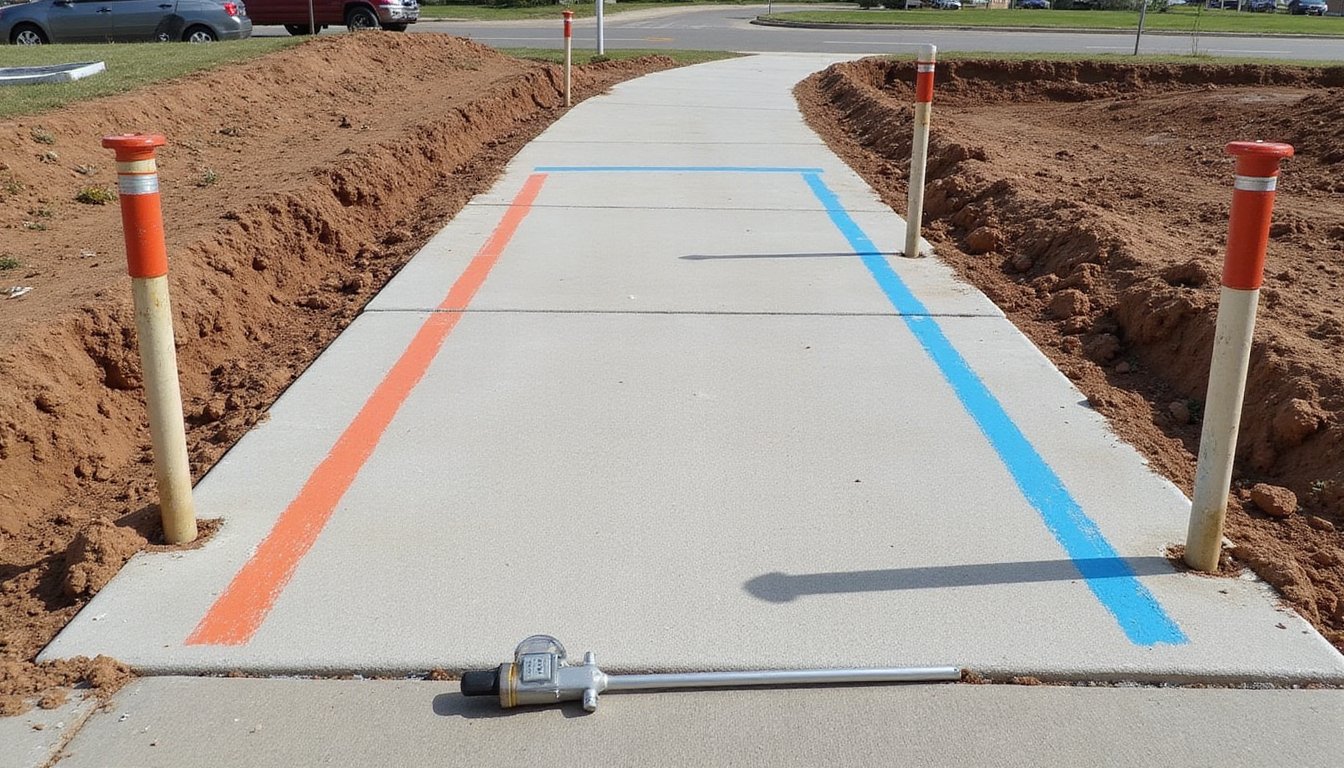
Before any asphalt sidewalk installation begins, contractors must conduct a thorough site evaluation to identify existing conditions that’ll affect construction quality and longevity. You’ll need to examine surface conditions by documenting crack patterns, deterioration levels, and foundation stability indicators like buckling or warping. Identifying drainage issues requires mapping water flow patterns, noting standing water locations, and checking for improper runoff that could compromise pavement integrity.
During layout planning, you’ll determine alignment and width based on accessibility regulations and local zoning requirements. Inspecting structural stability involves verifying subgrade consistency and elevation uniformity to prevent uneven thickness or premature failure. You must integrate the design with existing features, driveways, curbs, and utilities while ensuring ADA compliance. Survey the topography to identify low-lying areas that are prone to water pooling and may require additional drainage solutions. Cracks located within 40 feet of each other may signal deeper structural problems requiring additional subgrade investigation and reinforcement. Consider using non-destructive testing methods as a screening tool to assess subgrade properties without disrupting the site or requiring subsequent repairs. Document all findings and use proof rolling to identify weak subgrade areas requiring reinforcement before construction proceeds.
Removing Existing Materials and Preparing the Ground
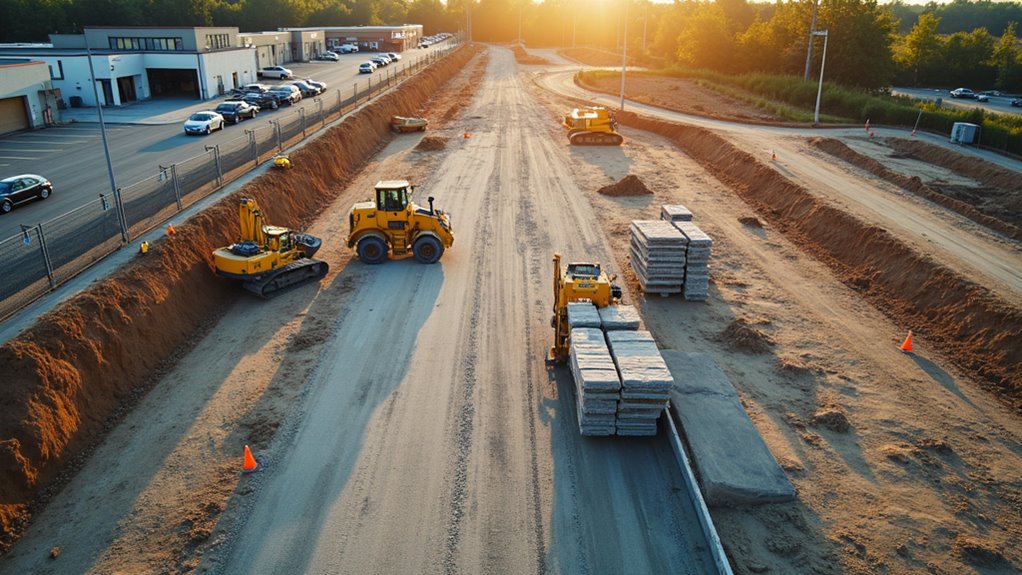
Once your site evaluation and layout planning are complete, physical removal of existing materials begins with selecting the appropriate demolition method for your specific conditions. Milling machines, excavators, or hand tools remove asphalt surfaces based on project scale and pavement thickness. You’ll typically extend removal to compromised gravel or aggregate bases using excavating equipment, ensuring unstable materials aren’t reused. Breaking compacted soils and removing plastic liners underneath establishes proper drainage pathways for your new installation.
You must inspect for underground utilities before demolition and implement safety protocols, including site barriers and personal protective equipment. Disposing of excavated materials requires separate hauling solutions since municipal services reject construction debris. Asphalt is 100% recyclable through specialized centers. When handling hazardous materials like old paint or thermoplastics, you’ll need compliance with environmental regulations throughout the removal process. Grading the stone sub-base properly ensures water flows in the correct direction away from the sidewalk surface. Recycling asphalt reduces your project’s greenhouse gas emissions while cutting down on raw material costs. Removal costs typically range from $1-$3 per square foot depending on your contractor and local area rates.
Establishing Proper Grade and Installing the Sub-base
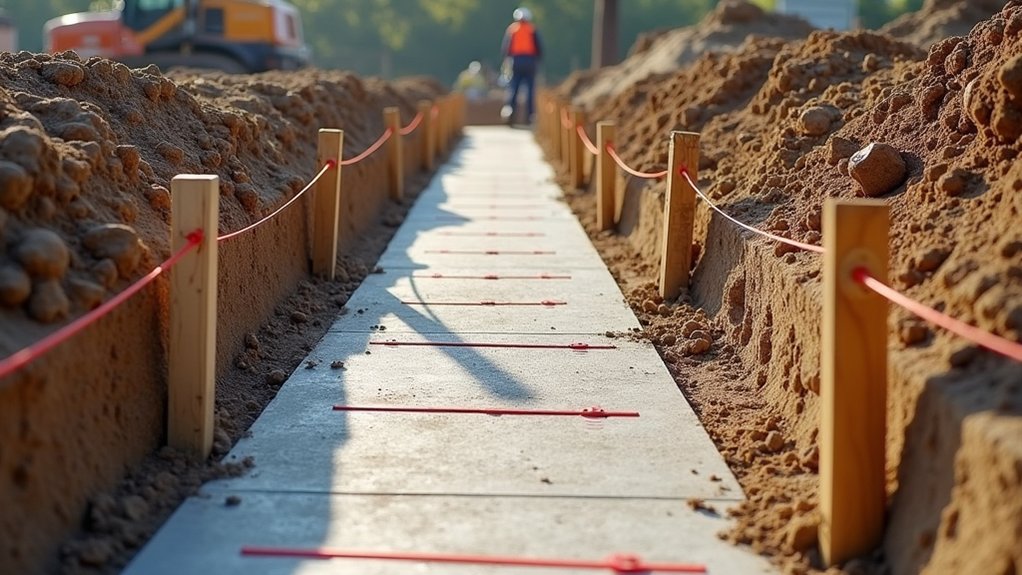
Establishing proper grade forms the foundation for a compliant, durable asphalt sidewalk that meets accessibility standards and drainage requirements. You’ll set grade elevations to match engineered plans, positioning the curb edge above street grade for adequate drainage. ADA compliance mandates maximum slopes of 1:20 (5%) longitudinally and 1:48 (2.08%) cross-slope, with surface variations not exceeding 3/8 inch in 10 feet.
For sub-base installation, you’ll place 4 to 8 inches of DOT-spec crushed stone or gravel, guaranteeing soil stability through uniform distribution. Moisture control considerations are critical before compaction; you must achieve 95% maximum density per AASHTO T 99. The aggregate base is less sensitive to moisture fluctuations and effectively separates the pavement from underlying subgrade materials, providing enhanced performance. Fine grading adjustments confirm deviations remain within 1/2 inch of specified elevations, creating smooth surfaces that prevent ponding and support long-term performance. The graded surface must eliminate any changes in level exceeding 1/4 inch to prevent trip hazards and ensure ADA compliance.
Adding the Binder Layer for Structural Support
After the sub-base reaches ideal compaction, you’ll apply the binder layer, a mixture of large aggregate and asphalt oil that forms the pavement’s primary structural support. This layer distributes traffic loads and provides the necessary shear strength to prevent rutting and deformation. Proper material composition and thorough compaction are critical quality control points that determine the sidewalk’s long-term performance. The binder layer is evenly laid over the prepared sub-base and shaped to match the final pavement design. This supportive structure helps create a stronger, more durable pavement that will withstand years of use. The binder serves as the base for the final surface course that will be applied next.
Binder Composition and Function
The binder layer builds upon the base course by introducing a carefully engineered asphalt mixture that distributes structural loads and bridges the shift between foundation and wearing surface. You’ll specify this intermediate course through binder tailoring, adjusting SARA fractions (saturates, aromatics, resins, asphaltenes) to match environmental and traffic demands. Asphaltenes provide high-temperature stability, while aromatics guarantee low-temperature flexibility. Polymer-modified binders deliver adhesion enhancement and extended performance grade ranges. This derivative of crude oil is produced during the refining process and carefully formulated to ensure optimal cohesion with aggregates. Bitumen acts as the binder component, providing both cohesion and flexibility to the asphalt concrete mixture.
| Component | Function |
|---|---|
| Asphaltenes (5–30%) | Structural stability, high-temp performance |
| Resins (25–60%) | Dispersion, adhesion to aggregates |
| Polymer Modifiers | Elasticity, deformation resistance |
You’ll maintain precise mix temperatures and binder-to-aggregate ratios during placement. The layer waterproofs underlying courses, absorbs stress cycles, and provides cohesive strength that locks aggregates under traffic loading.
Compaction and Quality Checks
Once the binder layer is placed, you’ll initiate compaction within 300 feet of the paving machine to capitalize on retained heat, typically 275–300°F at spread, that keeps the asphalt mix workable. Begin with a double drum vibratory roller for breakdown, followed by a pneumatic tire roller applying kneading action to stabilize aggregate interlock. Finish with a static steel roller to eliminate surface imperfections and roller patterns. Throughout this sequence, temperature monitoring guarantees you’re compacting above 175°F minimum. You’ll verify density using nuclear gauges or core samples, targeting 92–96% of theoretical maximum density. Conduct visual inspections for segregation and uniformity after each pass. Random depth checks confirm thickness specifications, while compaction logs and test results provide regulatory documentation and prevent premature failure. The binder layer creates a secure bond between the aggregate base and the asphalt surface layer, which is essential for preventing delamination and ensuring long-term pavement performance. This binder comprises aggregate and oil that helps the final asphalt surface adhere properly to the underlying structure.
Laying the Asphalt Surface Layer
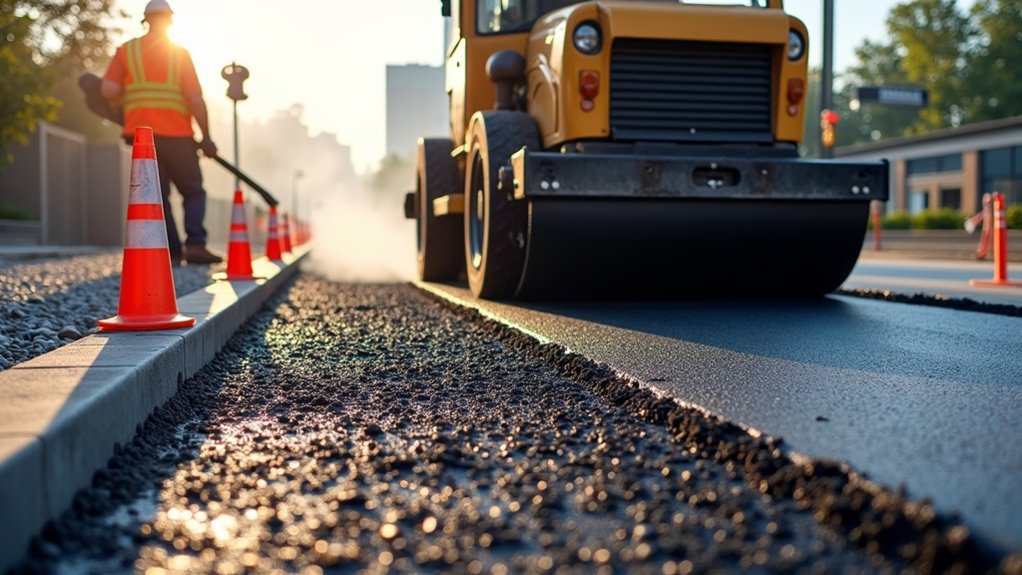
Once the binder layer has cured, you’ll apply the hot mix asphalt surface layer while it maintains a temperature between 275°F and 300°F to guarantee proper workability. Your paving machine distributes the HMA evenly across the prepared surface, with operators adjusting the screed to achieve the specified thickness of 1.5 to 2 inches. This controlled application process establishes uniform coverage and sets the foundation for achieving the density requirements during subsequent compaction. The final surface layer typically incorporates smaller aggregate particles to deliver a smoother, quieter finish that enhances both performance and visual appeal.
Hot Mix Application Process
Proper installation of the hot mix asphalt surface layer demands precise coordination of material delivery, temperature control, and placement techniques. You’ll maintain HMA within 10°C of plant-specified temperature during laydown to ensure ideal compaction. Temperature monitoring throughout delivery prevents material cooling that compromises workability. Before placement, you’ll apply tack coat, a bituminous emulsion, at rates between 0.14 to 0.32 L/m² on all contact surfaces. This emulsion application promotes interlayer bonding when applied to clean, dry surfaces above minimum temperature thresholds.
Your paving machine spreads HMA evenly, maintaining consistent mat thickness while the screed establishes proper elevation and drainage slope. Hand tools address edges and shifts where mechanical equipment can’t reach. You’ll coordinate truck arrivals to maintain continuous operations, preventing mat temperature loss and ensuring seamless butt joints.
Achieving Proper Layer Thickness
Laying down the asphalt surface layer requires careful attention to thickness specifications that match your application’s structural demands. For sidewalks and pedestrian trails, you’ll typically need 2–3 inches of compacted asphalt over a stable aggregate base. Your project timeline planning must account for proper layer composition and curing.
Critical thickness considerations include:
- Aggregate-to-lift ratio: Each layer must be at least 3x the maximum aggregate size for adequate compaction and performance
- Load requirements: Light pedestrian traffic permits thinner applications, while heavy-duty access points need increased depth
- Climate factors: Freeze-thaw cycles and temperature variations may necessitate additional thickness for longevity
Proper maintenance considerations during installation, including adequate base compaction and drainage, directly influence your sidewalk’s 15–30 year service life expectancy.
Compacting and Finishing the Sidewalk Surface
After asphalt placement, you’ll need to act quickly to compact and finish the surface before the material cools beyond workable temperatures. Begin with breakdown rolling using heavy steel drum or pneumatic rollers, followed by intermediate and finish passes to achieve the specified 92-95% maximum theoretical density. Adjust your rolling pattern based on asphalt thickness, aggregate size, and ambient conditions to prevent material displacement.
For surface finishing, perform final rolling to eliminate roller marks and guarantee uniformity. Apply drag brooming or tining to create appropriate surface texture that improves skid resistance on pedestrian pathways. Complete edge finishing by compacting sidewalk boundaries and applying sealers where specified. Remove excess surface water and verify proper drainage slope. Measure compaction density with nuclear or electronic gauges to confirm specification compliance before allowing the surface to cure.
Frequently Asked Questions
How Long Does Asphalt Sidewalk Installation Typically Take From Start to Finish?
You’ll need 2-4 weeks total from initial planning to usable surface. Expect 1-2 weeks for permits and scheduling, followed by 2-5 days of on-site work. Proper base preparation typically requires half to one day, while asphalt paving takes 1-2 days. You can walk on it after 24 hours, though full curing needs 6-12 months. Seasonal weather factors considerably impact your timeline; cold temperatures and precipitation will delay installation and extend your project duration.
What Is the Cost Difference Between Asphalt and Concrete Sidewalks?
You’ll typically pay 30-50% less for asphalt sidewalks compared to concrete, though material durability affects long-term value. Asphalt’s lower installation complexity reduces labor costs, as it requires fewer curing steps and faster placement procedures. However, concrete’s superior lifespan of 30-50 years versus asphalt’s 20-30 years may offset initial savings. You must factor in asphalt’s more frequent maintenance requirements, seal coating every 2-3 years, when calculating total ownership costs for your project.
Can Asphalt Sidewalks Be Installed During Winter or Cold Weather?
You shouldn’t install asphalt sidewalks when temperatures drop below 50°F, as cold weather prevents proper compaction and bonding. Appropriate weather conditions, ambient and surface temps above 50°F, are essential for achieving adequate density and preventing premature failure. Without proper installation techniques like maintaining mix temperatures between 275–300°F and ensuring unfrozen subgrade, you’ll risk thermal segregation, weak pavement strength, and early cracking. Most contractors recommend postponing installation until spring for ideal results and warranty compliance.
How Soon Can Pedestrians Walk on a Newly Installed Asphalt Sidewalk?
You can typically walk on newly installed asphalt sidewalks after 24-48 hours, though walking surface readiness depends on weather conditions and contractor assessment. While the surface may appear dry within hours, the curing time requires this waiting period to prevent scuffing or denting. Cooler temperatures extend the process, while warm, dry conditions optimize it. You’ll reach full strength after two weeks, but initial pedestrian traffic is safe once the 48-hour threshold passes and temporary barriers are removed.
What Maintenance Is Required to Extend an Asphalt Sidewalk’s Lifespan?
You’ll need routine inspections monthly to catch cracks and drainage issues early, plus immediate crack sealing to prevent water infiltration. Apply sealcoating every 2–3 years to protect against UV damage and oxidation. Maintain proper drainage by cleaning grates regularly, and remove debris through scheduled sweeping to prevent moisture retention. When surface distresses accumulate, perform periodic resurfacing using fog seals or slurry seals. Address spills promptly and avoid power washing to minimize moisture-related damage.