
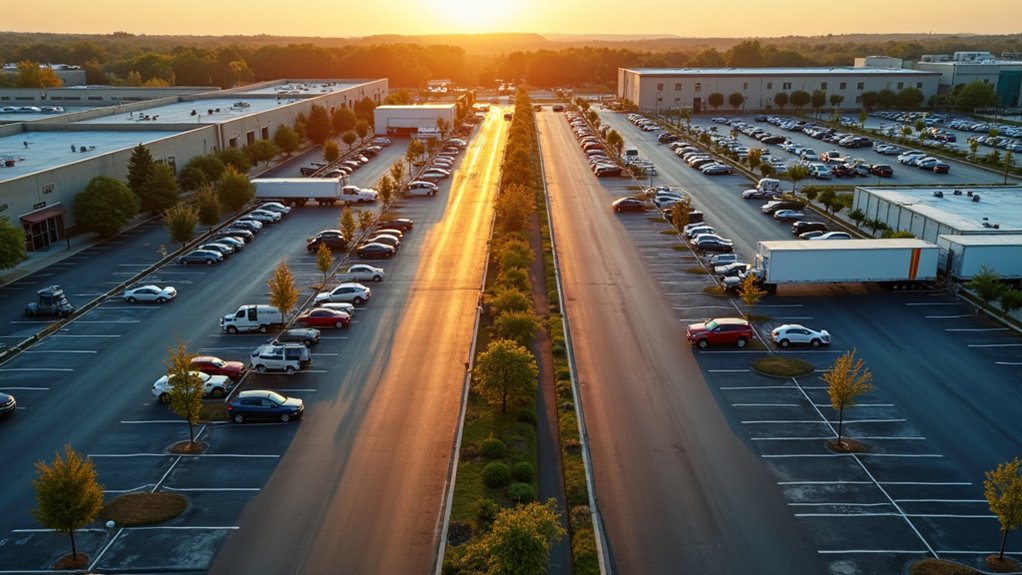

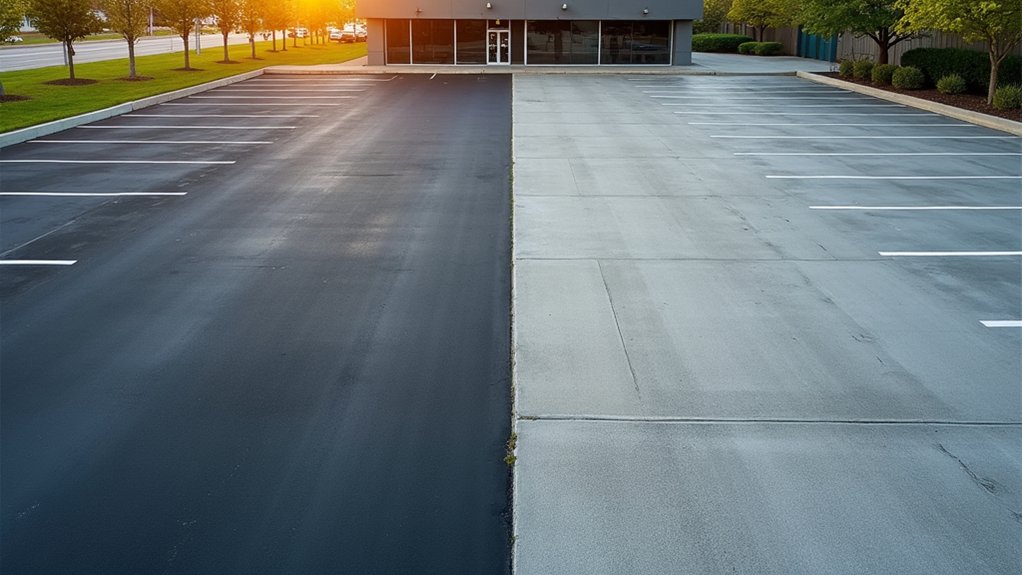
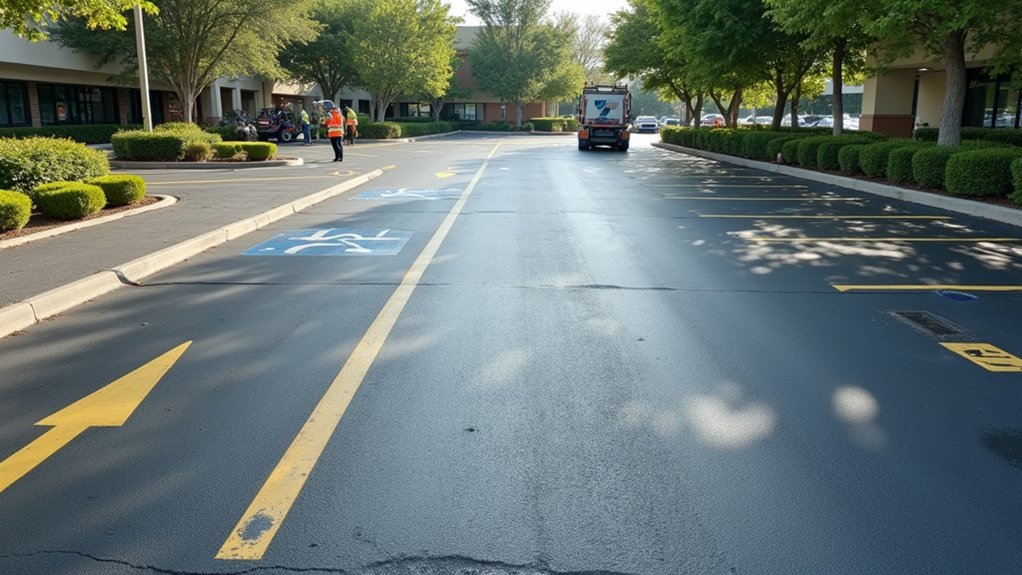
An asphalt overlay lasts 8 to 15 years on a stable base, though your actual lifespan hinges on thickness, traffic load, and climate. Standard overlays at 1.5 to 2 inches handle light-duty applications well, while heavy truck routes drop to 7 to 12 years. Residential driveways average 12 to 20 years, and highway overlays reach roughly 14.8 years. Proper maintenance, including sealcoating every 3, 5 years and annual crack sealing, can push performance toward the upper range. The factors below break down exactly what determines where your overlay falls on that spectrum.
How Long Does Asphalt Overlay Last on Average?
Your asphalt overlay lifespan varies considerably by application. Residential driveways average 12 to 20 years, commercial parking lots hit 10 to 15 years, and low-traffic residential streets reach approximately 20 years. You’ll extend performance beyond baseline projections by scheduling crack sealing, sealcoating every 2, 3 years, and conducting routine inspections. Compaction density during installation remains the strongest predictor of long-term durability. Heavy truck routes typically see reduced overlay longevity of 7 to 12 years, making mix design and thickness critical factors in achieving expected performance on high-traffic surfaces. Road damage increases in proportion to axle weight to the fourth power, which explains why even modest increases in truck loading can dramatically accelerate overlay deterioration. Walkways and bike paths experience significantly less loading demand yet still only achieve 8 to 15 years of service life, underscoring how climate exposure and maintenance practices affect longevity independent of traffic volume.
Why Some Asphalt Overlays Fail Before the 10-Year Mark
When you place an asphalt overlay over poor underlying soil, unstable subgrades with inadequate compaction or excessive moisture, you’re building on a foundation that will settle and crack regardless of surface quality. Insufficient overlay thickness compounds this problem, as layers too thin to absorb design loads experience accelerated fatigue cracking, often failing within 8 years under traffic exceeding 80 kN axle loads. If you also neglect crack repair maintenance, water infiltrates the base layer, erodes fine materials, and triggers structural failure well before the overlay reaches its expected 10, 15 year service life.
Poor Underlying Soil Quality
Although most asphalt overlays are engineered to deliver 10, 15 years of service life, failures that occur well before that threshold often trace back to a single root cause: poor underlying soil quality. Your subgrade’s composition directly determines asphalt resurfacing durability, since it serves as the primary foundation for load distribution across all pavement layers.
If your native soil contains high organic matter, decomposing plant material, leaves, or biological debris, it softens under moisture exposure and creates unstable bearing conditions. Texas black clay soils present additional challenges as nearly impermeable aquitards that trap water against base layers. High water tables compound this by eroding soil structure from below. Without proper mineral ratios, adequate air content, and controlled moisture levels, your soil can’t bear weight, and your overlay fails prematurely.
Insufficient Overlay Thickness
Even with a stable, well-compacted subgrade beneath your pavement, an asphalt overlay won’t reach its 10, 15 year design life if it lacks the thickness needed to handle actual traffic loads. Among critical asphalt overlay durability factors, thickness directly determines load distribution capacity and crack resistance.
| Failure Mechanism | Thin Overlay Consequence |
|---|---|
| Structural load mismatch | Rutting, shoving under heavy vehicles exceeding 80 kN axle loads |
| Reflection cracking | Substrate cracks propagate to surface within 2, 3 years |
| Moisture infiltration | Accelerated base saturation and freeze-thaw damage |
| Material consolidation | Permanent deformation from insufficient compaction density |
| Base layer compromise | Cumulative structural vulnerability across all pavement layers |
You can’t compensate for inadequate thickness through maintenance alone, undersized overlays fail systematically, reducing expected service life by 40, 50%.
Neglected Crack Repair Maintenance
Failing to seal cracks within the first 1, 3 years of their appearance lets moisture penetrate directly into the base layer, triggering a chain of structural failures that can cut an overlay’s service life below 10 years, even when thickness and installation meet specification.
Neglected crack repair maintenance ranks among the most critical asphalt wear and tear factors, producing these measurable consequences:
- Moisture infiltration softens binder and weakens subgrade support
- Reflective cracking propagates from underlying pavement to overlay surface
- Surface raveling accelerates oxidation-driven aggregate loss
- Alligator cracking signals irreversible structural fatigue
- Pothole formation demands full-depth replacement rather than surface repair
Without intervention, small cracks compound into system-wide failure. Properties lacking sealcoating and crack sealing for over a decade consistently require complete repaving, converting preventable maintenance into costly reconstruction.
How Thickness Changes Your Overlay Lifespan
When you’re deciding on overlay thickness, the numbers make a clear case: standard applications fall between 1.5 and 2 inches, but that range isn’t one-size-fits-all. Your asphalt driveway overlay life expectancy depends directly on this specification. Thin overlays at 1.5 inches deliver 10+ years on structurally sound, low-distress surfaces. Doubling thickness adds 5 to 7 years, a non-linear gain worth noting.
For residential streets, standard thickness extends service life by 10 to 15 years. High-traffic zones compress that to 7 to 10 years despite equivalent thickness. Polymer-modified mixes and RAP incorporation enhance durability within these ranges. The relationship between thickness and longevity isn’t purely additive, it’s influenced by traffic volume, material quality, and existing pavement condition. Every additional millimeter compounds structural performance.
How Weather, Traffic, and Soil Shorten Overlay Life
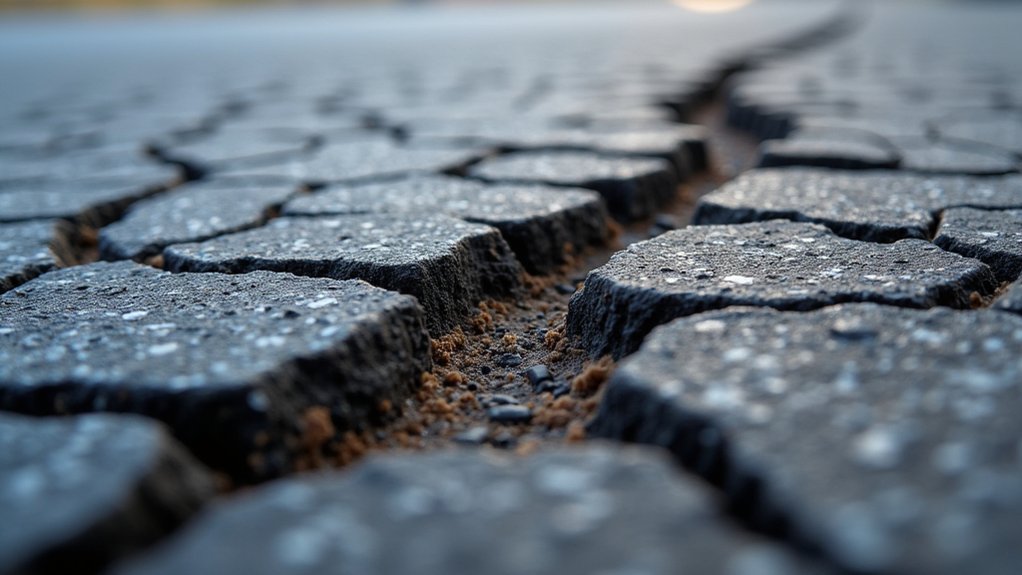
Your asphalt overlay faces three primary degradation forces: freeze-thaw cycles that expand trapped moisture and generate internal cracking, heavy vehicle loads exceeding 80 kN per axle that accelerate surface fatigue, and unstable soil conditions that erode structural support from below. Each factor alone can reduce your overlay’s lifespan by 30, 50%, but when they combine, such as heavy traffic on a saturated, frost-damaged base, failure rates compound and can cut service life to under 8 years. Understanding how these forces interact helps you target maintenance where it’ll prevent the most damage.
Freeze-Thaw Cycle Damage
Among the most destructive forces acting on asphalt overlays, freeze-thaw cycling ranks as a primary accelerant of structural failure in cold-climate regions. When water infiltrates surface cracks and freezes, it expands 9, 10%, generating over 25,000 psi of internal pressure. Each cycle widens existing fractures and drives moisture deeper into the pavement structure, compounding pavement cracking and rutting factors that reduce overlay service life.
You’ll observe this damage progression through specific mechanisms:
- Crack expansion: Each freeze-thaw cycle forces cracks wider and deeper
- Binder degradation: Cycling reduces asphalt stiffness, compressive strength, and fatigue resistance
- Aggregate stripping: Frozen water breaks the adhesion bond between binder and aggregate particles
- Void increase: Mineral aggregate void percentages rise, destabilizing the overlay matrix
- Frost heave: Ice lenses forming in base layers push pavement upward, accelerating surface deterioration
Heavy Traffic Wear
While freeze-thaw cycling attacks overlay integrity from within the pavement structure, heavy traffic compounds that damage by applying relentless mechanical stress from above, and the data shows traffic load ranks as the single largest variable in overlay service life reduction.
You’ll see pavement overlay longevity drop considerably under heavy axle loads. Commercial parking lots endure 10, 15 years, while interstate highway overlays max out at 10 years under sustained high-volume traffic. Repeated heavy axle loads cause plastic deformation and fatigue cracking in the asphalt binder, accelerating rutting and surface failure.
For heavy truck routes, you’re gaining only 8, 15 years even with maintenance. When traffic stress combines with weather deterioration, durability falls below 13, 17 years for standard roads. In high-load applications, full-depth paving outperforms overlays for long-term performance.
Poor Soil Effects
Because traffic and freeze-thaw cycles attack asphalt from opposite directions, mechanical stress from above, volumetric pressure from within, it’s easy to overlook the third critical failure vector: the soil beneath the overlay. Poor soil effects can reduce overlay lifespan by 40, 50% when subgrade conditions aren’t addressed before paving.
Key soil-related failure mechanisms include:
- Expansive clays that swell with moisture, generating upward pressure on pavement layers
- Inadequate compaction causing differential settling and longitudinal cracking
- Weak subgrade support reducing the overlay’s structural load capacity
- Moisture-saturated soils undermining base layer integrity from below
- Shifting fill material creating voids that lead to surface depressions
You’ll want to integrate subgrade evaluation into your asphalt maintenance best practices. Proper soil compaction and base preparation provide the stable foundation overlays require for full-term performance.
Overlay Lifespan by Use: Driveways, Lots, and Highways
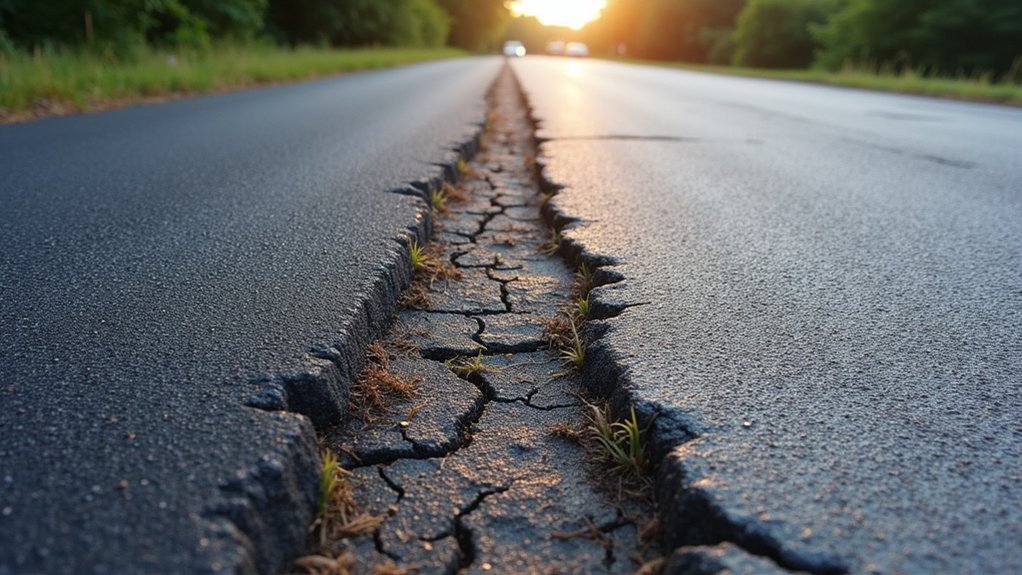
Three distinct use categories, driveways, parking lots, and highways, produce markedly different overlay lifespans due to variations in traffic loading, axle weights, and daily cycle counts. Understanding overlay lifespan by use: driveways, lots, and highways helps you plan maintenance budgets accurately.
Residential driveways typically deliver 12, 20 years, with overlays averaging 10, 15 years under light passenger vehicle loads. You’ll extend performance by limiting heavy equipment access.
Commercial parking lots yield 12, 15 years for properly installed overlays. Passenger-only lots push toward 25 years, while heavy truck access reduces durability to approximately 15 years.
Highway overlays average 14.8 years based on long-term data, with CDOT studies confirming 12-year mill-and-overlay cycles. You can extend interstate surfaces to 20 years through thin overlays every 7, 10 years, maintaining structural integrity across 50-year total pavement life.
Maintenance That Adds Years to Your Asphalt Overlay
Once your asphalt overlay is in place, a structured maintenance program becomes the single most effective tool for maximizing its service life, studies show consistent upkeep can extend overlay longevity by up to 30 percent.
Follow this asphalt overlay maintenance schedule to protect your investment:
- Monthly visual inspections, Identify cracks, potholes, and standing water before structural compromise occurs.
- Crack sealing annually, Fill hairline and alligator cracks early using rout-and-seal methods to prevent base failure.
- Sealcoating every 3, 5 years, Block UV oxidation and water infiltration while restoring surface durability.
- Drainage correction seasonally, Regrade low areas and clear catch basins to eliminate pooling that weakens base layers.
- Targeted patching in high-stress zones, Address potholes promptly with hot or cold mix to prevent damage propagation.
Asphalt Overlay vs. Full Replacement: Which Lasts Longer?
Even with a disciplined maintenance program in place, there’s a point where preserving an existing surface can’t match the performance gains of starting from scratch, and knowing that threshold separates a smart investment from wasted spending.
| Metric | Overlay vs. Replacement |
|---|---|
| Overlay lifespan | 8, 15 years on stable base |
| Replacement lifespan | 15, 30 years with maintenance |
| Overlay cost | $2, $5/sq ft |
| Replacement cost | $5, $12/sq ft |
| Base failure impact | Reduces overlay to 2, 5 years |
Your asphalt resurfacing performance drops sharply when the underlying base shows structural compromise, pumping, deep cracking, or widespread alligator patterns. Overlays cost 30, 50% less upfront but require more frequent intervention. Full replacement delivers superior long-term cost efficiency, especially under heavy truck traffic exceeding 80 kN axle loads.
Signs Your Asphalt Overlay Has Reached End of Life
When your asphalt overlay’s Pavement Condition Rating drops to 55 or below, you’ve crossed into end-of-life territory, and the visible signs confirm what the data already shows. The asphalt surface deterioration timeline typically accelerates between years 7, 11, with measurable failures compounding rapidly.
Watch for these critical indicators:
- Alligator cracking spanning interconnected patterns, signaling fatigue failure from structural compromise
- Rutting depth exceeding threshold values after 8, 11 years of service
- IRI deterioration confirming ride quality has degraded beyond acceptable limits
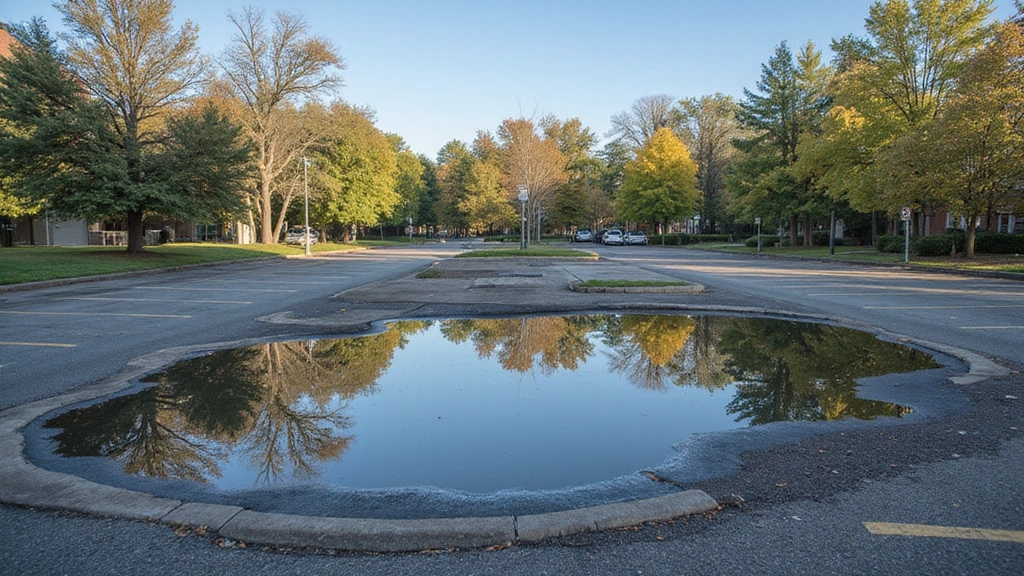
- Standing water and pooling indicating drainage failure that’s eroding the base layer
- Extensive patching requirements across multiple sections simultaneously
Once these conditions converge, you’re no longer maintaining an overlay, you’re managing failure. Base layer moisture damage at this stage favors full replacement over continued intervention.
How to Make Your Next Asphalt Overlay Last Longer
Recognizing end-of-life failure patterns is only half the equation, the other half is engineering your next overlay to outperform the last one. You’ll achieve measurable pavement preservation lifespan extension by implementing a structured maintenance protocol from day one.
Apply sealcoating every 2, 3 years to block UV degradation and water infiltration. Seal cracks immediately upon detection using rout-and-seal methods. Conduct biannual inspections each spring and fall to catch surface distress before it propagates into base layers.
You should maintain proper drainage slopes and limit rut depth to a half-inch maximum before overlaying. Avoid overloading surfaces with heavy vehicles, distribute axle loads evenly. Keep surfaces clean of debris and chemical spills to prevent drainage blockage and material degradation. These data-backed practices can extend overlay performance by up to 30 percent.
Frequently Asked Questions
Can You Put a Second Asphalt Overlay on Top of an Existing One?
You can apply a second asphalt overlay on top of an existing one, provided the underlying pavement maintains structural integrity. You’ll need to assess the substrate for sinking, rutting, or base-layer deterioration before proceeding. Apply a tack coat between layers to guarantee proper bonding, and consider milling to manage elevation changes. Keep in mind that each successive overlay adds cumulative weight and can reduce individual layer lifespan due to compounded structural stress.
How Much Does a Typical Asphalt Overlay Cost per Square Foot?
You’ll typically pay $2, $7 per square foot for a standard asphalt overlay. Small residential driveways under 1,000 sq ft trend toward $7 per square foot due to higher mobilization costs, while large commercial parking lots drop to $2, $3 per square foot through economies of scale. Labor accounts for roughly half your total cost, averaging $5, $7 per square foot. Specialty options like porous asphalt run $3, $8 per square foot.
Does Asphalt Overlay Increase Your Property Value After Installation?
Yes, an asphalt overlay can boost your property value by up to 10%, potentially adding $10,000 to your home’s worth. You’ll also enhance curb appeal by up to 7% through improved first impressions, smooth, crack-free surfaces outperform gravel or unpaved alternatives in neighborhood comparisons. Beyond dollar figures, you’ll accelerate your sale timeline and attract more competitive offers, since buyers won’t factor in immediate repair costs when evaluating your property.
How Long Should You Wait Before Driving on a New Overlay?
You should wait 48, 72 hours before driving on a new asphalt overlay with passenger vehicles. Heavy trucks require a minimum 14-day wait to prevent structural damage. In ideal conditions, 70, 80°F with low humidity, light traffic can resume after 48 hours at reduced speeds. Cooler or humid weather extends curing to 5, 7 days. Full curing takes 6, 12 months, but you’ll achieve safe initial load-bearing capacity within the first 72 hours under standard conditions.
Do Asphalt Overlays Require Permits From Your Local Building Department?
Yes, you’ll typically need permits for asphalt overlay work, though requirements vary by jurisdiction. In Minneapolis, you must obtain a Sidewalk Construction Permit for right-of-way work, with fees equaling 10% of construction value. Plymouth may require a grading permit if you’re excavating land. You’ll also need contractor bonding, insurance, and MnDOT ADA Certification. Always check your county, city, and township regulations before starting any overlay project.