


You’ll need between 1.5 and 4.5 inches of asphalt overlay for most projects, but the right thickness depends on your aggregate’s NMAS, traffic loading, and existing pavement condition. Your lift thickness must equal at least three times the NMAS to achieve proper compaction density. Residential driveways typically require 2 to 3 inches, while high-traffic zones demand 3 inches or more. The sections below break down exact specifications for every overlay scenario.
Most Asphalt Overlays Need 1.5 to 4.5 Inches
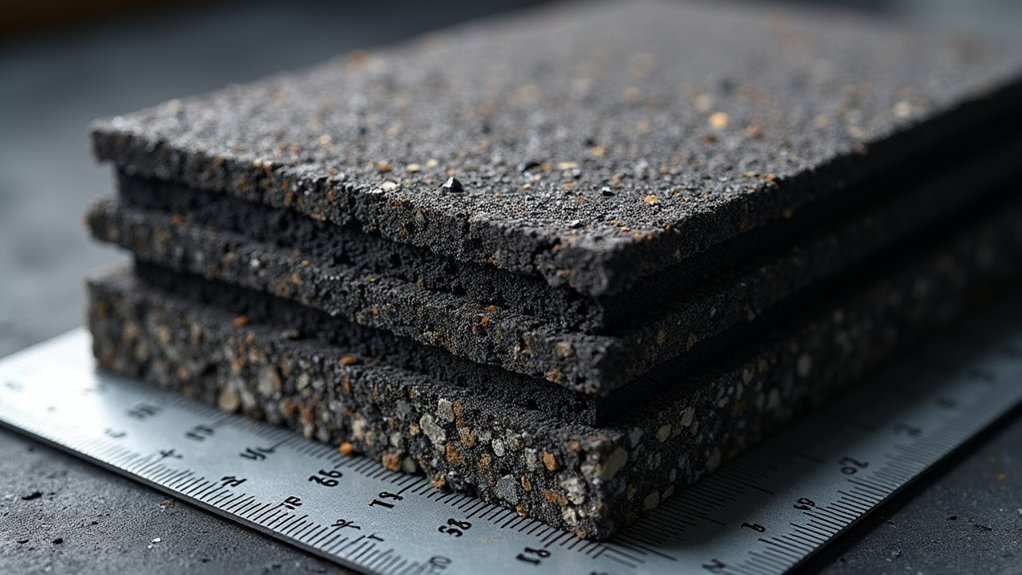
Most asphalt overlays fall within a 1.5- to 4.5-inch thickness range, though the exact depth you’ll need depends on traffic load, existing pavement condition, and the surface’s intended use. Standard asphalt resurfacing thickness guidelines specify 1.5 to 3 inches for most applications, while high-traffic zones require 3 or more inches to maintain structural integrity.
You’ll find pedestrian areas perform well at the lower end of this spectrum, whereas commercial lots typically need 3 to 4 inches using a two-layer binder and surface course system. Loading zones handling truck traffic demand 4 to 6 inches total. If you’re resurfacing a residential driveway, 2 to 3 inches of compacted asphalt handles standard passenger vehicles, with 3 to 4 inches reserved for heavier loads like boats or campers. Choosing an insufficient overlay thickness can cause cracking from uneven weight distribution, ultimately reducing pavement lifespan to just 5–7 years instead of the expected 15–30 years. For heavy-load applications such as industrial yards or freight terminals, the MS-23 Manual provides detailed thickness design guidance for asphalt pavements subjected to concentrated loads. Before determining the ideal thickness, contractors should assess the stability of the base layer, since a compromised base may require additional repairs prior to the overlay to ensure lasting performance.
Minimum Asphalt Overlay Thickness Rules
Three key rules govern minimum asphalt overlay thickness: the lift-to-aggregate ratio, the nominal maximum aggregate size (NMAS), and state-specific design standards. You must maintain a minimum lift thickness equal to three times the NMAS to achieve proper compaction and density. For thin overlays up to 1.5 inches, this ratio ranges from 3:1 to 5:1.
Your NMAS selection must not exceed 12.5 mm for 1.5-inch overlays. Common specifications include 9.5 mm, 6.3 mm, and 4.75 mm options for thinner applications. Caltrans limits stone size to one-third of layer thickness for 1- to 1.5-inch overlays.
State-specific requirements add further constraints. TxDOT’s TOM-C mandates 3/8-inch NMAS at 1-inch thickness with minimum 6% asphalt content. NJDOT requires 18% VMA and 7.4% asphalt content for high-performance thin overlays.
Maximum Overlay Thickness and Compaction Limits
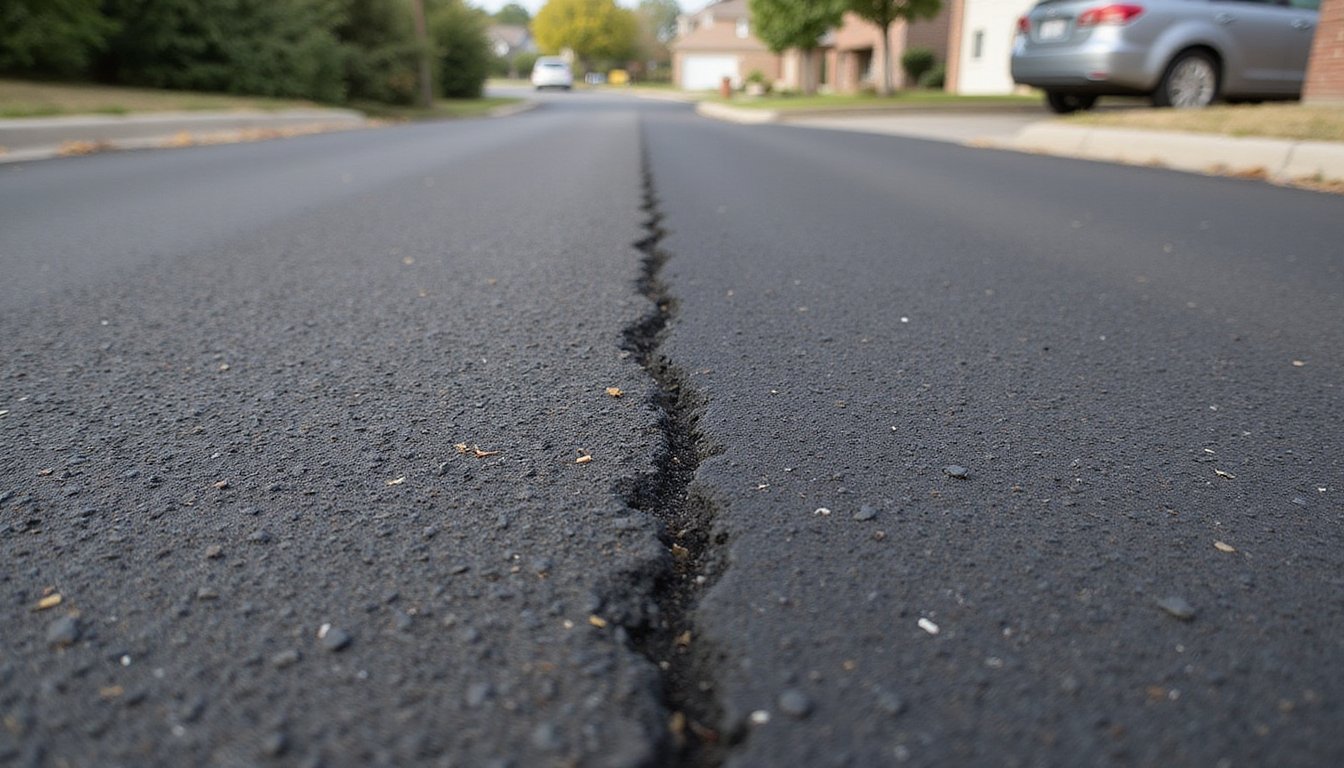
While minimum thickness rules establish the floor for overlay performance, maximum thickness limits define the ceiling—and exceeding them creates compaction failures that compromise the entire pavement structure.
When you’re using static steel-wheeled rollers, your maximum overlay thickness is limited to 3 inches. Exceeding this threshold produces inadequate density and impermeable mix failure. Regional specifications tighten these limits further—Ohio DOT restricts SMA overlays to 2 inches per lift, while Texas DOT’s TOM-C overlays range from just 0.75 to 1.25 inches.
For perpetual pavement designs, PerRoad 4.4 analysis sets the upper bound at 15.5 inches for poor subgrade conditions in warm climates. You’ll need to verify equipment specifications before placement begins, matching compaction capability to specified lift thickness in 0.25-inch intervals.
Why Aggregate Size Controls Overlay Thickness
You can’t select your overlay thickness without first accounting for the nominal maximum aggregate size (NMAS), since industry standards require a minimum lift-to-NMAS ratio of 3:1 for coarse-graded mixes and 4:1 for dense-graded mixtures to guarantee proper aggregate alignment during compaction. If your lift thickness falls below these ratios, aggregates won’t orient correctly under the screed and rollers, preventing you from achieving the 92–96 percent density target needed for impermeability and structural performance. For thin overlays of 37.5 mm or less, this constraint limits you to a maximum NMAS of 12.5 mm, while static steel-wheeled rollers impose an upper compaction limit of 3 inches per lift regardless of aggregate size.
NMAS Ratio Requirements
Every asphalt overlay must satisfy a fundamental engineering constraint: the lift thickness can’t fall below a specific multiple of the mixture’s nominal maximum aggregate size (NMAS). For conventional dense-graded mixtures, you need a minimum 4:1 ratio of asphalt overlay thickness to NMAS. Superpave designs specify a 3:1 to 5:1 range, depending on gradation characteristics.
Coarser mixtures demand ratios at or above 4:1 to prevent aggregate fracturing during compaction. If you’re placing a 12.5 mm NMAS mix, your minimum lift thickness calculates to 37.5 mm at a 3:1 ratio. Maryland’s specification illustrates this precisely—requiring 9.5 mm NMAS at 1½-inch minimum thickness, yielding a 4:1 ratio. These ratios aren’t arbitrary; they guarantee aggregate interlock, impermeability, and proper volumetric properties while preventing compaction-induced particle degradation.
Compaction Needs Dictate Size
Because compaction forces aggregates to reorient and interlock within the mat, lift thickness must accommodate that physical rearrangement—and the controlling variable is nominal maximum aggregate size (NMAS). You’ll need a minimum lift of three times NMAS to achieve proper aggregate alignment, density, and impermeability. Dense-graded mixes typically require three to four times NMAS for controlled workability during rolling.
Under current asphalt compaction depth standards, static steel-wheeled rollers compact lifts up to three inches maximum. If you specify lifts too thin, you’ll sacrifice workability and density. Too thick, and you’ll introduce instability during compaction. For 9.5mm NMAS surface mixes, that translates to a 1.5-inch minimum thickness. Over high spots, you must maintain at least twice the largest aggregate size to prevent mat tearing.
Lift Thickness Limits Apply
When you select an aggregate size for your overlay mix, you simultaneously lock in the minimum lift thickness—the two variables aren’t independent. Your asphalt overlay design calculations must account for the minimum lift-to-NMAS ratio to guarantee proper aggregate alignment and density achievement during compaction.
- Dense-graded mixes require lift thickness of 3 to 4 times NMAS for adequate compaction and impermeability.
- Thin overlays (1.5 inches or less) demand 12.5 mm NMAS or smaller, maintaining a 3:1 to 5:1 ratio.
- Static steel-wheeled rollers cap maximum single-lift thickness at 3 inches regardless of mix type.
- Over high spots, mat thickness must equal at least twice the largest aggregate particle to prevent dragging.
These constraints aren’t guidelines—they’re compaction physics.
How Thick Should a Thin Asphalt Overlay Be?
When you’re specifying a thin asphalt overlay, you need to work within a thickness range of 0.5 to 1.5 inches (12.5–37.5 mm), where minimum lift thickness must equal at least twice the largest aggregate size over high spots to guarantee proper compaction and mat uniformity. Your aggregate NMAS selection—whether 4.75 mm, 6.3 mm, 9.5 mm, or 12.5 mm—directly governs the achievable overlay thickness, since maintaining a 3:1 to 5:1 lift-thickness-to-NMAS ratio prevents segregation and guarantees density targets of 92–96 percent. For applications demanding superior crack resistance on structurally sound pavements, you can specify high-performance thin overlays (HPTO) at 1 inch or less, which use polymer-modified PG 76 binders with minimum VMA values of 16–18 percent and asphalt contents of 6–7.4 percent to maximize durability under low to moderate traffic.
Minimum Thickness Requirements
Three key variables—nominal maximum aggregate size (NMAS), traffic load, and application type—determine the minimum thickness you’ll need for a thin asphalt overlay. The minimum thickness requirements mandate a lift-to-NMAS ratio between 3:1 and 5:1 to guarantee proper compaction and impermeability. Coarser mixtures push this ratio to 4:1.
Your standard asphalt overlay depth varies by application:
- Residential driveways: 2–3 inches for light-duty traffic
- Commercial parking lots: 3 inches minimum in light traffic zones
- Local roads: 4 inches minimum for moderate traffic volumes
- Bikeways and paths: 2–3 inches over aggregate base
You’ll select NMAS based on target thickness—9.5 mm NMAS for overlays under 1.5 inches, 12.5 mm NMAS for overlays up to 1.5 inches with fine gradation.
Aggregate Size Selection
Selecting the correct nominal maximum aggregate size (NMAS) directly controls your minimum overlay thickness, compaction quality, and long-term mat density. For overlays 1.5 inches or less, you must specify NMAS of 12.5 mm or smaller. Dense-graded mixtures require lift thickness at minimum four times the NMAS, while finely graded mixes permit three times. This means a 9.5 mm NMAS mix demands at least 1.5 inches of placement thickness.
Your asphalt layer thickness measurement must account for the 3:1 to 5:1 lift-to-NMAS ratio to guarantee proper aggregate alignment during compaction. For thin overlays, 4.75 mm and 9.5 mm NMAS mixes are standard selections, offering reduced placement depths without sacrificing density. Aggregates must pass 100% through the 3/8-inch sieve when lifts fall below 1.5 inches.
High-Performance Overlay Options
Once you’ve matched aggregate size to lift depth, the next decision centers on whether a high-performance thin overlay delivers the structural and functional performance your pavement requires. These asphalt resurfacing engineering specifications define two primary mix categories optimized for distinct placement thicknesses:
- TOM-C: Placed at 0.75 to 1.25 inches using 3/8-inch NMAS, targeting moderate-distress corridors requiring enhanced durability and skid resistance.
- TOM-F: Placed at 0.50 to 0.75 inches, addressing oxidized surfaces, minor cracking, and friction loss on structurally sound pavements.
- Binder grade: PG 76-22 required across both categories, ensuring high-temperature rutting resistance without RAP or RAS inclusion.
- Design gyrations: Set at 75 for all roadways, maintaining minimum VMA thresholds of 16.5% to 18%.
You’ll achieve long service life and low life-cycle cost when placement meets these specification-driven parameters.
Ultra-Thin Asphalt Overlays Under One Inch
When does an asphalt overlay qualify as “ultra-thin,” and why would you choose one over a standard-thickness application? Ultra-thin asphalt overlays range from ½ inch to 1½ inches and use dense-graded mixtures with a nominal maximum aggregate size of 12.5 mm or smaller. You’ll maintain a lift thickness-to-NMAS ratio between 3:1 and 5:1 to achieve adequate compaction.
| Specification | Requirement |
|---|---|
| NMAS Options | 4.75 mm, 6.3 mm, 9.5 mm |
| Bond Coat Rate | 0.11–0.15 gal/yd² |
| Target Application | 83 lb/yd² |
You’d select ultra-thin asphalt overlays when the existing base is structurally sound but exhibits surface distresses—raveling, polishing, bleeding, or low-severity rutting. These overlays restore skid resistance and provide a new wearing surface without significant grade elevation changes.
Which Asphalt Mix Matches Which Overlay Thickness?
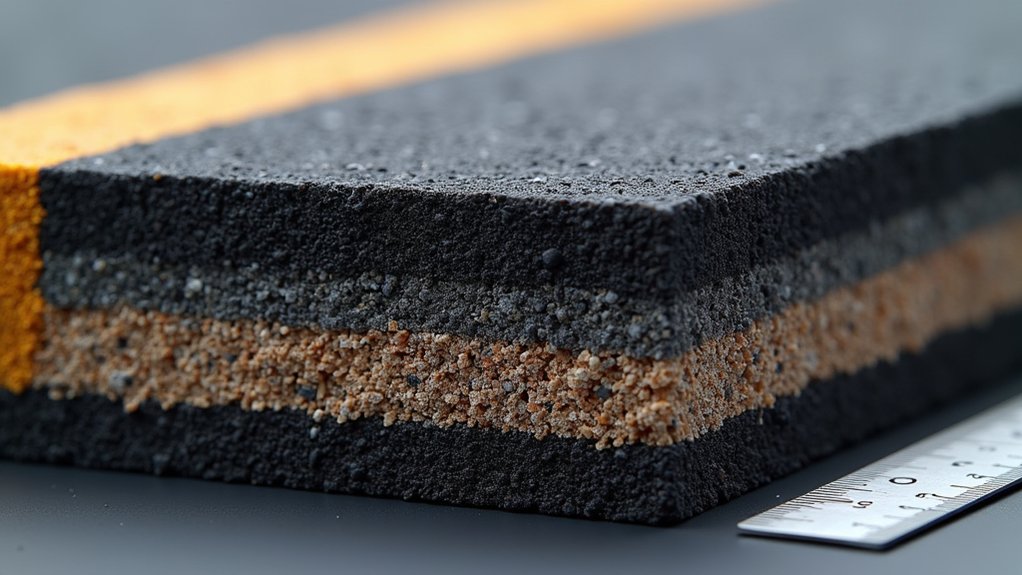
How precisely you match asphalt mix design to overlay thickness determines whether you’ll achieve target density or end up with a permeable, undercompacted mat. Your lift thickness must maintain a minimum 3:1 ratio to nominal maximum aggregate size, scaling up to 5:1 for ideal compaction. This ratio directly governs aggregate alignment and achievable density.
When reviewing asphalt overlay specifications, apply these mix-to-thickness pairings:
- 6.3 mm NMAS: Designed for thin overlays under 1 inch, requiring 75 design gyrations and a minimum 16.5% VMA
- 9.5 mm NMAS: Suitable for 1- to 1.5-inch lifts with standard gradation control
- 12.5 mm NMAS: Maximum size for 1.5-inch overlays, gradation maintained on the fine side of the maximum density line
- High-performance thin lift mixes: Require 50 design gyrations, targeting ≤2.0% Gmm voids with 8.0–15.0 film thickness
Asphalt Overlay Thickness for Concrete Pavements
Matching mix design to lift thickness controls compaction quality, but overlaying rigid concrete pavement introduces a separate set of structural constraints that shift your minimum thickness requirements upward. Ohio DOT mandates a minimum 3-inch (76 mm) asphalt overlay on rigid pavement or base, exceeding the 1.5-inch conventional threshold for flexible surfaces.
You’ll need to account for asphalt binder layer thickness within this 3-inch minimum to guarantee adequate stress distribution across existing joints and cracks. Without sufficient depth, reflective cracking propagates through the overlay within months. Thin asphalt overlays on concrete pavements deliver 6–10 years of service life, while thicker sections on low-distress surfaces exceed 10 years. A 1-inch permeable asphalt interlayer can serve as stress relief beneath the structural lift, reducing interface stresses at slab joints.
How to Match Overlay Thickness to Pavement Condition
Because pavement condition dictates every downstream decision in overlay design, you’ll need to classify distress severity before selecting mix type or thickness. Low-distress surfaces with minor oxidation or skid loss require a 4.75-mm NMAS mixture at ⅝-inch minimum thickness. Moderate distress—environmental cracking or surface wear—calls for a 9.5-mm NMAS mix at ¾-inch thick, up to 1¾ inches maximum for dense-graded HMA preventive maintenance.
When evaluating driveway asphalt overlay thickness or roadway applications, match these condition-specific parameters:
- Minor surface cracking or oxidation: 4.75-mm NMAS at ⅝-inch lift thickness
- Moderate environmental cracking: 9.5-mm NMAS at ¾-inch to 1¾-inch range
- Rut depth exceeding ½ inch: mill before overlaying to prevent rut reappearance and variable density
- Excess crack sealant present: remove pre-overlay to prevent mat instability and compaction interference
Frequently Asked Questions
How Does Freeze-Thaw Cycling Affect Asphalt Overlay Lifespan and Performance?
Freeze-thaw cycling considerably degrades your overlay’s performance by exploiting moisture infiltration. When water in cracks freezes, it expands roughly 10%, exerting over 25,000 psi of internal pressure—widening fractures and weakening binder-aggregate bonds. You’ll see reduced stiffness, increased void content, and accelerated stripping with each cycle. Overlays thinner than 30 mm are especially vulnerable, often failing within 6–24 months. You can mitigate this by specifying adequate thickness and achieving 92–96% compaction density.
What Compaction Density Percentage Is Required for a Durable Asphalt Overlay?
You need to achieve 92–96% of theoretical maximum density** for a durable asphalt overlay. Specifically, you’ll want an average in-place density of at least 93–94%**, with no individual core test falling below 90%. You should verify results using nuclear density gauges during placement and confirm with laboratory-analyzed core samples. Achieving proper compaction eliminates air voids that accelerate oxidation, moisture infiltration, and premature structural failure under repeated traffic loading.
Can Asphalt Overlays Affect Surface Drainage and Water Runoff Patterns?
Yes, asphalt overlays can considerably alter surface drainage and water runoff patterns. When you apply overlays exceeding 1.5 inches, you’ll change existing grades and slopes, potentially redirecting water flow. Thinner overlays maintain grade with minimal disruption on sound pavements. You should assess drainage conditions pre-overlay and correct any ponding through grade adjustments or subsurface features. Overlays also restore transverse profile and longitudinal smoothness, which actually improves overall drainage performance when properly designed.
How Long Does a Properly Designed Asphalt Overlay Typically Last?
You can expect a properly designed asphalt overlay to last 10–15 years under standard conditions. With routine maintenance—sealcoating, crack sealing, and timely patching—you’ll push that lifespan closer to 20 years. Overlay thickness directly influences durability; increasing it by one standard increment adds 5–7 years of service life. Traffic volume, freeze-thaw exposure, and subgrade strength also affect longevity. Highway overlays perform best, reaching 15–25 years when you’ve optimized thickness and compaction density.
Is Milling the Existing Surface Necessary Before Placing an Asphalt Overlay?
Milling isn’t always necessary, but you’ll need it when the existing surface shows significant cracking, rutting, or oxidation. If your pavement’s structurally sound with minor defects, you can apply a thin overlay directly using a tack coat for adhesion. However, milling exposes fresh aggregate, corrects profile irregularities, and guarantees uniform overlay thickness—extending pavement life by 5–10 years. You should follow local specifications and assess distress levels before deciding.