
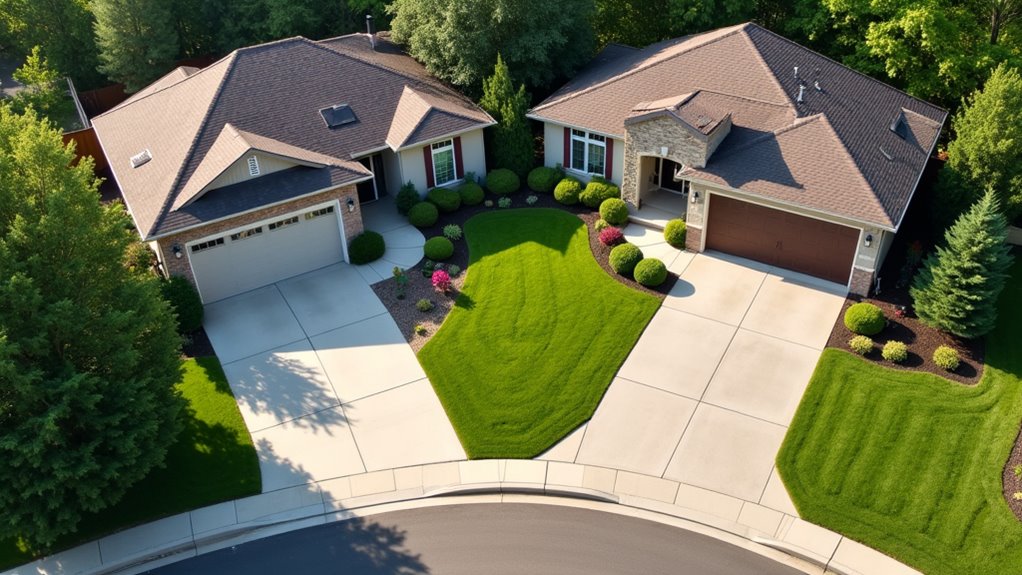
When evaluating the best driveway type, concrete often stands out for its balance of durability and long-term cost effectiveness. Concrete driveways provide load-bearing capacity that lasts up to 2.5 times longer than asphalt and can remain functional for 20–30 years with proper maintenance. They handle heavy vehicle traffic well, resisting cracking and deformation while maintaining structural integrity under sustained pressure. Although initial installation costs are higher than asphalt, concrete typically requires fewer repairs over time, resulting in lower lifetime maintenance costs. The sections below compare how different driveway materials perform across varying climates and traffic conditions.
Understanding Driveway Durability Factors That Impact Long-Term Value
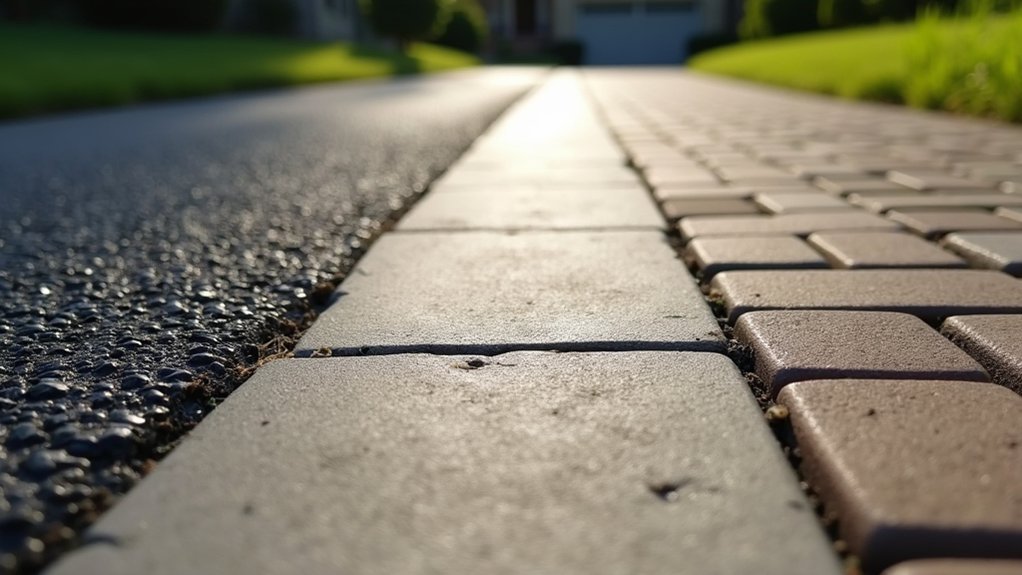
When evaluating driveway longevity, you’ll find that climate conditions serve as the primary determinant of material performance. Freeze-thaw cycles cause significant expansion and contraction, with concrete proving more susceptible to cracking than asphalt’s superior material flexibility. Heavy rainfall and UV exposure accelerate surface degradation, demanding protective seal coating applications. Regular sealing and maintenance can extend concrete driveway lifespan to 20-30 years despite these environmental challenges.
Your soil compression characteristics directly influence structural stability. Clay soils cause shifting that compromises driveway integrity, while poor drainage allows water penetration that reduces service life substantially. You’ll need proper drainage systems to prevent moisture-related damage. Pavers’ interlocking design allows them to adapt to ground movements without compromising structural integrity, making them particularly resilient in areas with unstable soil conditions.
Traffic load patterns also determine material selection. Heavy vehicle weights accelerate surface wear, making asphalt’s flexibility advantageous for high-traffic applications. Concrete handles substantial loads but requires minimum four-inch thickness for residential installations to prevent premature failure. Proper base preparation is essential for ensuring adequate load-bearing capacity regardless of which surface material you choose.
Chip Seal Driveways: Affordable Traction With Decade-Long Performance
Chip seal driveways offer a cost-effective alternative that delivers 7-10 years of service at $5-7 per square foot—significantly less than asphalt or concrete installations. You’ll benefit from the textured surface that provides superior traction during rain and snow conditions.
Professional installation directly impacts longevity. The asphalt cement layer bonds hard rock chips, creating a durable surface with controlled moisture permeability. Similar to how roofing shingles use embedded granules to protect against abrasion and UV rays, chip seal functions as a two-layer protective system for your driveway.
Your maintenance scheduling should include:
- Patching cracks and potholes at first signs of damage
- Resealing every few years to maintain surface integrity
- Avoiding heavy vehicle traffic and studded tires
Light to moderate traffic conditions maximize lifespan. You should raise plow blades during snow removal to prevent surface snags. Quality materials and experienced contractors extend performance beyond the standard decade. Areas with severe winters or extreme heat may experience a shorter lifespan, making climate an important consideration when choosing this driveway type. The chip sealant also seeps into existing damage like cracks, pits, and small potholes, protecting the underlying asphalt from water absorption that causes softening and further deterioration.
Asphalt Paving: Flexible Strength for Freeze-Thaw Climate Conditions
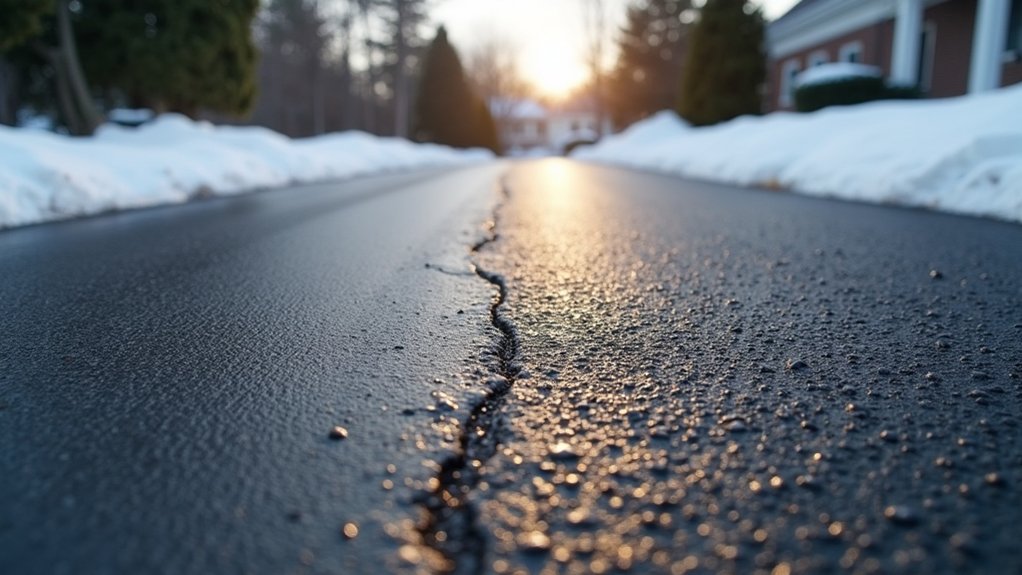
Asphalt’s flexible composition absorbs ground movement during freeze-thaw cycles, reducing the crack propagation that plagues rigid driveway materials. You’ll find that properly installed 3-inch hot mix surfaces maintain structural integrity through seasonal temperature swings, with TSR values indicating strong resistance to moisture-related damage. However, asphalt is prone to becoming sticky in hot climates, potentially leading to surface deformation during extreme summer heat. When cracks do develop, you can complete repairs quickly—fresh patches need just 72 hours before light vehicle use. With proper maintenance including seal coating every 2–3 years, asphalt driveways can last 15 to 25 years, making them a durable choice for Massachusetts homeowners.
Freeze-Thaw Crack Resistance
Repeated freeze-thaw cycles trigger multiple damage mechanisms that compromise asphalt’s structural integrity over time. You’ll observe frost heaving in air voids causing particle loosening, water expansion bursting existing cracks, and binder-aggregate stripping that weakens structural bonds. Freeze thaw deterioration trends show the sharpest strength decline occurs within the first 15-21 cycles before stabilizing. When water freezes within pavement structures, expansion pressures exceeding 220 MPa generate sufficient force to fracture even solid rock materials.
Your driveway’s crack resistance depends heavily on aggregate gradation influence. Consider these performance factors:
- AC-13 gradation outperforms other mixes in flexural tensile characteristics under cyclic stress
- FAM-1.18 mixtures demonstrate superior relaxation ability and lower shrinkage stress than FAM-2.36
- Optimal asphalt-aggregate ratios of 5.5% or higher enhance low-temperature bending performance
Freezing duration and temperature extremes dominate damage severity according to thermodynamic modeling, making material selection critical for northern climates. Research indicates that RS-type modified asphalt demonstrates better anti-aging properties, adhesion, and elasticity performance compared to standard formulations when subjected to high-frequency freeze-thaw conditions.
Quick Repair Turnaround
When freeze-thaw damage strikes your asphalt driveway, repair turnaround times vary considerably based on the restoration method you’ll select.
Crack-filling materials achieve surface dryness within 30-60 minutes, though full cure requires 2-3 days. For patching solutions, hot mix asphalt needs 48-72 hours for complete hardening, while cold patch delivers immediate drying times—you can drive on it right away, with full strength developing over weeks. This malleability makes cold patch particularly effective for repairs during freezing weather when temperature fluctuations continue. However, cold patch relies on chemicals to form a bond, making it sensitive to weather conditions during the curing process.
Full-depth reclamation demands at least 48 hours before traffic access, extending in humid conditions. Infrared technology minimizes water infiltration risks during restoration. For zero-cure solutions, natural asphalt products like RockAsphalt compact immediately, eliminating wait times entirely and maximizing your driveway’s operational availability throughout winter months. Extreme heat can actually delay the drying process or soften the asphalt, so timing your repairs during moderate temperatures ensures optimal results. Once repairs are complete, asphalt can safely support light traffic when internal temperatures drop below 147°F, allowing you to resume normal use relatively quickly.
Concrete Surfaces: Maximum Rigidity for Heavy Vehicle Traffic
When you’re parking heavy commercial vehicles or RVs on your driveway, concrete’s rigid material composition—a sand, cement, and gravel mixture—delivers load-bearing capacity that extends service life 2.5 times longer than asphalt alternatives. You’ll benefit from a surface that maintains structural integrity under sustained pressure without the shifting or deformation common in flexible pavements. Concrete also handles heavy loads without cracking under the weight of large machinery or recreational vehicles. This durability comes with aesthetic versatility that allows you to customize finishes, colors, textures, and patterns to complement your property. However, you must address freeze-thaw cracking risks through regular sealing every few years, as water penetration in colder climates can compromise even concrete’s superior durability.
Load-Bearing Capacity Advantages
Concrete driveways deliver superior load-bearing capacity through their inherent rigidity and compressive strength characteristics. Your 6-inch slab with 4,000 PSI strength supports concentrated loads up to 3,000 pounds per square foot, while concrete mix design factors like water-to-cement ratios directly influence density and durability. Slab reinforcement requirements become critical as thickness exceeds 5 inches, with steel rebar preventing catastrophic failure under heavy loads.
Key Load-Bearing Specifications:
- 6-inch thickness supports total weights approaching 70,000 pounds with proper subgrade preparation
- Upgrading from 4-inch to 5-inch thickness boosts capacity by nearly 50 percent
- 4,500 to 5,000 PSI formulations handle heavy-truck traffic demands
Thicker slabs distribute vehicle weight across larger cross-sectional areas, reducing stress concentration points that cause premature cracking in thinner installations.
Freeze-Thaw Cracking Risks
Despite concrete’s exceptional compressive strength, freeze-thaw cycles exploit its primary structural weakness—low tensile resistance. When water infiltrates surface pores, it expands 9% upon freezing, generating internal pressure that exceeds concrete’s tensile capacity. You’ll notice this damage manifests as scaling, flaking, and progressive crack propagation.
| Prevention Method | Application Frequency | Primary Function |
|---|---|---|
| Penetrative Sealers | Every 2-3 years | Moisture barrier application |
| Crack Filling | Pre-winter annually | Crack remediation techniques |
| Chloride-free De-icers | As needed | Surface protection |
To mitigate deterioration, you should apply deep-penetrating sealers that crystallize within voids, increasing surface density. Combine moisture barrier application with proactive crack remediation techniques—filling gaps before temperatures drop prevents water accumulation. Direct drainage away from slabs and use plastic snow removal tools to minimize moisture exposure and mechanical abrasion.
Gravel Options: Lowest Upfront Investment With Ongoing Maintenance Demands
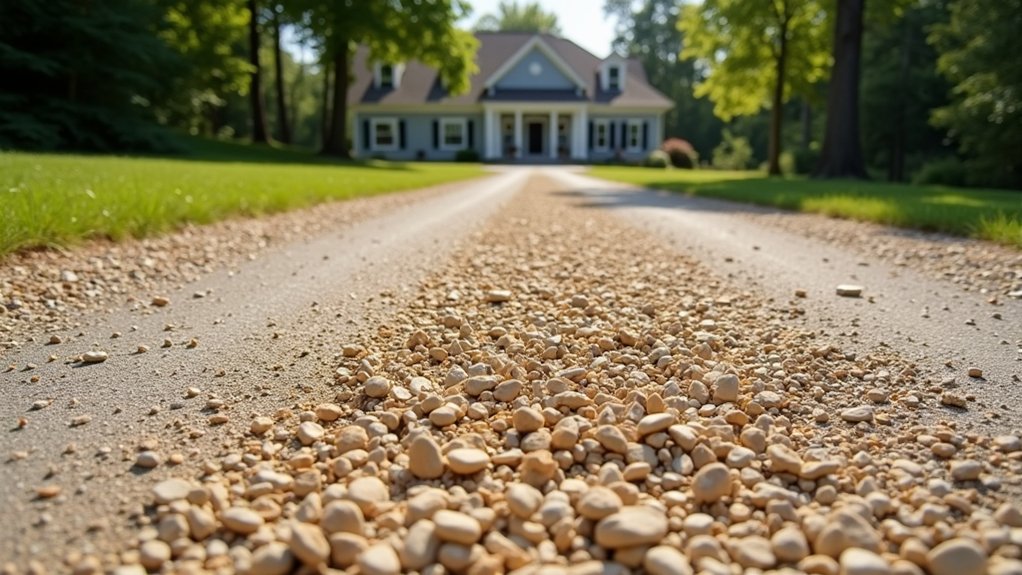
Gravel driveways deliver the lowest upfront investment among permanent driveway surfaces, with installation costs ranging from $1.25 to $3.00 per square foot compared to asphalt ($5-12/sq ft) or concrete ($6-15/sq ft). A single-car driveway runs $250 to $900 installed, with DIY materials dropping to $0.50 to $1.50 per square foot.
You’ll face ongoing maintenance demands that asphalt and concrete don’t require:
- Gravel replenishment: Add 3 inches periodically, costing $0.25 to $0.75 per square foot
- Gravel leveling: Budget $0.50 to $2.20 per square foot for regrading services
- Annual upkeep: Expect $100 to $400 yearly for regrading, gravel addition, and weed control
Stabilization grids at $2 to $4 per square foot reduce long-term maintenance by preventing shifting under traffic loads.
Paver and Brick Installations: Premium Longevity Exceeding 40 Years
Paver and brick driveways consistently deliver 25 to 50 years of service life, with properly maintained installations routinely exceeding the 40-year threshold that positions them among the longest-lasting residential driveway options.
You’ll benefit from freeze thaw cycle durability that outperforms solid concrete, as individual units expand and contract independently. Reputable suppliers guarantee consistent quality standards through manufacturing processes designed for lifetime performance.
| Cost Factor | Value Range |
|---|---|
| Installation | $10-$30/sq ft |
| Individual Repair | $5-$15/unit |
| Warranty Period | 25 years |
Your maintenance requirements remain minimal: sweep regularly, pressure wash periodically, and apply sealant every few years. When damage occurs, you’ll replace individual pavers without disturbing surrounding areas—a structural advantage that reduces long-term repair costs significantly.
Tar and Chip: Old-World Charm With Exceptional 75-Year Lifespan Potential
You’ll find tar and chip driveways deliver a rustic aesthetic with a practical lifespan of 7 to 10 years under standard conditions, though this extends beyond 10 years with light traffic and proper maintenance. While the 75-year potential requires multiple reapplication cycles every 5 to 7 years in high-use zones, each layer adds cumulative durability to your surface. Understanding the maintenance trade-offs—including occasional loose aggregate and 24-48 hour curing periods—helps you maximize this cost-effective option’s performance.
Unmatched Longevity Benefits
Tar and chip driveways deliver a distinctive old-world aesthetic that combines rustic charm with functional durability, though their longevity claims require careful examination. You’ll find standard lifespans range from 7-10 years, with proper installation extending performance to 10-15 years. The 75-year potential depends entirely on lifetime resurfacing cycles rather than single-application endurance.
Your driveway’s intrinsic design quality determines actual longevity. The asphalt-tar base bonds with embedded aggregate chips, creating washout resistance that loose gravel cannot match.
- Traffic impact: Low to moderate vehicle volumes maximize durability
- Climate sensitivity: Severe winters accelerate deterioration rates
- Maintenance requirements: Resealing every 5 years sustains structural integrity
Multi-layer applications through periodic re-chipping build cumulative durability, explaining how farm roads endure decades of continuous service.
Maintenance Trade-Offs Explained
Achieving the full 75-year lifespan potential requires commitment to five distinct maintenance protocols that balance effort against long-term durability gains.
You’ll observe a mandatory 24-48 hour curing period before any traffic exposure. Weekly debris removal prevents organic matter from causing surface deterioration. Annual pressure washing maintains structural integrity without chemical damage.
The most critical protocol involves your sealant application technique every 2-4 years. Fresh seal layers provide moisture infiltration prevention while protecting against UV degradation. You’ll recognize resealing needs when loose stones appear or smooth finish diminishes.
Post-winter crack inspections demand immediate attention. Fill small cracks with quality asphalt filler before expansion occurs. This proactive approach converts minimal maintenance effort into decades of extended service life.
Comparing Installation Costs Across All Six Driveway Materials
When comparing installation costs across all six driveway materials, gravel consistently ranks as the most budget-friendly option at $1 to $3 per square foot, while pavers command the highest investment at $10 to $50 per square foot depending on material selection and design complexity.
Gravel driveways cost as little as $1 per square foot, while premium pavers can reach $50 per square foot installed.
Your cost benefit factors extend beyond initial pricing. Asphalt averages $7 to $13 per square foot installed, while concrete ranges $6 to $15 per square foot. Grass driveways fall mid-range at $5 to $8 per square foot, and heated systems reach $12 to $21 per square foot.
- Gravel: $2,300 to $8,600 for 576 sq ft driveway
- Asphalt: $3,600 to $5,400 for 600 sq ft driveway
- Pavers: $6,000 to $18,000 average total installation
Return on investment depends on your climate, usage patterns, and maintenance commitment.
Maintenance Requirements That Affect Total Ownership Expenses
Although initial installation costs establish your upfront investment, ongoing maintenance requirements determine the true total ownership expenses over your driveway’s lifespan.
Resin-bound surfaces require minimal intervention—occasional sweeping or jet washing maintains appearance without recurring costs. Concrete driveways demand sealant application every 5–10 years across their 30–40 year lifespan, representing predictable driveway maintenance factors.
Asphalt requires sealcoating every 3–5 years plus periodic crack filling, increasing your total cost of ownership substantially. Tarmac needs re-sealing every few years, though the process remains affordable. Gravel presents the highest maintenance burden: frequent grading every 1–3 years, regular weeding, and replenishment costs averaging $0.25–$1 per square foot.
When calculating your total cost of ownership, factor these recurring expenses against installation savings. Low-maintenance options like resin-bound and concrete often deliver superior long-term value despite higher upfront costs.
Selecting the Right Driveway Material for Your Budget and Climate
Your maintenance budget and regional climate conditions directly determine which driveway material delivers ideal value for your specific situation. Concrete performs excellently in stable climates, delivering 25-80 years of service at $4-30 per square foot. Asphalt‘s flexibility makes it superior for freeze-thaw regions despite requiring sealcoating every 3-5 years.
Your climate and budget are the two most critical factors in choosing a driveway material that lasts.
Consider these factors when selecting your driveway material:
- Budget constraints: Gravel costs $1.25-2 per square foot versus pavers at $10-30, creating significant upfront cost differentials
- Climate performance: Chip seal and asphalt resist cracking better in cold climates than rigid concrete
- Home resale value: Paver driveways offer maximum customization potential with patterns and colors that boost property appeal
Match your selection to local weather patterns and long-term financial capacity for exceptional durability returns.
Frequently Asked Questions
Can I Install a New Driveway Surface Over My Existing Damaged Driveway?
Yes, you can install an overlay over your damaged driveway, but only if the damage is minor. You’ll need to assess structural integrity first—minor surface cracks allow overlay options when your subgrade remains stable without water damage. However, extensive cracking or foundation issues require cost effective alternatives like full-depth reclamation or complete replacement. You must guarantee proper drainage exists, fill cracks with appropriate sealants, and apply bonding agents for ideal adhesion between layers.
How Long Should I Wait Before Driving on a Newly Installed Driveway?
You should follow these recommended wait times based on your driveway material: concrete requires 24-48 hours for light vehicles, with the ideal curing duration of 7 days before heavy loads. Asphalt driveways allow driving within 24-72 hours post-installation. Paver driveways offer immediate use since interlocking units don’t require curing. Cold temperatures extend these timeframes by 50%, so you’ll need to account for seasonal conditions affecting structural integrity.
Which Driveway Materials Are Safest for Homes With Children or Elderly Residents?
You’ll find rubber pavers and textured paver driveways deliver the safest slip resistant surfaces for vulnerable residents. Rubber pavers provide shock-absorbing protection against the 800,000 annual slip-and-fall injuries requiring hospitalization, while their textured grip reduces falls in all weather conditions. Paver driveways offer beveled edges that minimize trip hazards. Combine these materials with well maintained lighting to enhance visibility, and you’ll create ideal safety for children and elderly family members.
Do Certain Driveway Types Affect My Home’s Resale Value More Than Others?
Yes, driveway materials greatly impact your home’s resale value. Paver and natural stone installations deliver maximum property value appreciation, adding up to $20,000 to your home’s worth. Concrete and asphalt driveways provide equal curb appeal enhancement, contributing $10,000-$20,000 in value. Gravel offers negligible resale returns despite lower upfront costs. You’ll achieve ideal ROI by selecting premium materials that balance durability with aesthetic appeal in your specific climate zone.
What Permits or HOA Approvals Are Typically Required for Driveway Installation?
You’ll need to secure necessary local permits from your municipality or Department of Transportation before installation begins. Requirements typically include submitting site plans with dimensions, materials, slope specifications, and proof of property ownership. If your property connects to state highways, you’ll need state-issued permits. Additionally, homeowner association requirements may dictate approved materials, colors, and dimensions. Always verify both permit and HOA compliance—violations can result in costly removal or modification mandates.