
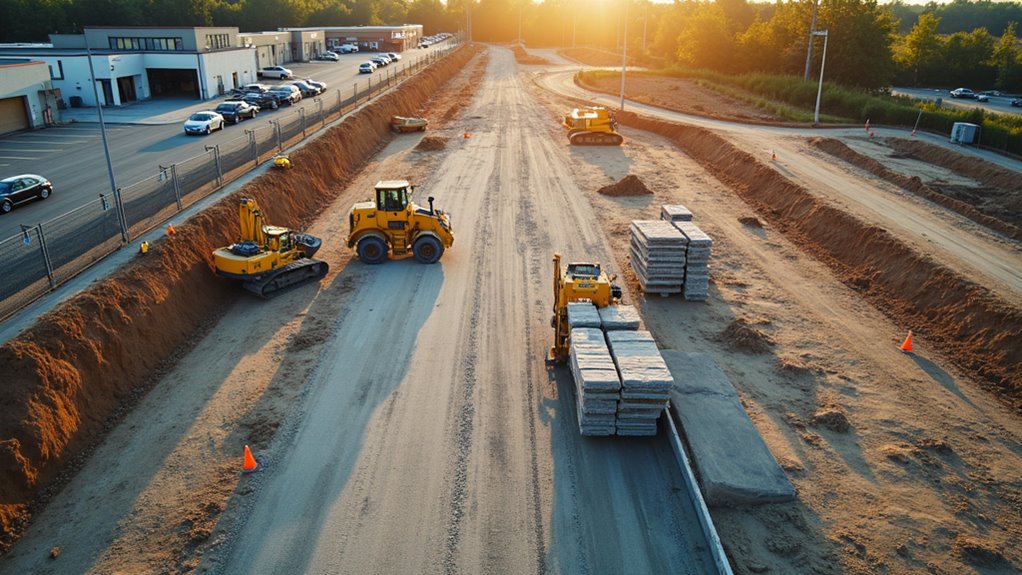
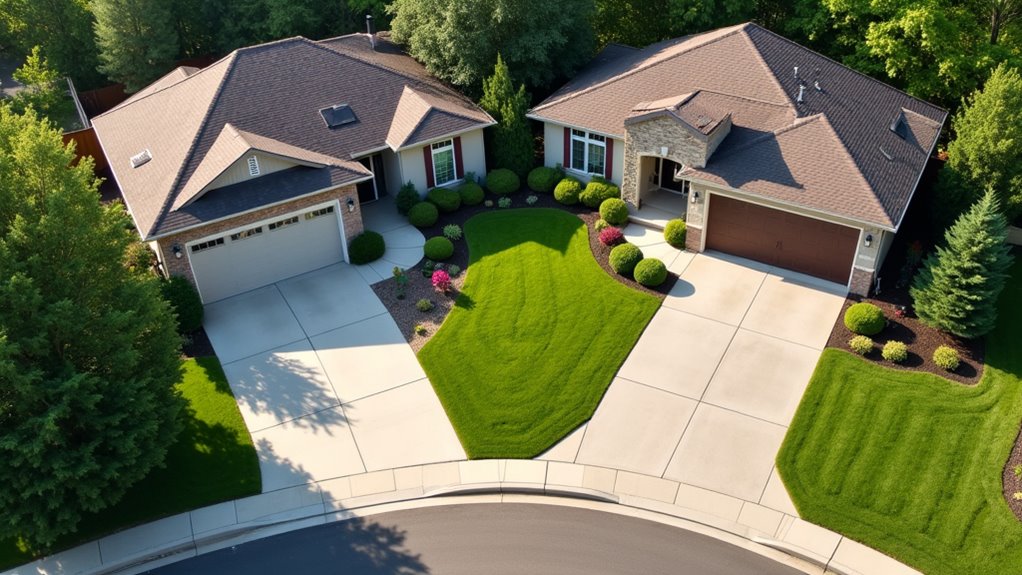
You’ll find concrete block paving excels in driveways, patios, walkways, and commercial plazas where its interlocking design delivers compressive strengths exceeding 8,000 psi while accommodating ground movement that cracks monolithic surfaces. Standard 60mm units achieve 30–50 MPa, with advanced formulations reaching 82 MPa through silica fume admixtures. You can expect 20–40 years of service life across residential and commercial installations, with targeted repairs replacing individual units rather than entire surfaces. The sections ahead break down performance specifications, installation standards, and comparative analysis against alternative paving systems.
Common Applications for Concrete Block Paving
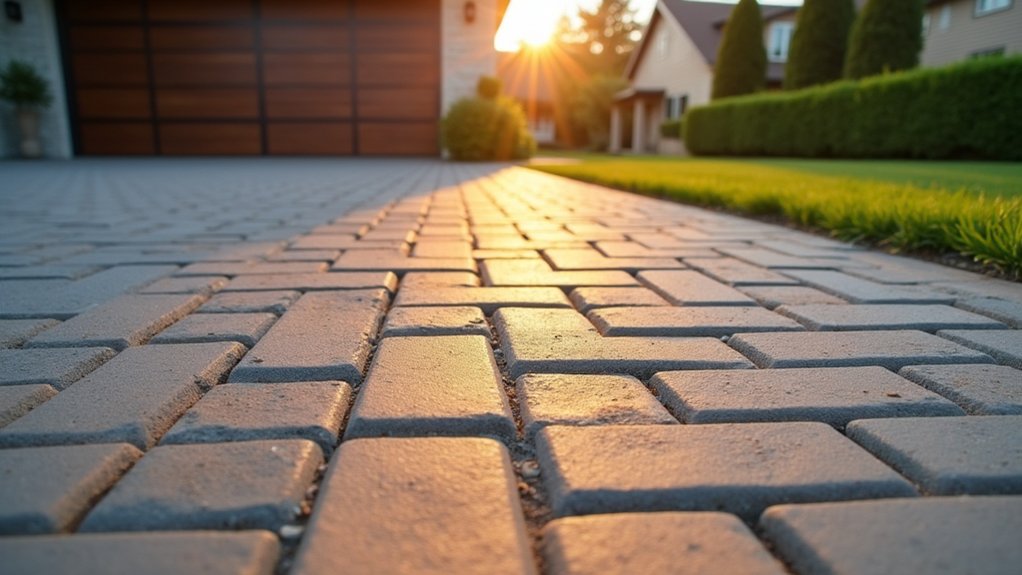
Because concrete block paving delivers exceptional load-bearing capacity and dimensional stability, it’s become the material of choice for driveways and parking areas in both residential and commercial settings. You’ll find it withstands daily vehicular traffic while resisting shearing and braking stresses effectively. For patios and outdoor living spaces, you can leverage customizable colors, patterns, and textures that enhance residential curb appeal and enable aesthetic integration with landscaping features like flowerbeds and steps. The interlocking systems provide stable walkways with minimal tripping hazards, adapting easily around curves and slopes. In public spaces, town centers, plazas, and pedestrian precincts, you’ll benefit from its durability under heavy foot traffic and resistance to chemicals, salts, and oils. Industrial applications demand extreme load capabilities, where easy block replacement maintains operational uptime cost-effectively. The affordability of block paving, typically costing only £3-6 per m² more than plain flags or slabs, makes it accessible for most residential and commercial projects. Installation requires a strong compacted base with landscape fabric and crushed stone to ensure longevity and prevent settling over time. The permeable options available in block paving also support environmental sustainability by allowing water drainage and reducing surface runoff.
Key Benefits and Advantages
When you’re evaluating paving solutions, concrete block systems deliver quantifiable performance advantages across structural integrity, aesthetic versatility, and lifecycle cost metrics. The interlocking design provides compression strength of 8,000 psi, more than three times standard concrete’s 2,500 psi rating, while individual unit replacement reduces maintenance complexity by 60-80% compared to monolithic surfaces. You’ll achieve decades of service life through a material system that accommodates ground movement, supports unlimited design configurations, and enables targeted repairs without full surface replacement. The permeable surface design enhances stormwater management by allowing water to drain through joints and reduce runoff into municipal systems. The textured surface provides slip-resistant traction, making concrete block paving particularly suitable for pool decks and outdoor areas where wet conditions occur frequently. The flexibility of concrete pavers ensures they will not crack due to weather changes, soil shifting, or seismic movement that would compromise traditional paving materials.
Exceptional Durability and Longevity
Concrete block paving delivers exceptional durability through measurable structural properties and proven field performance. You’ll find compressive strength data ranging from 30–50 MPa in standard 60mm units, with advanced formulations achieving 82 MPa through silica fume admixtures. Industry standards mandate minimum 50 N/mm² strength for structural applications, ensuring reliable load-bearing capacity under vehicular traffic.
Weather resistant properties stem from low water absorption and interlocking design, which distributes loads evenly while resisting freeze–thaw cycles, UV exposure, and chemical attack. Proper 28-day curing increases hardness by 20%, minimizing surface degradation. The ideal cement-to-aggregate ratio of 1:6 ensures optimal density and structural performance in manufactured blocks.
You can expect 20–40 years of service life in commercial installations, with individual unit replacement enabling localized repairs without full surface disruption. Modern production methods now incorporate recycled concrete aggregates at up to 20% replacement rates without compromising structural properties or durability standards. This longevity translates to reduced lifecycle costs and minimal maintenance beyond periodic cleaning and sealing.
Design Flexibility and Customization
Beyond structural performance, concrete block paving offers unmatched design flexibility through its modular composition and manufacturing precision. You’ll access extensive laying patterns, herringbone, basketweave, circular configurations, that enable space customization aligned with functional requirements and aesthetic objectives. Multiple shapes integrate seamlessly with landscape features: steps, borders, planters, and retaining walls.
| Design Parameter | Customization Options |
|---|---|
| Laying Patterns | Herringbone, basketweave, circular, random |
| Color Range | Neutrals to vibrant shades, custom blends |
| Surface Finishes | Smooth, tumbled, shot-blasted, cobble-mimic |
| Shapes/Sizes | Rectangular, square, geometric, curved modules |
| Applications | Driveways, patios, walkways, commercial spaces |
Color selection spans understated neutrals to bold hues, while surface treatments, tumbled, sand-blasted, shot-blasted, provide slip resistance and visual appeal. You can incorporate decorative inlays, accent borders, and thematic motifs that enhance property value and align with architectural elements or branding requirements. The available textures can mimic natural materials like stone, brick, or wood, allowing homeowners to achieve authentic appearances without the maintenance demands of traditional materials. The patterned paver blocks enable intricate designs that transform ordinary surfaces into distinctive landscape features suited for both modern and traditional settings.
Simple Repairs and Maintenance
One of the most compelling advantages of concrete block paving systems lies in their exceptional serviceability: you’ll perform repairs and maintenance with remarkable efficiency compared to monolithic pavement alternatives. Damaged units can be individually extracted and replaced without disturbing adjacent pavers, preserving design integrity and surface aesthetics while minimizing material costs. You’ll address subsurface utility access through localized removal and reinstatement, maintaining pattern continuity. Routine maintenance requires only basic sweeping, washing, and periodic joint sand replenishment, tasks achievable without specialized equipment. This modular approach drastically enhances economic feasibility: isolated repairs prevent escalation into costly full-surface reconstruction, while DIY maintenance capabilities reduce professional service dependencies. Regular inspection cycles identify settlement or drainage issues early, enabling targeted interventions that extend pavement lifespan and sustain structural performance throughout the design service life. For improved durability and reduced maintenance frequency, stabilized joint sand minimizes joint sand loss and helps maintain structural interlock between pavers. Without regular maintenance care, the surface can become uneven, overgrown with weeds, or discoloured, compromising both appearance and functionality. Investing consistent effort into routine maintenance helps you avoid bigger repairs down the line, ultimately saving both time and money over the pavement’s operational lifetime.
Potential Drawbacks to Consider
- Structural instability: Subbase failure or improper installation causes blocks to shift, creating uneven surfaces and tripping hazards
- Maintenance demands: Moss, weeds, and jointing sand loss require periodic chemical treatment and re-sanding
- Aesthetic degradation: UV exposure and pollutants cause color fading, while staining becomes permanent without prompt intervention
- Skill dependency: Long-term performance hinges entirely on initial workmanship quality and adherence to installation standards
- Higher upfront investment: Block paving requires a more costly initial expenditure compared to alternatives like tarmac or gravel, encompassing materials, installation labor, and base preparation excavation
- Drainage complications: Incorrectly installed block paving creates drainage issues that result in water puddling and potential flooding on the surface
- Repair complexity: Concrete slabs are highly susceptible to cracking from freeze-thaw cycles and require professional assistance to repair, significantly increasing overall maintenance costs
Performance Characteristics and Maintenance Requirements
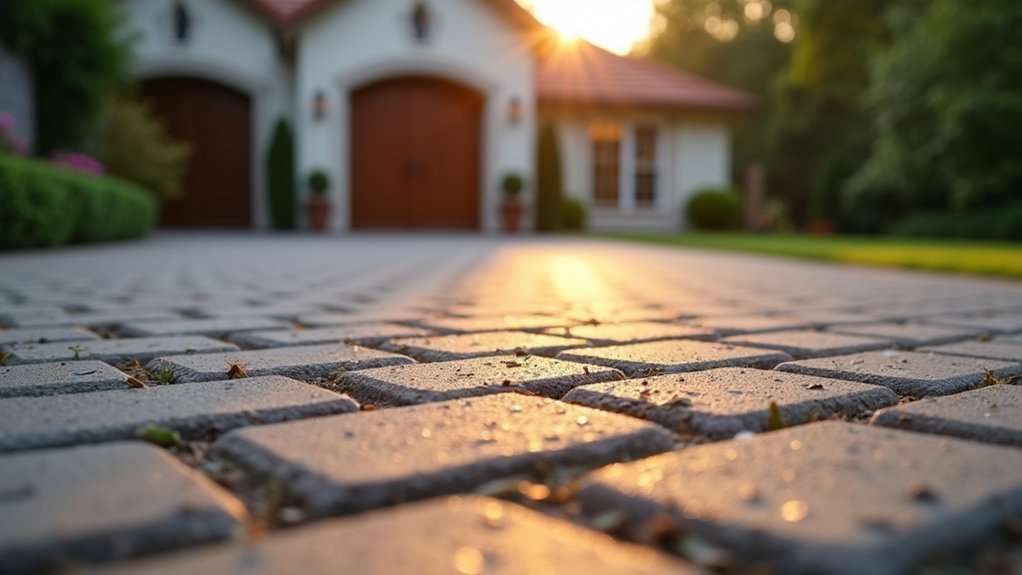
Concrete block pavers deliver compressive strengths typically ranging from 30-50 MPa for 60mm units, enabling them to support heavy vehicular loads and commercial traffic without structural compromise. Their abrasion resistance guarantees longevity under frequent surface friction, while flexural strength, directly tied to density, determines resistance to bending forces and cracking. You’ll find these blocks withstand freeze-thaw cycles, impact, and weathering across multiple climates, achieving 20–25 year lifespans with proper maintenance.
Maintenance demands remain minimal: routine sweeping, washing, and periodic sealing preserve surface integrity. You can replace individual damaged units without full-area repairs, and blocks lift easily for utility access without visible reinstatement marks. Permeable designs facilitate drainage, preventing water pooling and slip hazards. Their skid resistance in wet conditions, combined with deformation resistance under heavy traffic, maintains consistent surface levels and safety compliance throughout their service life.
Comparing Concrete Block Paving to Alternative Surface Options
When evaluating surface solutions for driveways, walkways, and commercial hardscapes, you’ll find concrete block paving delivers measurable advantages over monolithic concrete slabs, asphalt, and stamped concrete alternatives.
A thorough cost-benefit analysis reveals critical performance distinctions:
- Structural resilience: Interlocking pavers flex under load and ground movement, reducing fracture risk by 40% compared to rigid concrete slabs
- Repair economics: Individual block replacement costs 60-75% less than concrete resurfacing or asphalt patching
- Stormwater management: Permeable paver systems achieve 80-90% infiltration rates versus 0% for impermeable concrete
- Lifetime performance: Block paving maintains structural integrity for 25-30 years with minimal maintenance, exceeding stamped concrete’s 15-year typical lifecycle
These quantifiable differences demonstrate why block paving consistently outperforms alternatives in durability, sustainability, and long-term value retention.
Installation Considerations and Best Practices
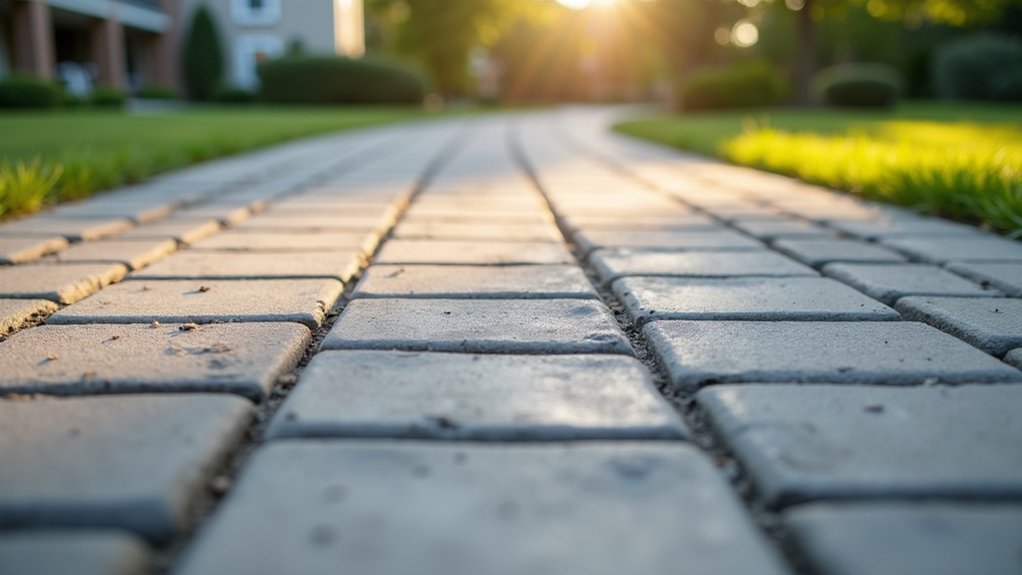
Successful concrete block paving installations require systematic attention to three interdependent elements: a stable, properly compacted base built in 3″–4″ lifts, precise edge restraints to prevent lateral movement, and consistent grading at 1/8″–1/4″ per foot for drainage. You’ll need to compact your base material in multiple passes, six or more, before addressing bedding depth, laying patterns, and joint specifications. Your choice of edge restraint system, combined with proper slope maintenance throughout all layers, directly determines the longevity and performance of the finished surface.
Proper Base Preparation Steps
Before installing concrete block pavers, you’ll need to execute a methodical base preparation sequence that directly determines long-term performance and structural integrity. Excavation considerations include removing soil to accommodate paver thickness, 1″ bedding sand, and appropriate base depth, 4–6″ for pedestrian applications, 8–12″ for vehicular loads. Proper aggregate base selection requires well-graded crushed gravel (3/4″ minus) while avoiding recycled concrete due to efflorescence potential.
Critical preparation steps include:
- Mark boundaries 6–12″ beyond finished edges for adequate base retention
- Install geotextile fabric between subsoil and aggregate in clay or poor-drainage conditions
- Compact base in 2–4″ lifts using minimum 5,000 lbs force plate compactor
- Maintain 1/8″–1/4″ per foot drainage slope away from structures throughout excavation and base installation
Laying Patterns and Techniques
A properly compacted base establishes the foundation, but the selected laying pattern determines both structural performance and long-term durability of the paved surface. Herringbone at 45° or 90° delivers maximum interlock strength, making it essential for driveways and vehicular loads. Stretcher bond offers faster installation with half-block offsets, suitable for pedestrian areas but limited in lateral resistance. Stack bond and basket weave prioritize aesthetic considerations through decorative geometry while sacrificing structural interlock. Intricate pattern layouts demand precise edge cutting and alignment using string lines to prevent drift. You’ll need to draw blocks from multiple packs to avoid color banding, lay from set pavers to safeguard the bedding layer, then perform 4–6 perpendicular vibro-compaction passes. Sweep jointing sand before and after compaction to lock units and guarantee uniform load transfer across the installation.
Edge Restraints and Drainage
Critical installation parameters include:
- Vertical restraining surface: Minimum 1″ (25 mm) contact with paver sides
- Base penetration: Channel extends 2–3″ below pavers into compacted aggregate
- Drainage slope: Maintain 1/4″ per foot minimum away from structures
- Spike anchoring: 8–12″ galvanized steel spikes for plastic/partial-depth restraints
Proper slope integration prevents water accumulation beneath bedding layers, reducing freeze-thaw damage and edge settlement failures.
Environmental Impact and Sustainable Drainage Solutions
While concrete block paving offers durability and design flexibility, its environmental footprint demands scrutiny. Concrete production accounts for 5–7% of global CO2 emissions, with block paving generating 75.46 kg CO2/m² across its lifecycle, lower than natural stone’s 110.81 kg CO2/m². You’ll reduce embodied carbon by specifying low-carbon alternatives incorporating fly ash or recycled aggregates, achieving 17–20% lower greenhouse gas emissions. Recycling and reuse of pavers at end-of-life further minimizes environmental impact.
Concrete block permeable paving (CBPP) provides sustainable drainage solutions by allowing water infiltration, reducing stormwater runoff and promoting groundwater recharge. These systems function as effective SuDS components, mitigating urban heat island effects while filtering pollutants. Transport distance considerably affects carbon footprint; locally sourced materials reduce emissions substantially compared to long-distance shipping.
Enhancing Property Value With Block Paving
Beyond the environmental considerations of concrete block paving, financial performance metrics reveal substantial property value implications. Your installation directly influences curb appeal impact, with professionally executed driveways generating 5–10% valuation increases. Buyer psychology studies confirm driveways rank among top purchasing factors, accelerating sale velocity while maintaining asking prices.
Key Financial Performance Indicators:
- ROI Range: Block paving projects deliver 50–100%+ returns, with premium installations reaching $3,000–$20,000 resale value gains
- Market Differentiation: Properties with block paving in under-served neighborhoods command premium positioning
- Maintenance Cost Reduction: Individual block replacement capability minimizes long-term repair expenditures
- Functional Expansion: Multi-use applications (driveways, patios, walkways) create lifestyle features that broaden buyer demographics
The 5% CAGR in global block paving markets validates sustained demand for these property enhancements.
Frequently Asked Questions
Can Concrete Block Paving Be Installed Over Existing Surfaces?
Yes, you can install concrete block paving over existing surfaces if they’re structurally sound and stable. You’ll need proper subbase preparation, repair cracks wider than 5mm, clean thoroughly, and guarantee adequate falls for water runoff. However, drainage concerns are critical; without correct slope or channels, moisture becomes trapped beneath, causing premature failure. Use a 30–50mm bedding layer (sand or mortar) between the existing surface and blocks. For high-traffic areas, full dig-out remains the superior option.
What Is the Typical Warranty Period for Concrete Block Pavers?
You’ll typically receive a lifetime warranty for structural integrity from manufacturers, though this applies only to the original property owner. Workmanship warranties from installers run 1–3 years. Commercial applications usually get shorter coverage of 1–5 years. To maintain validity, you must follow manufacturer recommendations strictly, including proper installation by certified contractors, adequate drainage, and regular maintenance. Coverage excludes cosmetic issues, improper use, and labor costs for repairs.
Are Special Tools Required for DIY Concrete Block Paving Installation?
Yes, you’ll need specialized tools beyond basic hand implements. A plate compactor is essential for proper compaction tools functionality, achieving 95% density per ASTM D698 standards. You’ll also require screeding equipment, block splitters for accurate cuts, and protective equipment, including knee pads and safety glasses. While shovels and levels suffice for prep work, renting a vibrating compactor ($75–$100 daily) guarantees interlocking stability. Budget $200–$400 for purchasing basic specialized tools or opt for rental alternatives.
How Much Weight Can Concrete Block Paving Support per Square Foot?
When properly installed, you’ll find concrete block paving supports 8,000 to 10,000 pounds per square foot, with heavy-duty units exceeding this threshold. The load-bearing capabilities depend on your paver’s thickness (2–3 inches ideal), compressive strength (3,000–8,000 psi), and base compaction quality. You’ll maximize performance through proper drainage planning and joint stabilization. While offering excellent weather resistance, concrete pavers require reinforced bases for heavy vehicles compared to natural stone alternatives.
Does Concrete Block Paving Increase Property Insurance Premiums?
No, concrete block paving typically decreases your property insurance premiums rather than increasing them. Insurance actuaries recognize concrete masonry’s superior fire and impact resistance, resulting in premiums 2.5 to 3 times lower than wood-frame alternatives. While some insurers may cite increased coverage costs or higher maintenance requirements as concerns, documented studies show builder’s risk insurance dropped over 50% with concrete masonry. You’ll likely see significant savings due to reduced underwriting risk.