
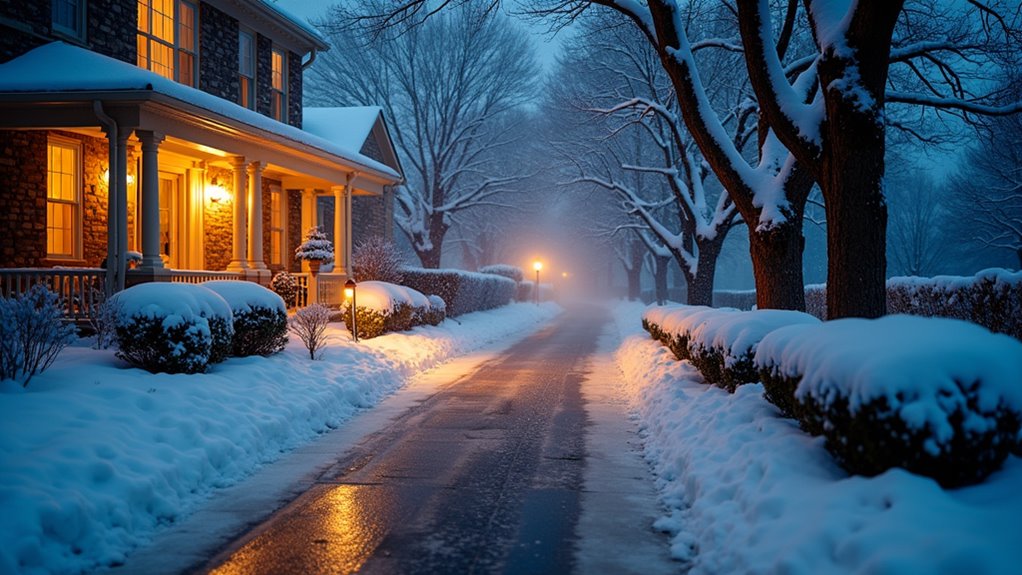
You’ll pay $10-$30 per square foot for paving stones versus $3-$7 for asphalt, but pavers last 25-100 years compared to asphalt’s 15-30 years. While asphalt requires sealcoating every 2-3 years at $120-$300, pavers need less frequent maintenance and allow individual unit replacement instead of complete resurfacing. Pavers boost home value by $5,000-$20,000, resist freeze-thaw damage better, and provide superior drainage through permeable options. The detailed analysis below examines how these specifications translate into long-term value.
Upfront Installation Costs Per Square Foot
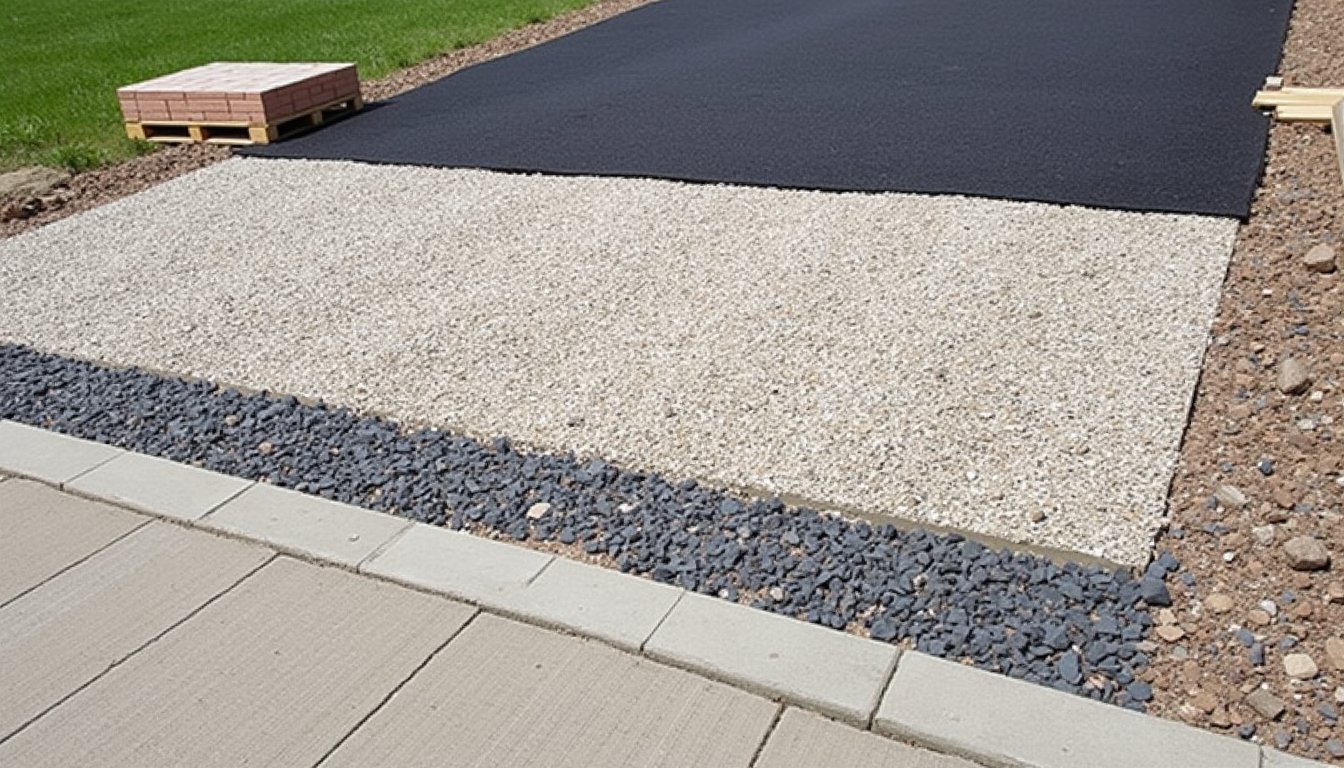
The upfront installation cost gap between paving stone and asphalt driveways is substantial and quantifiable. You’ll pay $10–$30 per square foot for standard paver installation versus $3–$7 for asphalt, a 2–6 times differential. Material selection drives this variance: concrete pavers start at $10–$20 per square foot, brick ranges $10–$25, while natural stone reaches $25–$50. Labor accounts for $6–$15 per square foot in paver projects due to intensive hand placement, compared to machine-spread asphalt’s lower installation cost. Paver installation is notably more labor-intensive, with labor costs representing 60-70% of the total project cost. Customization options and design complexity increase paver pricing considerably, with premium cobblestone installations commanding $25,000–$50,000 for 1,000 square feet. Asphalt’s seasonal aesthetic appeal remains limited, offering minimal design variation. Base preparation for pavers requires meticulous gravel, sand, and edge restraint work, further elevating costs beyond asphalt’s straightforward aggregate base requirements. Proper base and preparation is crucial for the longevity of the paver driveway. A two-person crew typically installs approximately 100 square feet of pavers daily, though intricate cutting patterns can reduce this rate to 50 square feet per day.
Expected Lifespan and Long-Term Durability
Lifespan projections reveal a decisive advantage for paving stone installations, with concrete pavers delivering 25–50 years of service, brick pavers reaching 25–100 years, and natural stone options exceeding a century under ideal conditions. Asphalt typically reaches end-of-life at 15–30 years, requiring full replacement once severe cracking occurs.
Paving stones outlast asphalt by decades, with natural stone exceeding 100 years compared to asphalt’s 15–30 year lifespan.
Critical durability differentiators include:
- Damage containment: Pavers allow individual unit replacement; asphalt demands complete resurfacing
- Freeze-thaw resistance: Jointed paver installations accommodate ground movement; asphalt propagates cracks
- Water management: Permeable paver systems enhance environmental sustainability through superior drainage; impermeable asphalt risks base erosion
Installation complexity directly impacts longevity; proper base preparation proves essential for both materials. Extreme temperature variation and heavy traffic accelerate asphalt deterioration more severely than modular paver systems, where individually supported units distribute load effectively. Professional installation extends driveway lifespan significantly, as improper techniques lead to shifting and settling that compromise structural integrity. Beyond installation quality, regular maintenance and sealing every few years significantly extends the functional life of paver driveways while protecting against premature deterioration. Routine maintenance can add 5-10 years to a driveway’s life, making the investment in periodic care financially prudent for both material types.
Ongoing Maintenance Requirements and Repair Expenses
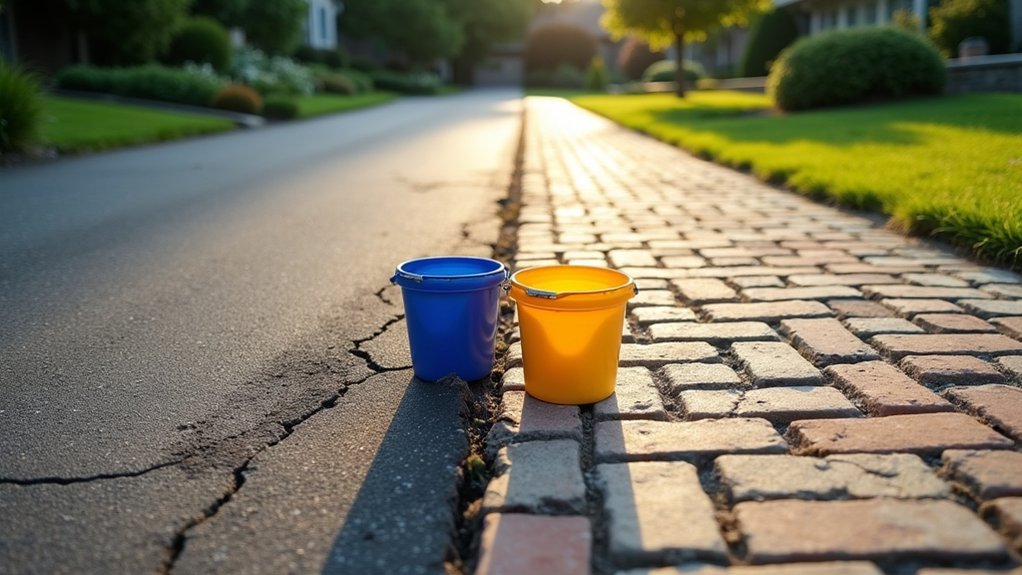
You’ll face distinctly different maintenance schedules and cost structures between paving stone and asphalt driveways throughout their service life. Pavers require annual joint sand refilling and sealing every 2–5 years, while asphalt demands more frequent sealing every 2–3 years plus immediate crack repair to prevent structural deterioration. Your long-term expenses will largely depend on repair frequency, pavers offer economical single-stone replacement, whereas asphalt often necessitates professional resurfacing or patching that affects larger surface areas. Regular cleaning with a hose or power washer helps maintain paver surfaces and can extend the time between more intensive maintenance procedures. Permeable pavers can lock gravel into place for enhanced stability and prevent debris buildup that would otherwise require frequent raking. With consistent preventive care, a well-maintained driveway can last significantly longer than one that receives only reactive repairs, potentially doubling its service life and reducing your total ownership costs.
Routine Maintenance Cost Differences
Beyond initial installation expenses, ongoing maintenance costs create a substantial disparity between asphalt and paving stone driveways over their operational lifespans. Your asphalt driveway demands sealcoating every 2–4 years at $120–$300 per application, plus routine cleaning ($100–$300 annually) to address seasonal dirt accumulation and oil penetration. Conversely, paver driveways require these maintenance protocols:
- Annual cleaning: $200–$500 for professional power washing with minimal staining susceptibility
- Joint stabilization: Polymeric sand reapplication every 3–5 years ($150–$350) to prevent vegetation intrusion
- Optional sealing: $600–$1,200 every 2–3 years for natural pigment preservation and enhanced surface protection
While asphalt necessitates frequent interventions to maintain structural integrity, paver maintenance focuses on aesthetic enhancement and joint stability, typically resulting in lower cumulative annual expenditures despite higher per-application sealing costs. The typical asphalt driveway’s 15-20 year lifespan influences long-term maintenance planning and replacement budgeting considerations. For comparison, gravel driveways offer excellent drainage capabilities but require regular raking and periodic gravel replenishment to maintain surface integrity. Repair expenses also differ significantly, with asphalt requiring $3–$5 per square foot for small pothole repairs while individual damaged pavers can be replaced without affecting surrounding areas.
Repair Frequency and Expenses
Structural resilience defines the fundamental distinction between paver and asphalt repair cycles, with each material exhibiting characteristic failure patterns that dictate intervention frequency and cost allocation. You’ll address paver repairs every 3–5 years at $7–$30 per square foot for targeted interventions, joint sand replenishment, individual stone replacement, or leveling sunken sections. Asphalt demands similar frequency for crack patching ($2–$5 per square foot) but escalates to complete resurfacing every 10–15 years. Installation complications stemming from inadequate base preparation accelerate deterioration in both systems, though pavers’ modular design permits surgical replacement without full-area demolition. Neglecting timely repairs compounds environmental impact through increased material consumption and waste generation. Professional paver specialists command labor rates of $50–$110 per hour, reflecting the technical expertise required for proper stone extraction, base evaluation, and reinstallation protocols. Paver maintenance extends beyond structural repairs to include sealing every 2-3 years for high-traffic driveways, which protects against oil stains, stabilizes joint sand, and extends overall lifespan. Asphalt driveways exhibiting alligator cracking patterns indicate foundation failure requiring complete repaving rather than surface-level crack filling, as the interconnected fissures prevent effective repair and create tire-adhering surfaces when treated with warmed filler materials. Asphalt’s 15–30-year lifespan versus pavers’ 25–75+ years fundamentally alters long-term repair economics and resource allocation strategies.
Design Flexibility and Property Value Impact
- Investment Return: Paver installations can increase home value by $5,000–$20,000, commanding higher premiums than asphalt in value-centric neighborhoods.
- Longevity Factor: Pavers’ 30–50 year lifespan versus asphalt’s 15–25 years translates to sustained valuation through reduced replacement cycles.
- Maintenance Economics: Individual paver replacement maintains design integrity at lower cost compared to asphalt’s full-surface repairs that diminish visual quality. Asphalt requires sealing every 2-5 years, adding recurring costs of $90–$210 per application that compound over the driveway’s lifetime.
Premium materials consistently outperform functional alternatives where neighborhood standards favor upscale specifications.
Performance Across Different Weather Conditions
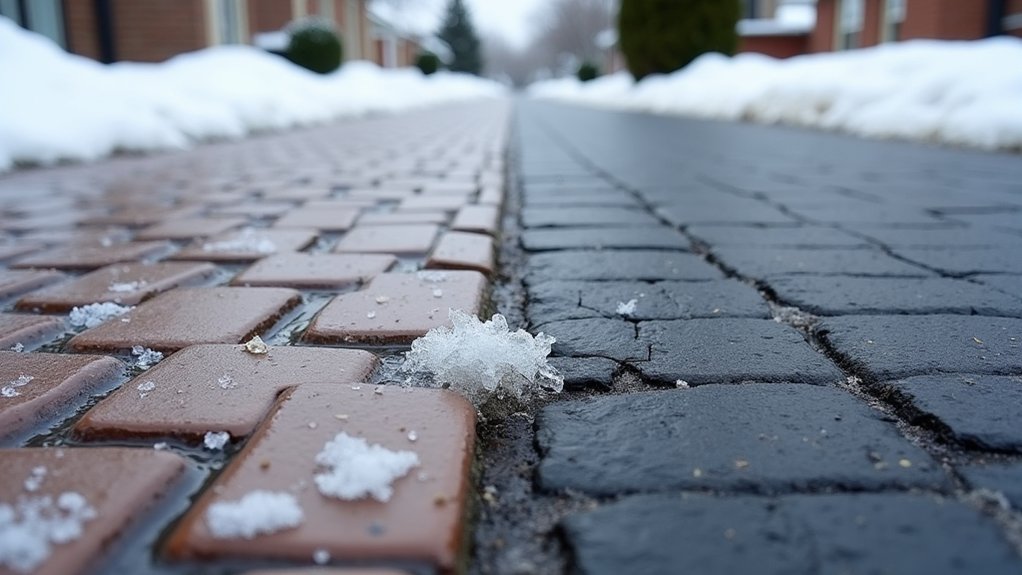
Your driveway’s material performance under regional climate stresses directly affects long-term maintenance costs and structural integrity. Freeze-thaw cycles test each surface’s ability to accommodate expansion without cracking, while asphalt’s flexibility contrasts sharply with pavers’ modular movement tolerance. Heat absorption, drainage capacity, and ice management further differentiate these materials, making climate-specific selection essential for cost optimization.
Freeze-Thaw Cycle Resilience
When subfreezing temperatures cause moisture within driveway materials to expand and contract repeatedly, the structural integrity of your pavement faces its most demanding test. Your material selection directly correlates with freeze-thaw performance through moisture absorption levels and dense composite construction.
Freeze-thaw resistance by material:
- Porcelain pavers (<0.5% water absorption) and natural stone (granite, limestone) deliver superior performance through minimal internal expansion
- Concrete pavers resist damage when properly sealed and installed with 6–12 inch compacted sub-base plus geotextile underlayment
- Asphalt exhibits high vulnerability, prone to extensive cracking, heaving, and surface deterioration requiring frequent crack repair and resurfacing
Edge restraint systems and polymeric sand further enhance joint stability. Individual paver replacement remains straightforward, while asphalt typically demands costly sectional resurfacing after harsh winters.
Heat and Drainage Performance
Beyond structural durability in cold conditions, thermal behavior and water management create distinct performance profiles that separate paving stones from asphalt across temperature extremes and precipitation events. Stone pavers absorb less heat, maintaining lower surface temperatures that reduce deformation risk in hot climates, while their permeable joints facilitate groundwater recharge and minimize stormwater runoff. Asphalt’s impermeable nature demands supplemental drainage infrastructure to prevent pooling and base layer deterioration. The textured paver surface retains superior wet-traction characteristics, whereas asphalt becomes slick during initial rainfall or oil contamination. Heat-accelerated binder breakdown necessitates frequent asphalt resealing, while modular paver construction enables targeted repairs without full-surface intervention. In regions experiencing intense rainfall or extreme heat, permeable paver systems deliver measurable advantages in flood mitigation and thermal stability compared to monolithic asphalt installations.
Construction Time and Project Disruption
Timeline considerations enormously impact project planning for driveway installations, with asphalt and paving stone systems requiring distinctly different construction durations. Asphalt’s specialized equipment needs enable faster completion, typically 3-5 days total, using automated paving machines and rollers. However, you’ll face 2-3 weeks of curing restrictions before full vehicle loads are permitted. Paver installations demand greater labor intensity, requiring 5-10 days for precise stone placement, but you’ll gain immediate usability upon completion.
Critical timeline differences include:
- Access disruption: Asphalt blocks entire property access for 2-5 days; pavers permit staged construction
- Weather vulnerability: Asphalt installation delays occur with rain or cold; pavers proceed independently of temperature
- Operational readiness: Asphalt requires 14-day cure time; pavers support immediate full-weight traffic
Total Lifetime Investment and Return on Investment
While initial price quotes provide essential budgeting data, you’ll make the most informed driveway investment decision by calculating total lifecycle costs across decades of ownership. Pavers deliver superior ROI through 25–50 year durability versus asphalt’s 12–20 year span, reducing replacement frequency. Although pavers cost $10–$30/sq ft upfront compared to asphalt’s $7–$13/sq ft, their maintenance intervals extend 3–5 years versus 2–3 years for asphalt.
| Cost Factor | Pavers | Asphalt |
|---|---|---|
| Lifespan | 25–50 years | 12–20 years |
| Maintenance Cycle | Every 3–5 years | Every 2–3 years |
| Property Value Impact | High customizability increases resale | Limited design contribution |
Sustainability considerations further enhance paver ROI; permeable options may qualify for local incentives while maintaining structural integrity longer, eliminating costly resurfacing projects that plague asphalt installations.
Frequently Asked Questions
Can I Install Pavers or Asphalt Myself to Save Money?
You can install pavers yourself to save 30–40% on costs, though it demands precise driveway base preparation with compaction equipment and 7–14 days of labor-intensive work. Asphalt DIY offers 40–50% savings but requires hot-mix expertise and heavy machinery rental. Professional installation considerations include warranty coverage (2–10 years for pavers) and reduced error risk. Pavers allow design adjustments during installation, while asphalt’s rapid setting makes mistakes costly, often necessitating complete replacement if you lack proper technical experience.
Do Paver or Asphalt Driveways Require Special Permits or Approvals?
You’ll typically need permits for both paver and asphalt driveways, as they’re governed by local zoning regulations and municipal building codes. Most jurisdictions require approval before altering impervious surfaces and drainage patterns. Your municipality will review site plans, setback compliance, and lot coverage percentages. Permeable pavers often receive expedited approval in eco-conscious districts. Contact your planning department early, you’ll need to verify HOA restrictions, environmental assessments, and stormwater management requirements before starting construction.
How Do Weight Limits Differ Between Paver and Asphalt Driveways?
You’ll find paver driveways support 8,000-10,000 pounds with superior weight capacity considerations due to their 9-inch compacted base versus asphalt’s 4-5 inches. Durability comparisons reveal concrete pavers achieve 10,000 psi compressive strength, three times stronger than poured concrete. Your paver system distributes loads more effectively through flexible joints that resist cracking, while asphalt’s solid surface fractures under heavy vehicles and temperature fluctuations, compromising structural integrity and load-bearing performance over time.
Are There Financing Options Available for Paver Driveway Installation?
You’ll find contractor financing widely available for paver installation, offering payment plans through third-party lenders with approval in hours. Options include deferred-interest programs and flexible terms up to seven years. Personal loans provide $100-$100,000 at 8-36% APR, while HELOCs leverage home equity for lower rates. Credit cards work for smaller projects with promotional offers. Do-it-yourself options eliminate labor costs but require material financing through retailers. Compare multiple lenders to optimize interest rates and avoid hidden fees affecting your project specifications.
Can Existing Asphalt Driveways Be Converted to Paver Driveways Easily?
Converting your existing asphalt driveway to pavers isn’t easy, it’s labor-intensive and technically demanding. You’ll need complete asphalt removal, deep excavation (typically 15+ inches), and proper multi-layer base installation with compaction equipment. Proper drainage requirements must be engineered into the base design, while maintenance considerations include edging installation and joint stabilization. The process requires heavy machinery, professional expertise, and careful attention to specifications. For most homeowners, it’s a complex undertaking best handled by experienced contractors.