
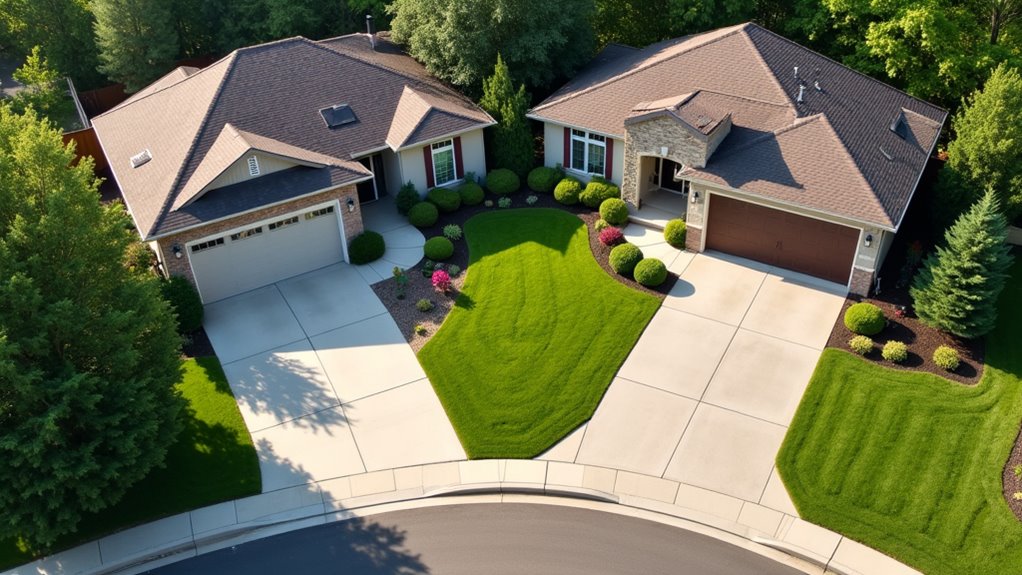
Paving your driveway creates five significant problems you’ve likely overlooked: it generates a heat island effect that raises your property’s temperature by 3-10°F and increases cooling costs by 5-11%; it fragments wildlife habitat and disrupts local ecosystems; asphalt production emits 30-50 kg of CO₂ per ton; impermeable surfaces block 95-100% of rainfall infiltration, reducing groundwater recharge by 40-60%; and you’ll face $5,000-$15,000 in maintenance costs over the driveway’s lifespan. Understanding these hidden impacts helps you make informed decisions about your property’s hardscaping investments.
Your Driveway Is Creating a Mini Heat Island in Your Yard
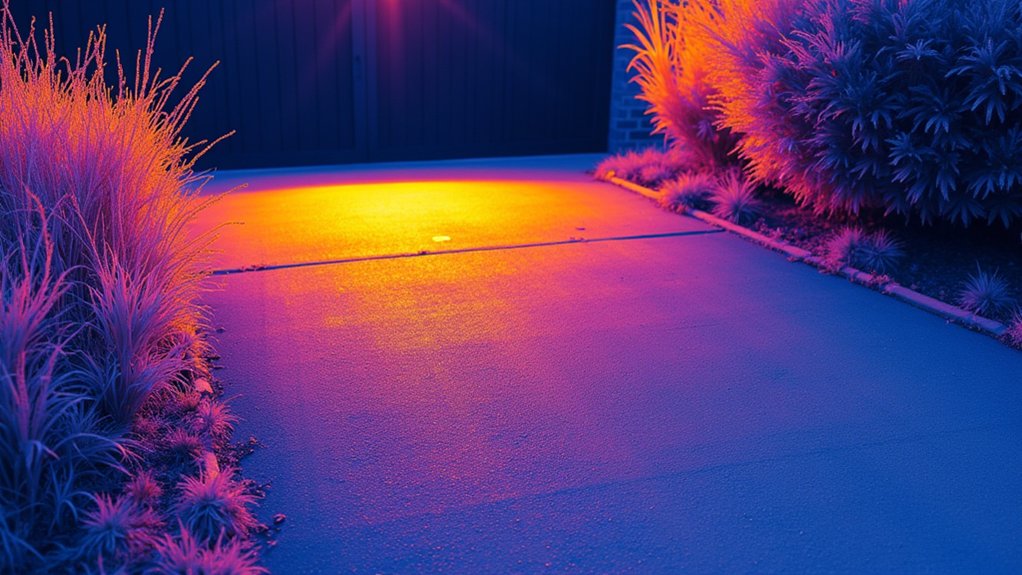
While natural ground surfaces typically reflect solar radiation and dissipate heat through evapotranspiration, your paved driveway operates as a heat-absorbing thermal mass that fundamentally alters your yard’s microclimate. Asphalt surfaces absorb 80–95% of sunlight, reaching mid-day temperatures up to 152°F, Paving your driveway creates five significant problems you’ve likely overlooked: it generates a heat island effect that raises your property’s temperature by 3-10°F and increases cooling costs by 5-11%; it fragments wildlife habitat and disrupts local ecosystems; asphalt production emits 30-50 kg of CO₂ per ton; impermeable surfaces block 95-100% of rainfall infiltration, reducing groundwater recharge by 40-60%; and you’ll face $5,000-$15,000 in maintenance costs over the driveway’s lifespan. Understanding these hidden impacts helps you make informed decisions about your property’s hardscaping investments, substantially higher than cool pavement alternatives. This low-albedo material augments local ambient air temperatures by 3–10°F during peak hours, with convective effects producing daytime temperature increases up to 3 K in humid climates. Your driveway’s nighttime heat release sustains heightened temperatures after sunset, contributing to increased energy demands through 5–11% higher peak cooling loads for your home. Traditional pavements continue releasing absorbed solar radiation throughout the night, further intensifying the nighttime heating effect. Studies have demonstrated that concrete driveways remain more than 20°F cooler than asphalt surfaces at peak temperatures, offering a significantly reduced thermal impact. These sustained temperature differentials create diminished outdoor comfort in adjacent yard spaces, while radiating heat directly impacts stormwater runoff temperatures and ground-layer thermal profiles.
Paved Surfaces Are Silently Disrupting Local Wildlife
Beyond thermal impacts, your paved driveway functions as an ecological barrier that actively fragments local wildlife habitat and restricts species movement across your property. Small mammals, amphibians, and reptiles avoid crossing impervious surfaces, reducing landscape connectivity and genetic interchange between populations. Vehicle speeds on pavement elevate direct mortality rates; documented studies show paved roads cause considerably more wildlife casualties than unpaved alternatives. Drivers have reported seeing more accidents involving wildlife on newly paved routes compared to their previous dirt conditions. Artificial lighting from driveways compounds these effects through disruption of breeding cycles, altering avian mating call schedules and interfering with amphibian reproductive migrations. Roadways create dead zones for local wildlife by cutting through previously continuous landscapes. Isolated populations face increased predation risk as movement corridors narrow. Your driveway fundamentally creates a micro-scale version of highway fragmentation effects, measurably reducing population viability for species requiring unbroken habitat patches. Paved surfaces enable easier access to previously remote habitat areas, intensifying human disturbance and recreational pressure on sensitive wildlife populations. These cumulative impacts compromise local biodiversity at the residential scale.
The True Carbon Footprint of Asphalt Production
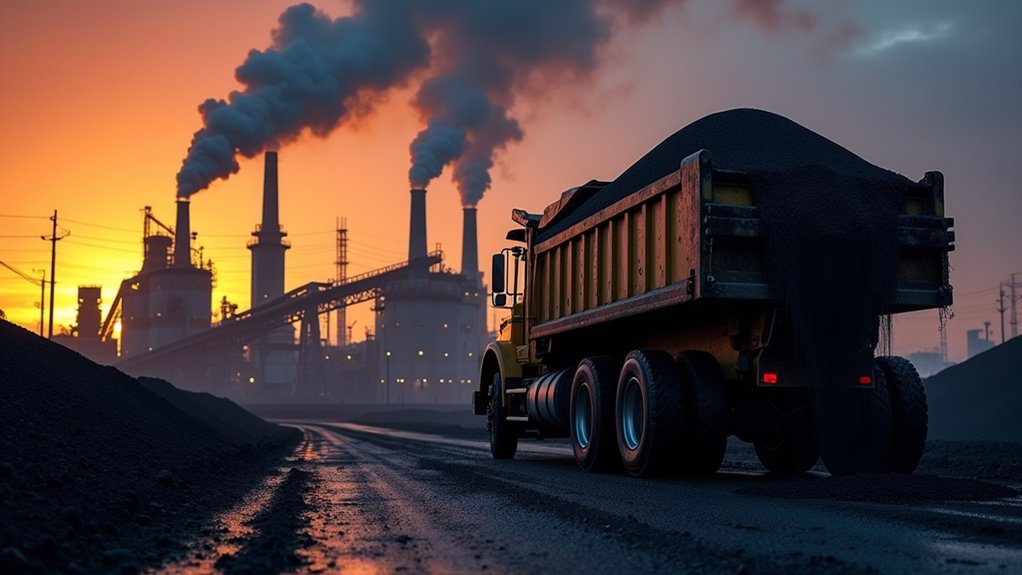
Although your residential driveway may seem insignificant in scale, its asphalt composition carries a substantial carbon burden beginning at the production facility. The energy sources used determine emissions intensity: producing one ton generates 30–50 kg of CO₂, with natural gas and oil heating reaching upper ranges. Consider these emission drivers:
- Raw material extraction and bitumen refining account for 43–75% of total supply chain emissions
- Heating aggregates to 300°F releases 18–22 lbs of CO₂ per ton through fuel combustion
- The mixing phase alone produces 54% of construction-related greenhouse gases
- Transportation via diesel trucks adds 4–7% to the carbon footprint
The impact of recycling offers mitigation: Reclaimed Asphalt Pavement reduces emissions by 15–20% per ton, while Warm Mix Asphalt technology cuts CO₂ output by 15–30% through lower processing temperatures. Notably, aggregate drying operations consume nearly half of the total energy expenditure during pavement construction, making this phase particularly carbon-intensive. Responsible sourcing of aggregates from quarries also plays a critical role in preserving natural landscapes and minimizing extraction-related environmental damage. Beyond the production facility, your finished driveway’s dark surface absorbs 80–95% of sunlight, contributing to elevated temperatures in surrounding areas.
How Impermeable Driveways Are Changing Your Property’s Water Flow
Your asphalt driveway blocks approximately 95–100% of rainfall from infiltrating into the ground, fundamentally altering how water moves across your property. This impermeability doubles runoff quantities compared to natural land cover, redirecting water that should replenish aquifers into storm drains instead.
| Impact Category | Measured Effect |
|---|---|
| Groundwater Recharge | 40–60% reduction |
| Runoff Volume Increase | 100–200% higher |
| Soil Moisture Deficit | 30–50% drier conditions |
| Erosion Rate | 2–5× baseline |
| Property Value Impacts | Flooding risk premiums |
The loss of soil moisture stresses vegetation, while concentrated runoff accelerates erosion and removes nutrient-rich topsoil. Areas exceeding 10% impervious cover experience measurably altered hydrologic cycles, with direct property value impacts from increased flooding susceptibility and reduced landscape health. Traditional paved surfaces create slippery conditions when water pools on the impermeable surface rather than draining into the ground. The collective impact of impermeable surfaces across urban neighborhoods compounds these drainage issues, contributing to system-wide infrastructure strain and increased flood risk. Runoff water carries pollutants such as petrol, oil, and brake dust into drains and streams, degrading water quality in local waterways.
The Expensive Maintenance Cycle You’re Signing Up For
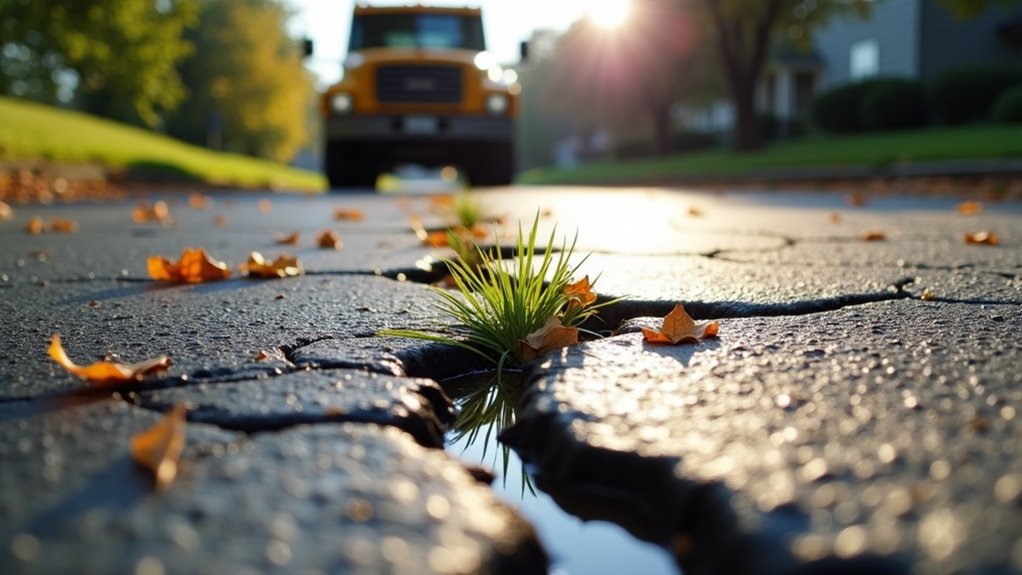
Paved driveways demand financial commitments extending decades beyond installation, with maintenance costs accumulating to $5,000–$15,000 over typical residential lifespans and premium installations exceeding $50,000. You’ll face unexpected annual expenses of $200–$400 for standard 480 sq ft driveways, compounding into substantial long term financial commitment.
Recurring maintenance requirements include:
- Re-sanding joints every 1–3 years at $0.50–$2 per sq ft as polymeric sand degrades from freeze-thaw cycles
- Professional sealing every 3–5 years costing $200–$400 per application
- Leveling sunken sections at $6–$15 per sq ft when ground settling occurs
- Replacing individual pavers at $15–$125+ each due to staining or damage
Neglecting routine care accelerates deterioration, triggering major restoration projects reaching $1,200–$4,500 for average driveways. Material selection significantly impacts repair frequency and costs, with natural stone pavers demanding $15–$30+ per square foot for repairs compared to concrete alternatives at $7–$15 per square foot. The initial installation alone represents a substantial commitment, with costs ranging from $10-$30 per square foot compared to more economical alternatives like asphalt at $7-$13 or concrete at $6-$15 per square foot. Northeast homeowners face particularly steep maintenance expenses due to harsh winter conditions requiring premium cold-resistant materials and more frequent repairs.
Frequently Asked Questions
What Are the Most Eco-Friendly Alternatives to Traditional Asphalt Driveways?
You’ll find porous concrete surfaces leading eco-friendly alternatives, delivering 80% rainwater infiltration while utilizing recycled aggregate. Recycled tire pavers offer exceptional durability with 100% waste diversion from landfills. Permeable grids reduce urban heat island effects by 10-15°F compared to asphalt. Gravel driveways provide the most cost-effective solution at $1-3 per square foot, lasting up to 100 years. These materials meet EPA LID standards while cutting stormwater runoff by 50-90%, vastly outperforming traditional asphalt’s environmental impact.
Can Permeable Paving Materials Reduce Both Heat Island Effects and Water Runoff?
Yes, permeable paving simultaneously addresses both challenges. You’ll achieve 43–98% runoff reduction while facilitating improved groundwater recharge through natural infiltration. The high void ratio enables evaporative cooling, lowering ambient temperatures and mitigating heat islands. You’ll also get reduced water pollution, up to 93% of suspended pollutants are filtered before reaching aquifers. Peak flows drop by 91% compared to conventional asphalt, while moisture retention actively cools surfaces, restoring your site’s natural hydrological cycle efficiently.
How Do Recycled Asphalt Options Compare to Traditional Materials Environmentally?
Recycled asphalt delivers substantial carbon footprint reduction, cutting energy use and emissions by eliminating virgin material production and petroleum reliance. You’ll achieve material durability considerations equivalent to traditional asphalt, with the Federal Highway Administration confirming RAP performs comparably at 30%+ mixtures. Over 99% of U.S. asphalt gets recycled, diverting landfill waste while reducing quarrying impacts. You’re minimizing VOC releases and heavy metal leaching risks remain negligible under typical conditions, making recycled options environmentally superior across lifecycle assessments.
Does Driveway Size or Placement Affect Its Environmental Impact Significantly?
Yes, both factors drastically alter environmental outcomes. Larger driveways multiply impervious surface area, escalating stormwater management considerations through increased runoff volume and reduced groundwater recharge. Placement on slopes or near waterways amplifies soil erosion impacts, accelerating sediment loading and pollutant transport into ecosystems. You’ll face compounded thermal effects, habitat fragmentation, and altered hydrology when sizing or siting poorly. Design choices, permeable materials, grading, and buffers can mitigate these risks, but scale and location remain critical determinants of total environmental burden.
Are There Tax Incentives for Choosing Environmentally Sustainable Driveway Materials?
Yes, you’ll find substantial sustainable incentives for eco-friendly driveways. Local programs offer tax rebates of $12–$15 per square foot, covering 50–75% of costs. State and federal tax credits reduce your taxable income when using certified sustainable materials. LEED certification provides additional financial rewards for stormwater reduction. You’ll also receive ongoing utility fee credits that lower stormwater management charges. Documentation requirements include material specifications and installation proof to qualify for these combined incentive structures.