
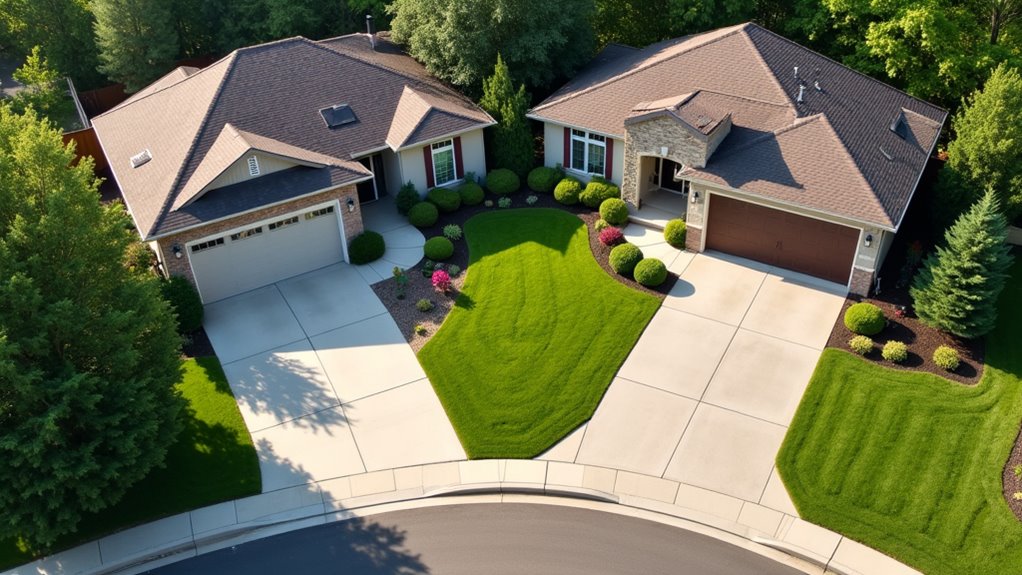
Cost Comparison: What You’ll Pay for Each Driveway Material
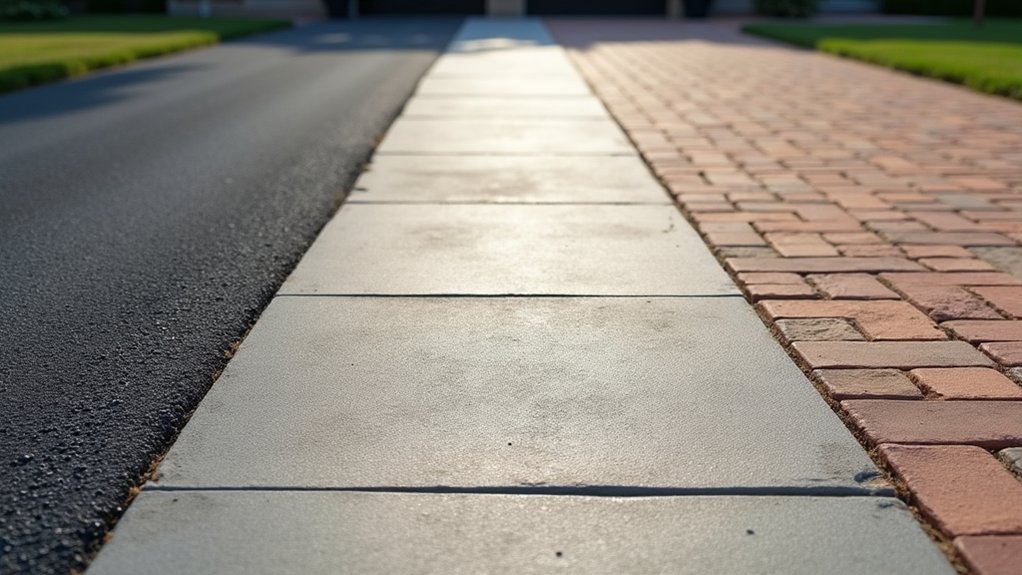
When you’re planning a new driveway, material costs will drive most of your budget decisions. Asphalt runs $6–$9 per square foot installed, making it your most affordable option. Concrete lands mid-range at $8–$11 per square foot, while pavers command $10–$25 per square foot depending on material choice.
For a 1,000-square-foot driveway, you’ll spend $4,500–$10,000 for asphalt versus considerably more for concrete or pavers. Regional cost differences matter too—Minnesota homeowners pay $3.95–$9.03 per square foot for asphalt compared to national averages.
Don’t overlook site preparation considerations. You’ll add $500–$2,000 for grading and base work on larger projects. Replacement projects tack on $1–$2 per square foot for demolition. Tree removal can cost $750 to $1,200 if roots or trunks obstruct your driveway path. These factors quickly shift your total investment beyond base material rates. Using the unit cost method helps set realistic expectations between you and your contractor, resulting in fair pricing and higher satisfaction with the finished project.
Installation Time and Process for Asphalt, Concrete, and Pavers
Your driveway project timeline hinges on which material you choose—and understanding each installation process helps you plan around work schedules, weather windows, and vehicle access needs.
Choosing the right driveway material determines your timeline—plan around weather, work schedules, and how long you’ll be without vehicle access.
Each material follows a distinct path from excavation to completion:
- Asphalt: 1-2 days for paving, but you’ll wait 3-5 days before driving on it
- Concrete: Single-day pour with a 7-day minimum cure before vehicle use
- Pavers: 2-4 days of labor-intensive placement with immediate use after compaction
- All materials: Expect 1-2 days for site prep plus potential permit delays
Weather impacts your project considerably. Seasonal factors like cold temperatures slow winter installs, while asphalt needs heat and concrete can’t handle excess moisture. Asphalt installation specifically requires temperatures between 50°F and 90°F for proper compaction and adhesion. Plan your installation during ideal conditions—typically late spring through early fall—to avoid costly delays. Before any paving begins, the site preparation phase involves removing existing pavement, grading for proper drainage, and compacting the soil to ensure a stable foundation. Your contractor should also assess drainage and soil stability during this phase to prevent future cracks and extend the life of your driveway.
Durability and Lifespan: Which Driveway Surface Lasts Longest
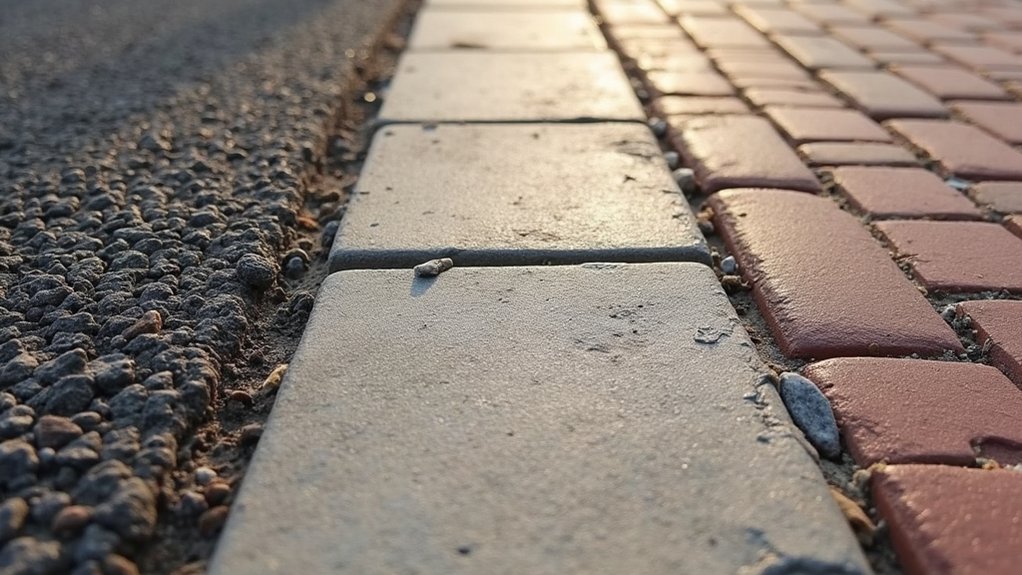
Choosing a driveway material isn’t just about curb appeal—it’s a long-term investment that’ll shape your maintenance schedule and replacement costs for decades.
Asphalt delivers 15-20 years under typical conditions, extending to 30 years with regular sealcoating. Its flexibility makes it ideal for cold climates but problematic in heat-prone regions where softening occurs. Made from aggregates and bitumen, asphalt remains a cost-effective and quick-to-install option. Its compressive strength and ease of repair also make it suitable for high-traffic areas. The installation process involves heating and rolling the material onto the prepared surface, typically completing in just two days.
Concrete outlasts asphalt by 10-20 years, offering 30-40 years of service—potentially 50+ with diligent care. Its suitability for climate conditions favors hot regions, though freeze-thaw cycles pose cracking risks.
Pavers win the longevity race at 25-50 years. Individual units resist cracking, and their versatility in design options means you’re not sacrificing aesthetics for durability. You’ll need proper base installation and periodic sealing to prevent shifting.
Maintenance Requirements for Each Paving Type
Longevity numbers only tell part of the story—what you’ll actually do to reach those 20, 40, or 50-year benchmarks matters just as much.
Asphalt demands the most consistent attention. You’ll need sealcoating every 2-4 years, crack sealing before each winter, and twice-yearly inspections. Budget $0.10-$0.25 per square foot annually, plus sealcoating costs. For new asphalt driveways, wait at least six months after installation before applying the first sealcoat to ensure proper curing. Understanding different crack types—including narrow, alligator, linear, and block cracks—helps you tailor repair strategies for more effective, long-lasting solutions.
Concrete requires less frequent intervention—periodic sanding and polishing maintains appearance, while chemical treatments address stains and surface wear. Pavers offer modular repair advantages; individual units can be replaced without affecting surrounding areas. For all driveway types, water causes the worst damage by weakening foundations through crack infiltration and freeze-thaw cycles.
Essential maintenance tasks by material:
- Asphalt: Sealcoating, crack filling, drainage maintenance, seasonal inspections
- Concrete: Resealing every 2-5 years, joint maintenance, stain removal
- Pavers: Joint sand replenishment, individual unit replacement, weed prevention
- All surfaces: Prompt spill cleanup, debris removal, drainage system upkeep
Aesthetic Appeal and Curb Appeal Considerations
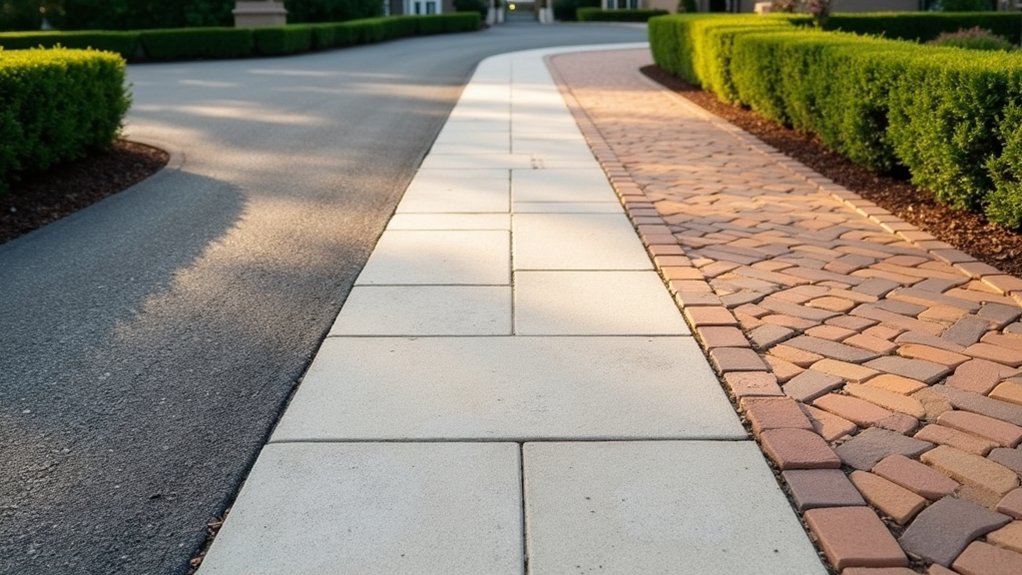
Everything from color selection to pattern complexity affects how your driveway integrates with your home’s overall design—and ultimately, what impression it leaves on visitors and potential buyers.
Design customization varies dramatically across materials. Pavers offer endless combinations of colors, shapes, and patterns for maximum visual uniqueness. Asphalt limits you to black or gray, while concrete restricts choices to manufacturer-set options. As Belgard Master Craftsman Dan Hughes notes, the only limit is your imagination when designing with pavers.
| Feature | Pavers | Asphalt | Concrete |
|---|---|---|---|
| Color Options | Unlimited | Black/Gray only | Limited manufacturer colors |
| Pattern Flexibility | Endless combinations | None (requires borders) | Template-dependent |
| Long-term Appearance | 30+ years without decline | Fades and crumbles | Cracks and chips |
| Property Value Impact | Increases considerably | Decreases over time | Moderate at best |
Stamped alternatives can’t match pavers’ lasting aesthetic integrity, as heat distorts asphalt patterns and UV exposure fades concrete stains. Asphalt is particularly vulnerable to weather conditions, softening in heat and cracking during temperature fluctuations that compromise its surface appearance. When individual pavers become damaged, they can be easily lifted and replaced without disrupting the surrounding design, whereas stamped concrete repairs often result in mismatched patterns that compromise the overall appearance.
Frequently Asked Questions
Can I Install Pavers Over My Existing Asphalt or Concrete Driveway?
Yes, you can install pavers over your existing asphalt or concrete driveway. Before starting, you’ll need to conduct an existing surface condition assessment—your current surface must remain solid without crumbling, stay relatively flat, and have no cracks exceeding 1/2 inch. Overlay installation considerations include choosing between sand set, bituminous, or mortar methods depending on traffic load. You’ll save time and money by skipping excavation while gaining durable, easily repairable results.
Which Driveway Material Is Best for Areas With Heavy Rainfall or Flooding?
For heavy rainfall or flooding, you’ll want permeable pavers or porous asphalt. Permeable pavers let rainwater drain through gaps, reducing pooling and easing strain on storm drains. Porous asphalt works similarly, allowing water to flow through the surface. Whichever you choose, you’ll need a proper drainage system and moisture resistant base to handle water volume effectively. Gravel’s another budget-friendly option with excellent natural drainage for wet climates.
How Do Extreme Temperatures Affect Each Driveway Type Differently?
Extreme temperatures impact each material uniquely through thermal expansion and contraction cycles. You’ll find asphalt handles cold better—its flexibility accommodates freeze-thaw movement, though it softens in intense heat, reaching 152°F. Concrete’s rigidity makes it vulnerable to frost heave impact and cracking, but it stays cooler in summer. For pavers, rubber options resist winter cracking while wood varieties manage heat well. Permeable pavers also help with temperature-related stormwater issues.
Are Pavers or Concrete Better for Supporting Heavy Vehicles Like RVS?
Both options handle RVs well, but pavers offer distinct advantages for heavy vehicle support. You’ll benefit from their increased load bearing capacity—often exceeding 8,000 psi—and their interlocking design distributes weight evenly across the surface. Pavers also provide better drainage performance, reducing water damage beneath your RV’s parking spot. While concrete works fine, it’s prone to cracking under repeated heavy loads. Pavers flex with ground movement, making them your more durable long-term investment.
Which Driveway Material Is Most Environmentally Friendly or Sustainable?
Asphalt offers the strongest sustainability profile with its 99% recycling rate and lower production energy. However, you’ll want to ponder your specific goals. If you’re prioritizing permeable surface design, pavers and porous concrete excel at stormwater management. For heat island effect reduction, concrete’s reflective surface keeps surrounding areas cooler. You can maximize sustainability by choosing recycled asphalt or permeable pavers that combine recyclability with effective water infiltration.