

You’ll spend between $400 and $800 to sealcoat a standard 400-square-foot driveway, with the national average landing around $600. Per-square-foot pricing typically runs $0.15 to $0.25 for basic jobs. Your final driveway sealcoating cost depends on driveway material, surface condition, and necessary prep work. Extreme dirt adds $100, $200, while crack filling tacks on $0.35, $0.40 per square foot. Understanding these variables helps you budget accurately for the full project scope below.
National Average Driveway Sealcoating Prices
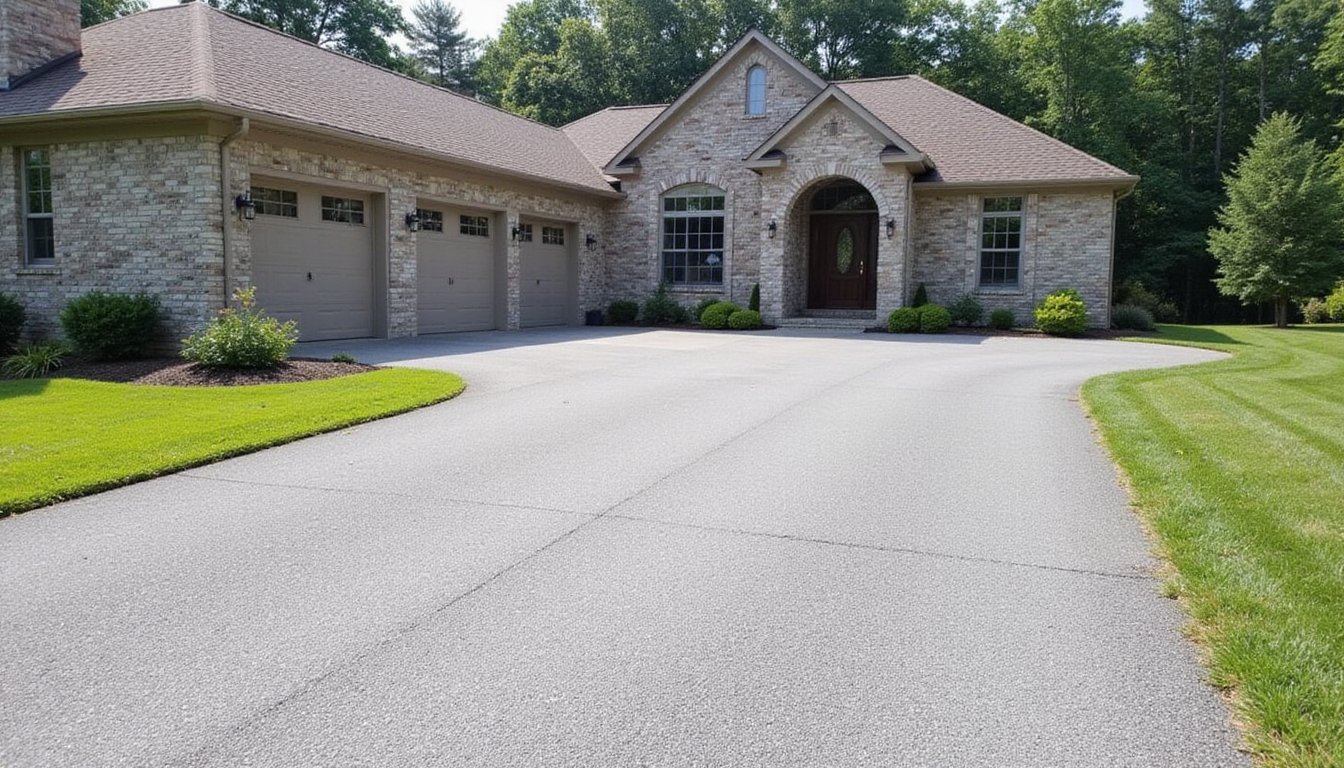
When planning your driveway sealcoating project in 2026, you’ll find national averages have remained relatively stable compared to recent years. The typical cost ranges from $400 to $800 for a standard 400-square-foot driveway, with the national average settling around $600.
Per-square-foot pricing runs between $0.15 and $0.25, translating to $225-$600 for a 500-600 square-foot driveway. Product composition variations affect these rates, as asphalt sealcoating specifically costs $0.88-$2.10 per square foot when factoring in materials and application methods.
Regional cost differences create significant price gaps across the country. You might pay as little as $176 in some markets or up to $1,230 in higher-cost areas. Labor accounts for $0.90-$1.50 per square foot, while materials add $0.10-$0.50. While DIY sealcoating offers lower upfront costs, it often comes with potential quality issues and hidden expenses that may offset initial savings. For optimal protection, experts recommend resealing your driveway every 2-3 years to maintain its condition and extend its lifespan. Obtaining detailed quotes from reputable local contractors remains the most accurate way to determine your actual project cost.
Cost Breakdown by Driveway Material Type
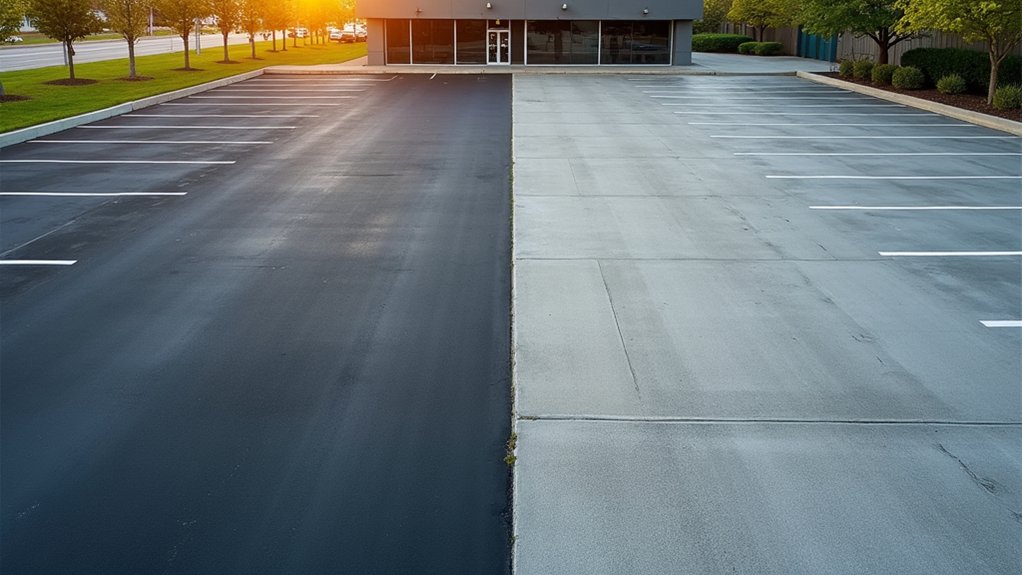
Because material type directly impacts your sealcoating budget, understanding the cost differences between asphalt and concrete driveways helps you plan more accurately.
Material type is the biggest factor in your sealcoating budget, knowing the difference helps you plan smarter.
Asphalt driveways require sealcoating every 2-3 years, with total costs ranging from $0.88, $2.10 per square foot including labor requirements. Concrete surfaces demand higher material costs, typically $1, $3 per square foot installed, due to specialized acrylic or epoxy sealants. Among asphalt sealer options, coal tar is the most affordable at just $0.08, $0.10 per square foot for materials. For DIY projects, one gallon of sealcoat covers 80-100 square feet, helping you estimate material quantities before purchasing.
- Asphalt sealcoating: $0.88, $2.10 per square foot total; uses polymer emulsion or coal tar sealants
- Concrete sealing: $1, $3 per square foot installed; requires acrylic or epoxy products
- Two-car concrete driveway: $575, $1,700 total project cost
Your concrete driveway’s material costs run approximately 30-40% higher than asphalt, though concrete typically needs less frequent resealing. Without proper sealcoating, your asphalt can develop damage that leads to more expensive repairs like complete repaving.
Key Factors That Influence Sealcoating Prices
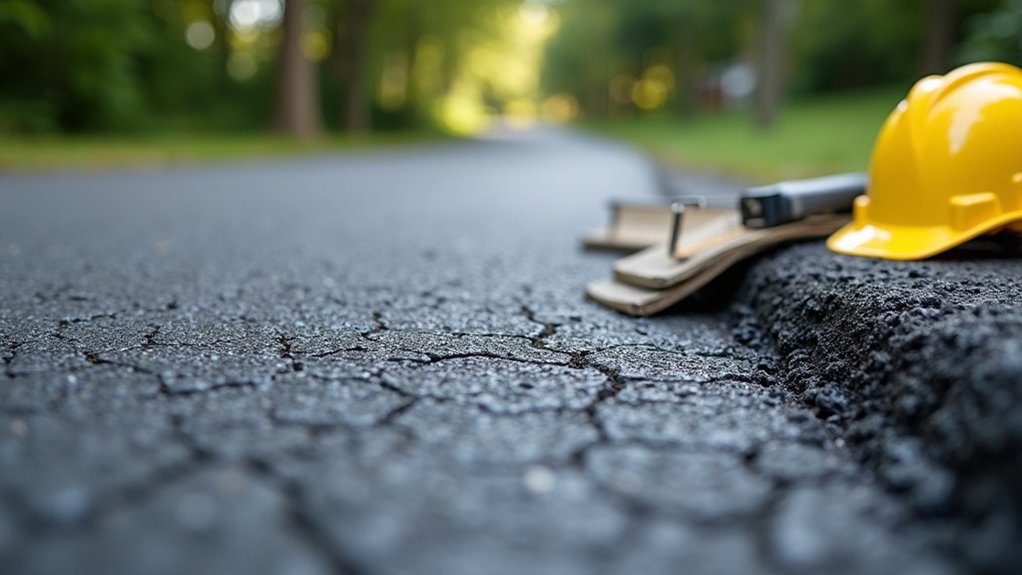
Several variables determine your final sealcoating bill beyond just square footage. Your driveway’s condition plays a major role, extreme dirt, mud, or weeds trigger a $100-$200 surcharge, while crack filling adds $0.35-$0.40 per square foot.
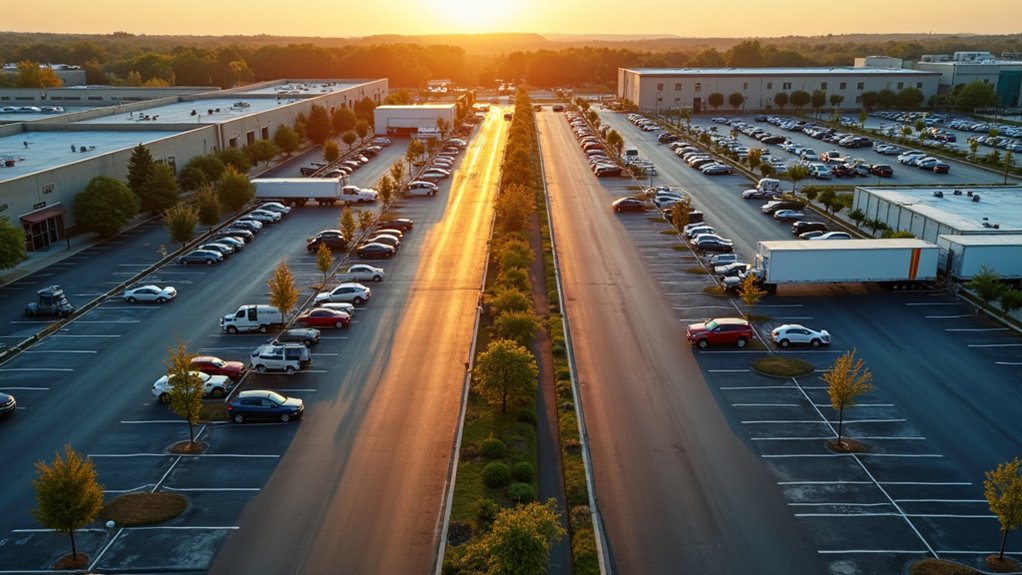
Economies of scale work in your favor on larger projects, dropping per-square-foot rates appreciably. A 20,000 sq ft commercial lot costs $3,000-$5,000, averaging far less per square foot than residential driveways.
Additive compositions directly impact pricing. Sand additives for slip resistance, polymer compounds for flexibility, and commercial-grade acrylics for chemical resistance all raise material costs. Your regional market matters too, high-competition areas see rates near $0.15 per square foot, while limited-competition zones push toward $0.23.
Complex layouts with tight corners, drainage systems, or obstacles like light posts require labor-intensive handwork, increasing your total investment. Driveways with slopes beyond 20 degrees may not be suitable candidates for sealing at all, potentially requiring alternative solutions that affect your overall project budget. Keep in mind that most contractors set a minimum price of $200 per address regardless of driveway size, which affects cost calculations for smaller properties.
Additional Services and Hidden Costs to Consider
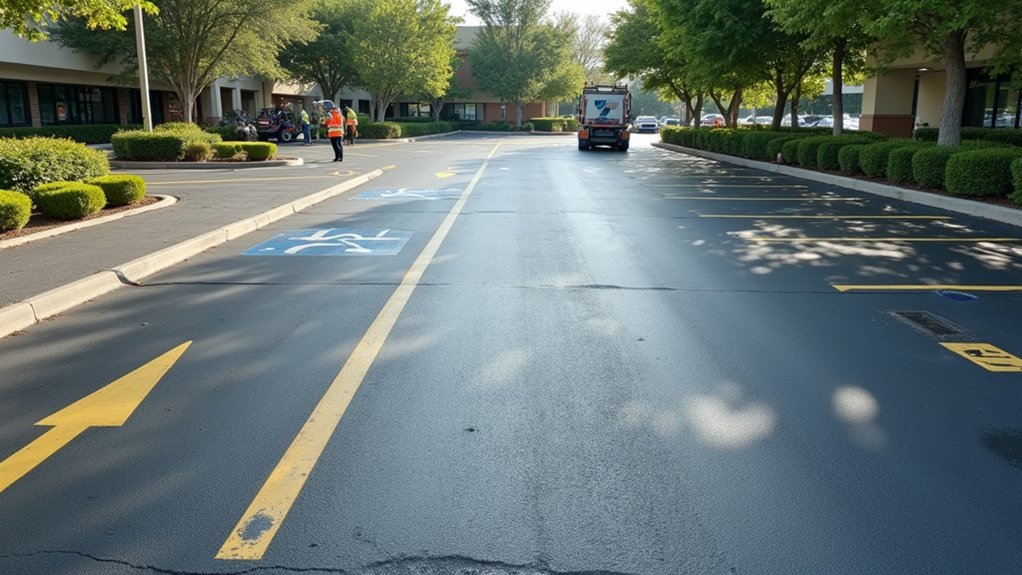
Beyond the base sealcoating rate, you’ll encounter several add-on charges that can drastically impact your project budget. Pressure washing runs $0.27, $0.39 per square foot when charged separately, while crack and pothole repairs average $3, $4 per square foot depending on your driveway material. Don’t overlook contractor project fees of $100, $200 that cover equipment, insurance, and mobilization costs.
- Surface preparation: Pressure washing guarantees proper sealer adhesion and prevents trapped moisture
- Structural repairs: Crack filling and pothole patching must occur before sealing to prevent accelerated deterioration
- Aesthetic enhancements: Fresh sod installation ($0.30, $0.83/sq ft) coordinates well with sealcoating projects
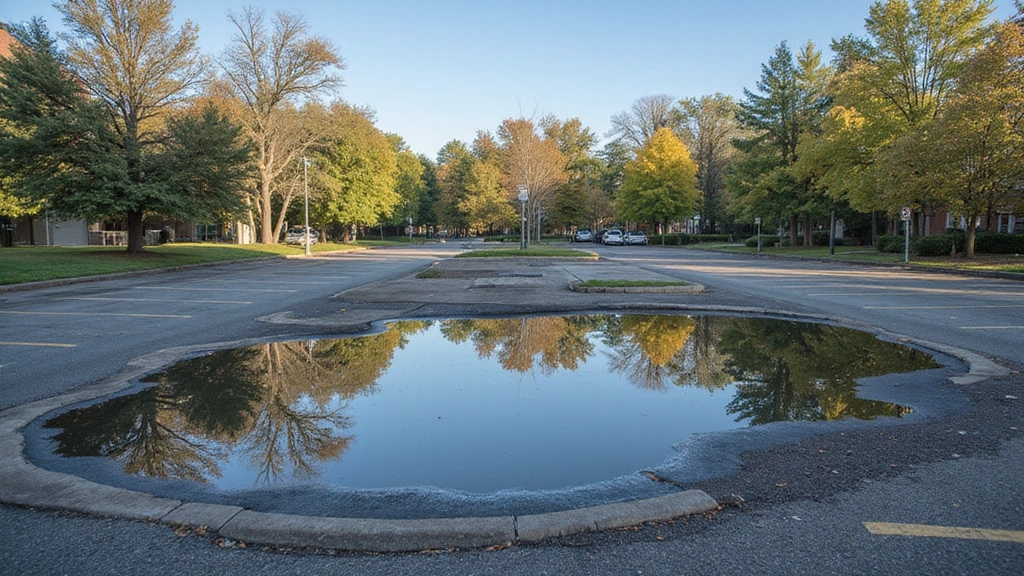
When evaluating material substitution options, factor these hidden costs into your total budget. Small jobs under $200 typically carry mandatory project fees regardless of scope. If your property has drainage structures, budget $2,500, $5,000 per basin for catch basin repairs before sealcoating can proceed. Skipping sealcoating may appear to save money initially, but delaying this protective treatment allows asphalt to break down faster, requiring more extensive repairs such as crack filling, pothole patching, or even full resurfacing.
Long-Term Maintenance Costs and Recommended Schedules
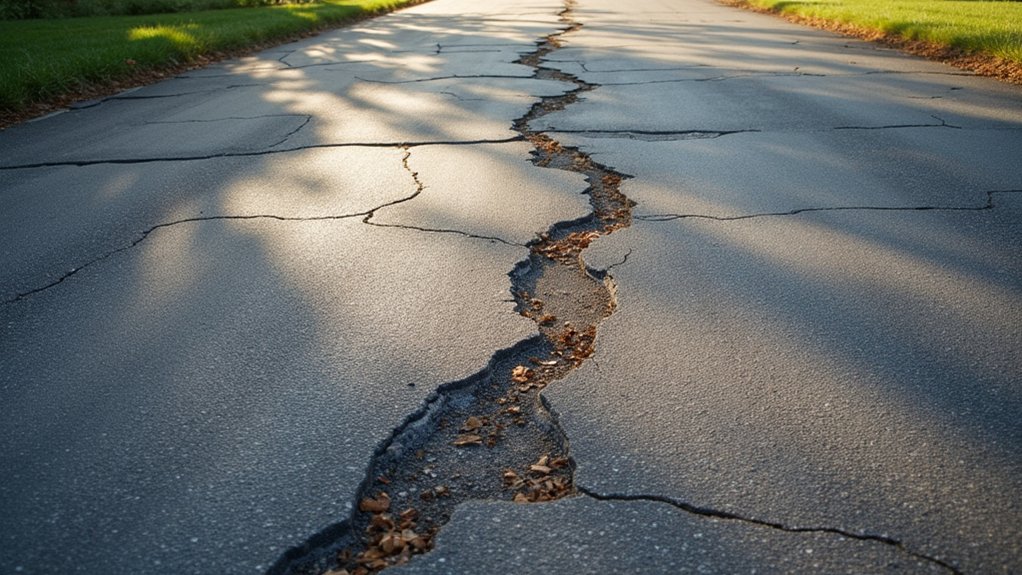
Consistent sealcoating every 2, 3 years delivers the strongest return on your maintenance investment, saving 60, 80% compared to full driveway replacement. A $250 sealcoating application prevents approximately $2,000 in future repairs, while prevention costs stay under $0.35 per square foot annually with a routine schedule.
You’ll need crack sealing every 6, 12 months at $0.30, $0.60 per linear foot to stop water infiltration. Schedule twice-yearly inspections to catch problems early. Skipping maintenance doubles your repair costs within a year and accelerates deterioration toward full depth replacement, which runs $6, $12 per square foot. However, sealcoating only works when your pavement is structurally sound without base failures or major alligator cracking.
Neglected driveways require repairs costing $2.50, $7.00 per square foot in damaged sections. By maintaining a consistent schedule, you’ll double your asphalt’s lifespan and avoid the exponential expense of complete reconstruction. Without proper sealcoating, your driveway loses its barrier against UV rays, rain, snow, and oil spills, accelerating the damage that leads to costly repairs.
Frequently Asked Questions
Can I Sealcoat My Driveway Myself, and How Much Would I Save?
Yes, you can sealcoat your driveway yourself. DIY material costs range from $20, $179 for sealer and repairs, plus $43 for basic tools like a squeegee, sprayer, and tape. Since the professional average runs $305, you’ll save $100, $200 by skipping contractor fees. However, professional application benefits include proper surface prep, even coverage, and warranty protection. If you’re comfortable with pressure washing, crack filling, and squeegee techniques, DIY offers significant savings.
How Long Should I Wait Before Driving on a Freshly Sealcoated Driveway?
You should wait 24-48 hours before driving on your freshly sealcoated driveway. The ideal curing time depends on temperature, humidity, and sealer thickness, warmer conditions above 50°F speed up the process. Light vehicles can typically access the surface after 48 hours, while full strength takes 7 days. Proper preparation techniques and following these wait times prevent premature damage, saving you the $0.15-$0.25 per square foot reapplication cost if you drive too soon.
What Weather Conditions Are Best for Applying Driveway Sealcoating?
You’ll get the best sealcoating results when you apply it within a suitable temperature range of 50°F to 85°F. Make certain the surface temperature stays above 50°F for proper adhesion. Ideal humidity levels should remain below 50% to prevent moisture interference. Check that no rain is forecasted for 24-48 hours before and after application. These conditions guarantee proper curing and help you avoid costly reapplication expenses.
Does Sealcoating Work on Driveways With Existing Oil Stains or Damage?
Sealcoating won’t work on untreated oil stains or damaged surfaces, stains bleed through fresh sealant, and cracks cause adhesion failure. You’ll need existing oil stain removal through degreasing or pressure washing ($0.27, $0.39/sq ft) before application. Proper driveway surface preparation includes filling cracks at $0.35, $0.40/sq ft and repairing potholes at $4.00, $10.00/sq ft. Without these steps, you’re wasting money since sealant only bonds effectively to clean, intact asphalt.
How Do I Find a Reputable Driveway Sealcoating Contractor in My Area?
You can find a reputable sealcoating contractor by checking online reviews on platforms like Thumbtack, Angi, or Google, aim for 4+ stars from 50+ reviews. Start by asking for referrals from neighbors who’ve had similar work done. Verify state licensing, confirm $1 million minimum liability insurance, and request proof of bonding. Get 3-5 written quotes comparing per-square-foot rates ($0.15-$0.50) and included services like pressure washing and crack repairs.