
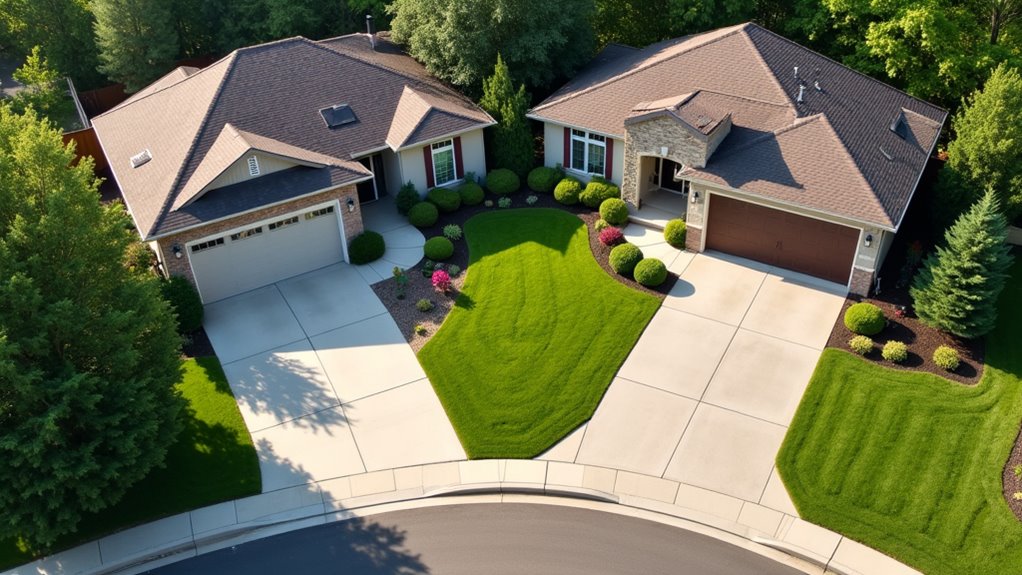
Concrete costs 45% more initially ($4-$10 per sq ft vs. $3-$7 for asphalt) but delivers 25-50 years of service compared to asphalt’s 15-30 years. You’ll wait 7-28 days for concrete to cure versus asphalt’s 24-48 hours. Concrete excels in hot climates and heavy-load applications, while asphalt’s flexibility handles freeze-thaw cycles better. Asphalt requires sealcoating every 2-5 years, though concrete repairs cost $300-$3,000 versus asphalt’s lower repair expenses. Understanding each material’s specific maintenance demands and climate performance characteristics will help you optimize your long-term pavement investment.
Cost Comparison: Initial Investment vs. Long-Term Value
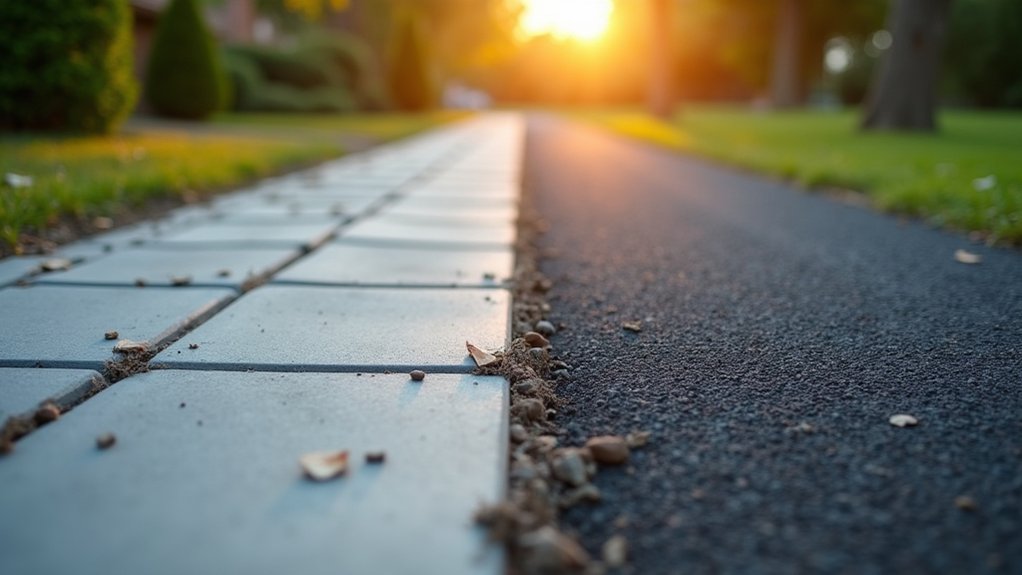
Budget constraints often drive the initial choice between concrete and asphalt paving, but this decision requires analysis beyond installation costs. Asphalt averages $3–$7 per sq ft versus concrete’s $4–$10 per sq ft, making it 45% less expensive initially. However, asphalt’s 3–5 year resealing cycle ($290–$800) and 15–30 year lifespan shift the economic equation. Concrete’s 30–40+ year durability and reduced maintenance frequency often equalize cumulative expenses over three decades. Asphalt’s shorter curing time reduces project delays and accelerates site usability compared to concrete installations. You’ll find concrete enhances property resale value through superior aesthetics and perceived longevity, while its reflective properties support environmental sustainability in hot climates. Concrete damage presents higher repair expenses, with costs ranging from $300 to $3,000 compared to asphalt’s more manageable repair budget. For long-term ownership, concrete delivers lower lifecycle costs despite higher upfront investment. Conversely, asphalt suits budget-conscious, shorter-term applications where immediate affordability outweighs extended value considerations. Asphalt price volatility tied to crude oil markets, rising 0.7% for every 1% oil increase, requires budget flexibility that homeowners must anticipate when planning projects.
Installation Speed and Curing Requirements
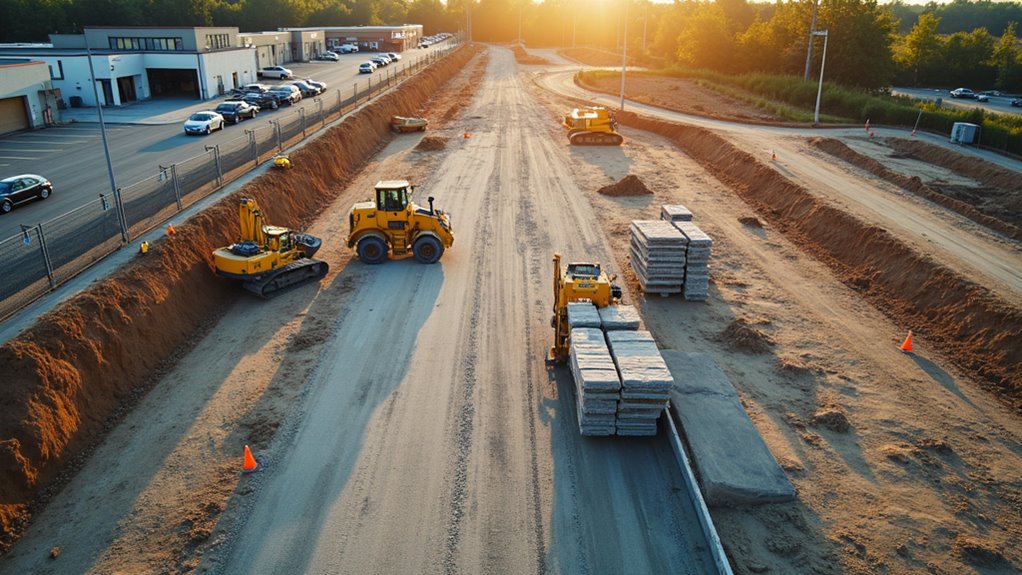
Time-sensitive projects demand careful evaluation of installation speed and curing requirements, where asphalt demonstrates significant advantages over concrete. You’ll complete most asphalt installations within 1-2 days, while concrete requires several additional days. Asphalt’s labor efficiency enables crews to lay 500-800 square feet hourly, substantially exceeding concrete’s 200-400 square feet installation capacity.
| Specification | Asphalt | Concrete |
|---|---|---|
| Installation Time | 1-2 days | Several days longer |
| Traffic Readiness | 24-48 hours | 7 days minimum |
| Strength Achievement | 90% in 1 day | 600 PSI in 3+ days |
Your asphalt surface becomes traffic-ready within 24-48 hours, while concrete demands 7-28 days for complete curing. Steel-wheel rollers compress asphalt to 92-95% density immediately, whereas concrete requires sustained 70% humidity throughout its hydration process. The faster installation process reduces labor downtime by 30% compared to concrete projects. Concrete paver installation involves a more complex process that adds both time and labor intensity to the project timeline. Asphalt can be installed and ready for light traffic within 48–72 hours, making it ideal for commercial projects where reduced downtime is essential.
Lifespan and Structural Durability
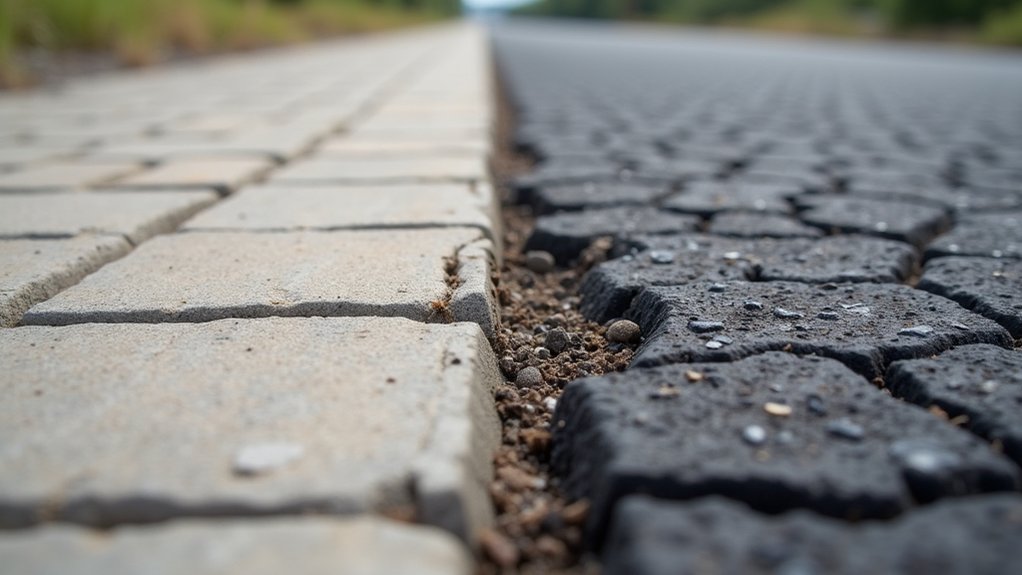
When evaluating long-term performance, concrete delivers 25–50 years of service life compared to asphalt’s 15–30 years under typical conditions. Federal studies confirm concrete interstates last 2.5 times longer than asphalt highways. Michigan DOT data shows concrete averages 27.5 years before major repairs, while asphalt requires intervention at 15.5 years.
Structural durability differs considerably between materials. Concrete’s rigid composition supports heavier loads and demonstrates superior chemical resistance to oils, salts, and UV exposure. Lower material porosity in properly cured concrete prevents moisture infiltration and freeze-thaw damage. Asphalt’s flexible nature accommodates minor soil movements and temperature fluctuations, reducing initial crack formation. However, its higher porosity accelerates weathering. Concrete maintains integrity in high-traffic zones with minimal maintenance, primarily joint sealing and occasional repairs, while asphalt demands sealcoating every 2–3 years to counteract degradation. Concrete’s rigid structure withstands heavy traffic without developing ruts or deformations that commonly plague asphalt surfaces. The durability stems from careful mixture proportioning that combines aggregates, portland cement, water, and supplemental materials in precise ratios to maximize strength and imperviousness. Concrete pavers offer an even more durable solution, with proper care extending their lifespan to 30-40 years or more.
Performance in Different Climate Conditions
Climate conditions fundamentally alter how concrete and asphalt perform throughout their service lives, making material selection contingent on regional weather patterns. In hot climates, concrete resists rutting and maintains rigidity at sustained high temperatures, while asphalt softens and deforms. Concrete’s high albedo reduces surface temperatures by 10–16°F compared to asphalt, mitigating environmental impacts related to urban heat islands and lowering cooling demands. Conversely, cold regions favor asphalt’s flexibility, which adapts to freeze-thaw cycles without cracking. Asphalt absorbs heat, accelerating snow melt and improving safety considerations during winter. Concrete requires expansion joints and cold-weather additives to prevent cracking. Moisture infiltration challenges both materials; asphalt needs regular sealing, while concrete demands joint sealing to prevent spalling when water freezes within slabs. Effective drainage systems are essential for both materials to minimize moisture-related deterioration and extend pavement longevity. Concrete’s high compressive strength enables superior performance under heavy-duty loads in varied climate conditions, reducing the risk of structural failure in high-traffic applications. Asphalt’s flexible surface adjusts to ground shifts more effectively than concrete, making it advantageous in areas experiencing seasonal temperature fluctuations and soil movement.
Maintenance Needs and Repair Complexity
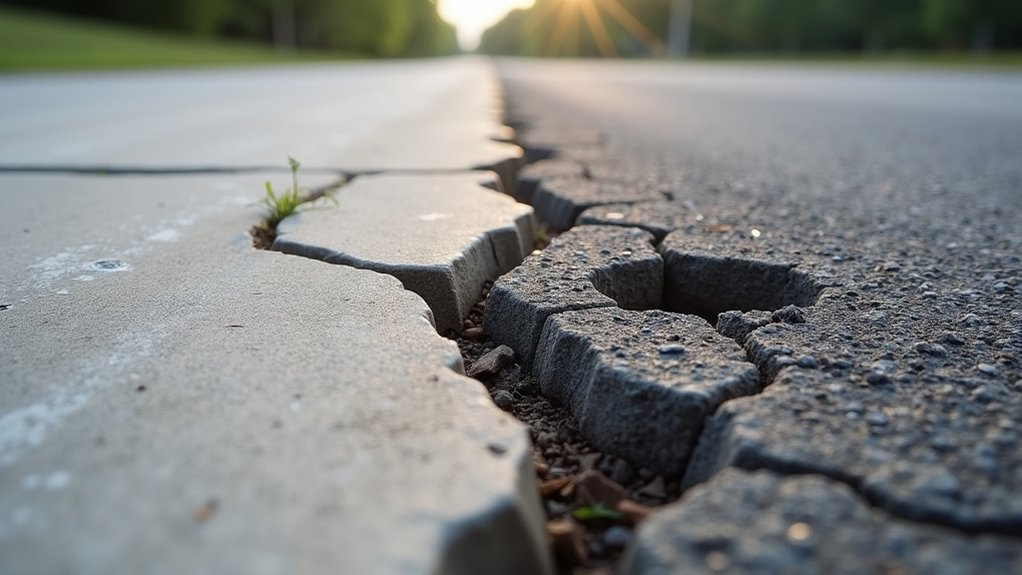
Beyond initial installation decisions, the long-term viability of concrete and asphalt pavements hinges on their distinct maintenance requirements and repair methodologies.
Pavement longevity depends less on installation choices than on understanding each material’s unique maintenance demands and repair approaches.
Asphalt demands sealcoating every 2–5 years and frequent crack repairs, though these interventions remain straightforward and cost-effective per event. Cumulative expenses can offset lower installation costs. Repairs minimize operational disruptions due to quick execution without specialized equipment. Potholes and cracks can be quickly repaired, maintaining surface integrity with minimal downtime. These maintenance strategies protect from oxidation, water infiltration, and general wear and tear.
Concrete requires less frequent maintenance over its 20–40+ year lifespan but involves complex, labor-intensive repairs like slab replacement. Consider these critical factors:
- Repair complexity: Concrete demands epoxy injection or full slab replacement versus simple asphalt patching
- Service interruptions: Concrete curing extends downtime compared to rapid asphalt fixes
- Visual aesthetics: Concrete shows stains prominently; asphalt’s dark surface masks discoloration
Concrete’s superior durability (30–60 years) ultimately reduces lifetime maintenance costs despite higher per-intervention expenses. Asphalt resealing costs average $420 every 3-5 years, contributing to ongoing expense considerations.
Frequently Asked Questions
Can Asphalt or Concrete Be Recycled at the End of Their Lifespan?
You’ll find both materials offer recyclable material composition, but asphalt leads considerably; over 99% of removed asphalt pavement gets recycled annually compared to concrete’s lower rate. Your disposal and repurposing options differ substantially: RAP can be reprocessed into new surface layers through hot or cold methods, saving up to 67% in costs, while recycled concrete typically serves as base aggregate rather than paving surfaces. Asphalt’s superior recyclability translates to 50 million cubic yards of landfill space saved yearly.
Which Material Provides Better Traction and Skid Resistance for Vehicles?
Asphalt provides better traction and skid resistance for your vehicles. Its textured, porous surface delivers superior wet weather performance by channeling water away and reducing hydroplaning risks. You’ll experience shorter braking distances on asphalt compared to concrete’s smoother finish. Industry testing confirms asphalt consistently meets skid resistance standards with less intervention, maintaining ideal friction through regular resurfacing. While you can texture concrete for improved grip, asphalt’s inherent properties and flexible maintenance make it your safer choice across varying conditions.
Does Concrete or Asphalt Paving Offer Superior Noise Reduction Properties?
Asphalt paving offers superior noise reduction, delivering 3-5 dB(A) less noise than concrete at highway speeds. You’ll benefit from asphalt’s sound absorption properties through its porous structure with 18-22% air voids that trap tire-pavement noise. Its vibration dampening characteristics further reduce sound by 1-2 dB with rubber modification. Concrete’s rigid, non-porous surface reflects sound rather than absorbing it, making it consistently louder despite specialized texturing methods like diamond grinding.
What Are the Environmental Impacts of Asphalt Versus Concrete Production?
You’ll find concrete production generates considerably higher greenhouse gas emissions; cement manufacturing alone accounts for ~8% of global CO2. However, asphalt’s petroleum-based bitumen production emits more SO2 and NOx pollutants. Water consumption varies by facility, but concrete mixing requires substantial water volumes. Asphalt’s advantage lies in its 99%+ recycling rate, while concrete’s longer service life reduces replacement frequency. Both materials’ environmental profiles improve through warm-mix technologies, recycled content, and optimized mix designs.
Which Material Is Better for Residential Driveways Versus Commercial Parking Lots?
For your residential driveway, you’ll want concrete, it delivers 30–50 years of long-term durability with minimal maintenance requirements compared to asphalt’s 2–3 year sealing cycle. For commercial parking lots, you’re better off choosing asphalt due to faster installation (2–3 days vs. 10) and lower upfront costs, though you’ll face higher maintenance requirements. Concrete’s superior load-bearing capacity (6,000 psi) makes it viable for heavy commercial traffic if budget allows.