

You’ll need to stay off your newly paved asphalt driveway for 48-72 hours before allowing pedestrian traffic, and wait at least three full days before driving on it. Larger vehicles like trucks require up to seven days of curing time to prevent tire marks and structural damage. While you can resume normal use after this initial period, complete curing takes 6-12 months, during which the asphalt gradually hardens to achieve ideal durability. Understanding the key factors that influence this timeline will help you protect your investment.
Initial Waiting Periods: When Can You Walk and Drive on New Asphalt?
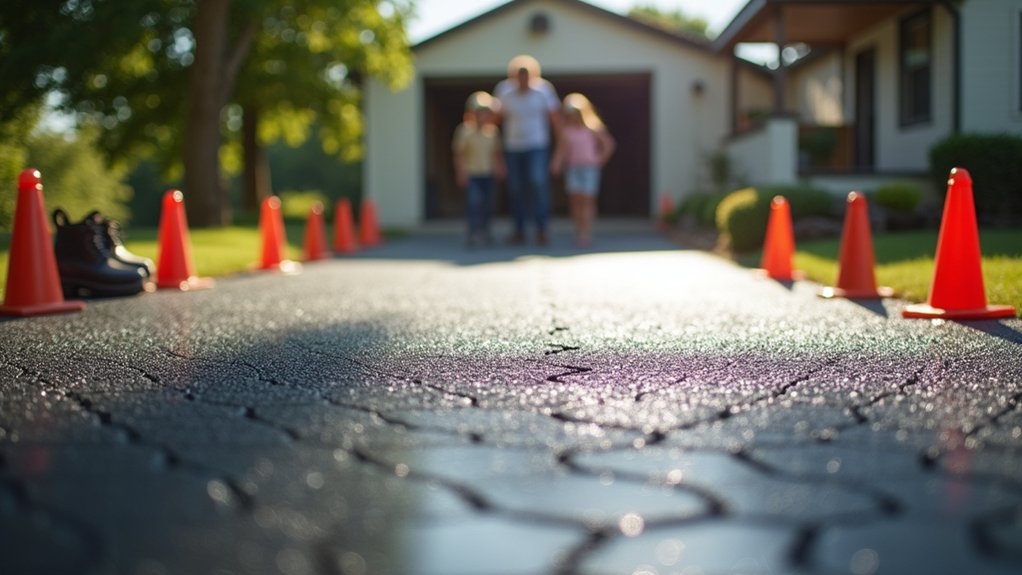
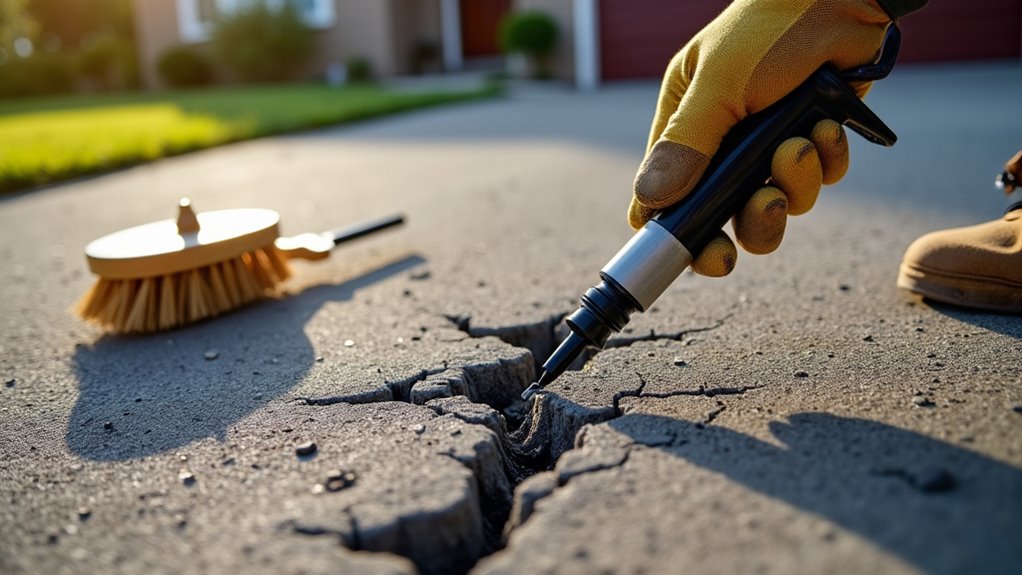
After your contractor completes the paving work, you’ll face an immediate question: when can you safely use your new driveway? The standard waiting period is 48–72 hours for both pedestrian and vehicle traffic. During this time, temporary access restrictions must remain in place to prevent surface damage. Walking prematurely can leave scuffs and minor dents, while early vehicle use risks tire marks and gouges. The surface must cool to ambient temperature before it can support weight properly. Larger vehicles like trucks require additional waiting time, up to 7 days for ideal durability. Implementing monitored maintenance protocols during this initial period protects your investment. Use cones or barriers to enforce restricted access, and instruct household members and visitors accordingly. Avoid washing the surface with a hose during the drying period, as premature water exposure can interfere with the curing process and compromise the asphalt’s structural integrity. Driving on the asphalt too soon can cause uneven surfaces, potholes, and cracking that compromise the pavement’s longevity. While your driveway will be dry enough for use within days, keep in mind that asphalt takes 6-12 months to fully cure and reach its maximum strength. Observing these precautions during drying ensures your driveway achieves maximum longevity and performance. Regular sweeping helps remove debris that could damage the surface.
How Weather Conditions Affect Your Driveway’s Drying Time
Several environmental factors directly control how quickly your new asphalt driveway will cure and become ready for use. Proper temperature monitoring guarantees optimal conditions between 70-80°F, while cold weather below this range compromises structural integrity and extends curing time. Maintaining ideal humidity levels within the 40-70% range supports efficient moisture evaporation; humidity exceeding 90% vastly delays drying and prevents proper sealant adhesion.
You’ll need at least 24-48 hours of rain-free conditions after paving, as precipitation can cause surface stripping and structural weakening. Direct sunlight accelerates curing through consistent heat application, while wind speeds of 3-5 MPH enhance evaporation rates by dispersing moisture-laden air. Sunlight and heat trigger the evaporation of water molecules from the asphalt surface, which is essential for the material to transition from its semi-solid state to a hardened pavement. Wind enhances evaporation and actively shortens the overall drying process by moving saturated air away from the pavement surface. Avoiding direct sunlight during sealcoat application prevents premature drying and cracking of the protective layer. Scheduling your project during spring or fall typically provides the most favorable environmental combination, moderate temperatures, controlled humidity, and stable weather patterns, minimizing drying time and maximizing pavement durability.
Understanding the Complete Curing Timeline: 6-12 Months
While surface conditions determine initial drivability, your asphalt driveway’s complete curing process extends 6-12 months beyond installation, a timeline that fundamentally affects long-term performance and durability. During this period, petroleum-based binders continue evaporating and aggregate materials progressively bond, transforming your pavement from impressionable material into a hardened surface resistant to rutting and cracking.
You’ll notice the asphalt remains slightly soft throughout curing, making it vulnerable to tire marks and permanent depressions from heavy loads. Restrict vehicle parking for two weeks minimum, rotating spots thereafter to distribute stress. Direct sunlight exposure accelerates the curing timeline compared to shaded driveway locations. Don’t apply sealcoating until the 6-12 month mark; premature application traps volatile compounds, compromising structural integrity. Unlike concrete which requires a proper watering schedule, asphalt cures through oxidation and evaporation. The impact of sealcoating after complete curing substantially extends pavement lifespan by protecting the now-hardened surface. Rain stops work on asphalt surfaces and can affect the early curing stages of your driveway. With proper maintenance and regular sealing, your asphalt driveway can provide reliable service for up to 30 years or even longer.
Key Factors That Determine How Long Curing Takes
The timeline for complete asphalt curing isn’t universal; it fluctuates based on five interconnected variables that either accelerate or impede the chemical and physical transformation of your driveway. Ambient temperature dramatically affects curing speed; optimal conditions (50°F–90°F) promote rapid hardening, while cold weather below 50°F considerably prolongs chemical stabilization. Your pavement’s thickness and surface composition variations directly influence cure times; thicker layers require extended periods, and hot-mix formulations cure faster than cold-mix alternatives. Humidity levels control evaporation rates, high moisture delays surface drying, while moderate conditions optimize hardening. Wind speed enhances airflow, accelerating moisture removal. Chemical stabilization techniques, including specialized additives and curing agents, can drastically reduce wait times. Finally, proper sub-base preparation and compaction guarantee uniform curing across your entire driveway surface. The complete curing process for your asphalt driveway continues for up to two years, with the initial six months representing the most critical period for proper stabilization. Rain can delay the curing process by introducing excess moisture that prevents proper surface hardening and chemical bonding. Additionally, foot and vehicle traffic can significantly slow down the curing process by causing pavement shifting and settling before the material has properly hardened.
Protecting Your New Driveway During the Curing Period
Understanding what affects curing speed means nothing if you don’t actively protect your investment during this vulnerable window. Cover the surface with plastic sheeting or curing blankets immediately after finishing to prevent rapid moisture loss. Apply a liquid membrane-forming curing compound once bleed water disappears, these temporary surface treatments lock in critical hydration. Maintain consistent dampness for 3–7 days using sprinklers or wet burlap; avoid letting concrete dry between waterings. Set up windbreaks using plywood to shield against drying winds. Restrict all traffic for 24–48 hours minimum, then permit only light foot traffic. Wait 3–7 days before light vehicles, and 28–30 days for heavy loads. Rushing vehicle use before the concrete achieves maximum strength can lead to permanent surface damage and cracking. Consider applying a cure-n-seal product with 15-18% solids using a sprayer or roller after the final broom finish to effectively combine curing and sealing in one step. San Diego’s moderate climate provides favorable conditions that support consistent concrete curing without extreme temperature fluctuations. Establish a routine maintenance schedule: inspect for cracks immediately, apply penetrating sealer after 21–30 days, and reseal every 2–3 years.
Frequently Asked Questions
Can I Park a Motorcycle or Bicycle on My Newly Paved Driveway?
You shouldn’t park either vehicle on fresh asphalt for at least 72 hours. While bicycles have lower tire pressures and distribute weight better, motorcycles exceed safe motorcycle weight tolerance during initial curing. Kickstands create concentrated pressure points that’ll indent soft pavement regardless of vehicle size. Use plywood pads under kickstands after the minimum wait period, or store your vehicles off-site for 14 days to guarantee ideal surface integrity and prevent permanent divots.
Will Pet Claws Damage the Asphalt During the Curing Period?
Yes, pet sharp claws can damage fresh asphalt during curing, especially in the first 72 hours. Unlike weight concerns from vehicles, claws create concentrated pressure points that scratch and indent soft pavement. You’ll risk permanent micro-cuts and surface deterioration if pets walk on tacky asphalt. Keep animals off for at least 3–7 days, longer in hot weather. The point-loading from claws exceeds typical foot traffic impact, compromising your driveway’s structural integrity before oxidation completes.
How Do I Know When My Driveway Is Fully Cured?
You’ll know your driveway’s fully cured when it’s completely hardened, shifts from black to gray, and emits no asphalt odor, typically after 6–12 months. Monitor curing temperature and curing humidity, as warm, dry conditions accelerate the process while cold, wet weather extends it. Test by pressing the surface; there shouldn’t be any tackiness or indentation. Don’t sealcoat until full cure’s achieved, and consult your paving contractor if you’re uncertain about completion status.
Can I Install Basketball Hoops or Other Fixtures During Curing?
You shouldn’t install fixtures during curing; wait at least 6 months to prevent surface indentations and compromised structural integrity. Anchoring basketball hoops or penetrating the surface disrupts molecular bonding and creates moisture intrusion points. If you’re planting nearby shrubs or securing landscaping items, avoid placing weight on uncured asphalt. Use temporary, moveable equipment only after 72 hours with extreme caution. Premature installations void warranties and cause permanent pavement damage through uneven settling and cracking.
Does Shade From Trees Affect Asphalt Curing Time Differently?
Yes, tree shade effects substantially slow your asphalt’s curing time by reducing heat-driven evaporation of binders. Lower sun exposure levels under canopies decrease pavement surface temperatures by 5°C to 7°C, delaying proper density attainment during initial cure periods. You’ll need to extend your stay-off timeline by 24-48 hours for heavily shaded driveways. While shade ultimately benefits long-term pavement durability, it temporarily prolongs moisture retention and slows the chemical hardening process essential for traffic readiness.