

To measure your driveway accurately before paving, break it into simple shapes, measure the length and width of each one, and multiply to get square feet. Then add the shapes together. A standard two-car driveway is about 20 to 24 feet wide and 20 to 30 feet long, or roughly 400 to 700 square feet. You’ll also want to measure the slope, since a driveway needs at least a 2 percent grade, about 1/4 inch per foot, to drain. With those numbers, you can estimate materials and compare quotes on the same basis.
Key Takeaways
- A 100-foot tape measure, stakes, string, a line level, and marking paint are all you need to measure most driveways.
- Splitting a driveway into rectangles, triangles, and curves makes square footage easy to calculate.
- Standard driveways are 10 to 12 feet wide for one car and 20 to 24 feet wide for two.
- A driveway should slope at least 2 percent for drainage and generally no more than 12 to 15 percent.
- Accurate measurements let you estimate asphalt or gravel and compare contractor quotes fairly.
How Do You Measure Your Driveway Accurately in 7 Steps
You measure your driveway accurately by marking where the new pavement will go, dividing it into shapes, measuring each shape, and checking the slope. These seven steps take about 30 minutes for a typical driveway.
1. Gather Your Tools
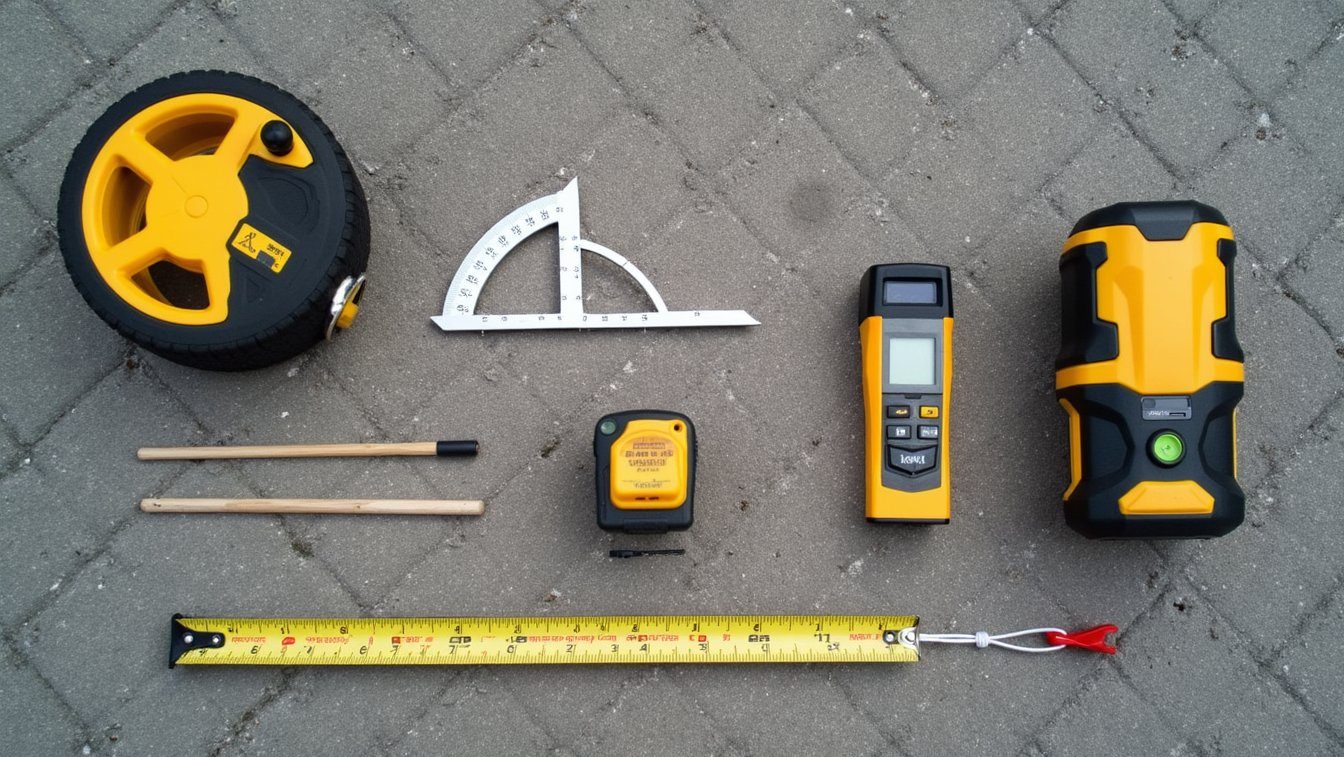
Gather a 100-foot tape measure (a 25-foot tape works for small driveways), four or more wooden stakes, a string line, a line level, marking paint or chalk, a notepad, and a helper. A measuring wheel speeds up long driveways. A phone measuring app is handy for double-checking, but the tape measure should be your main number.
2. Mark the Area You Want Paved
Mark the exact area to be paved with stakes or spray paint, including any widening, turnarounds, or parking pads you’re planning. Include the apron where the driveway meets the street, since it’s usually part of the job. If the apron is damaged, our guide on how to repair a driveway apron explains what’s involved.
3. Divide the Driveway Into Simple Shapes
Divide the driveway into rectangles, triangles, and curves. A straight driveway is one rectangle. A driveway that flares at the street adds two triangles or quarter-circles. An L-shaped driveway is two rectangles. Sketch it on paper and label each shape.
4. Measure the Length and Width of Each Shape
Measure the length and width of each shape in feet, pulling the tape tight and keeping it straight. On a driveway that isn’t quite straight or even, measure the width in three or four places and use the average. Measure everything twice.
5. Calculate the Square Footage
Calculate the area of each shape using the formulas in the table below, then add them together. Round up to the nearest 10 square feet.
6. Measure the Slope and Note Drainage
Measure how much the driveway rises or falls from end to end, using the string-and-level method below. Note where water pools, where downspouts empty, and any low spots. These affect base work and drainage, and both show up in the price.
7. Record Everything and Note Obstacles
Write down every measurement, the total square footage, the slope, and any obstacles such as manholes, trees, retaining walls, steps, or utility boxes. Take photos from both ends. With these notes you can estimate costs using our guide on how much it costs to pave a driveway, and give contractors the same information.
Measuring takes 30 minutes. It’s the best way to make sure every quote you get is pricing the same driveway.
How Do You Calculate Driveway Square Footage
You calculate driveway square footage by multiplying length by width for rectangles and using simple formulas for other shapes, then adding them together. Here are the formulas you’ll need:
| Shape | Formula | Example |
|---|---|---|
| Rectangle | Length × width | 40 ft × 12 ft = 480 sq ft |
| Triangle (flare at the street) | Base × height ÷ 2 | 6 ft × 6 ft ÷ 2 = 18 sq ft |
| Quarter circle (rounded flare) | 0.785 × radius × radius | 0.785 × 5 ft × 5 ft = about 20 sq ft |
| Full circle (turnaround) | 3.14 × radius × radius | 3.14 × 15 ft × 15 ft = about 707 sq ft |
| Curved driveway | Average width × length along the center | 11 ft × 90 ft = 990 sq ft |
For example, a 40-by-12-foot driveway with two rounded 5-foot flares at the street is 480 + 20 + 20 = 520 square feet. For a curved driveway, run the tape measure down the center line to get the length, rather than along one edge.
What Is the Standard Size of a Driveway
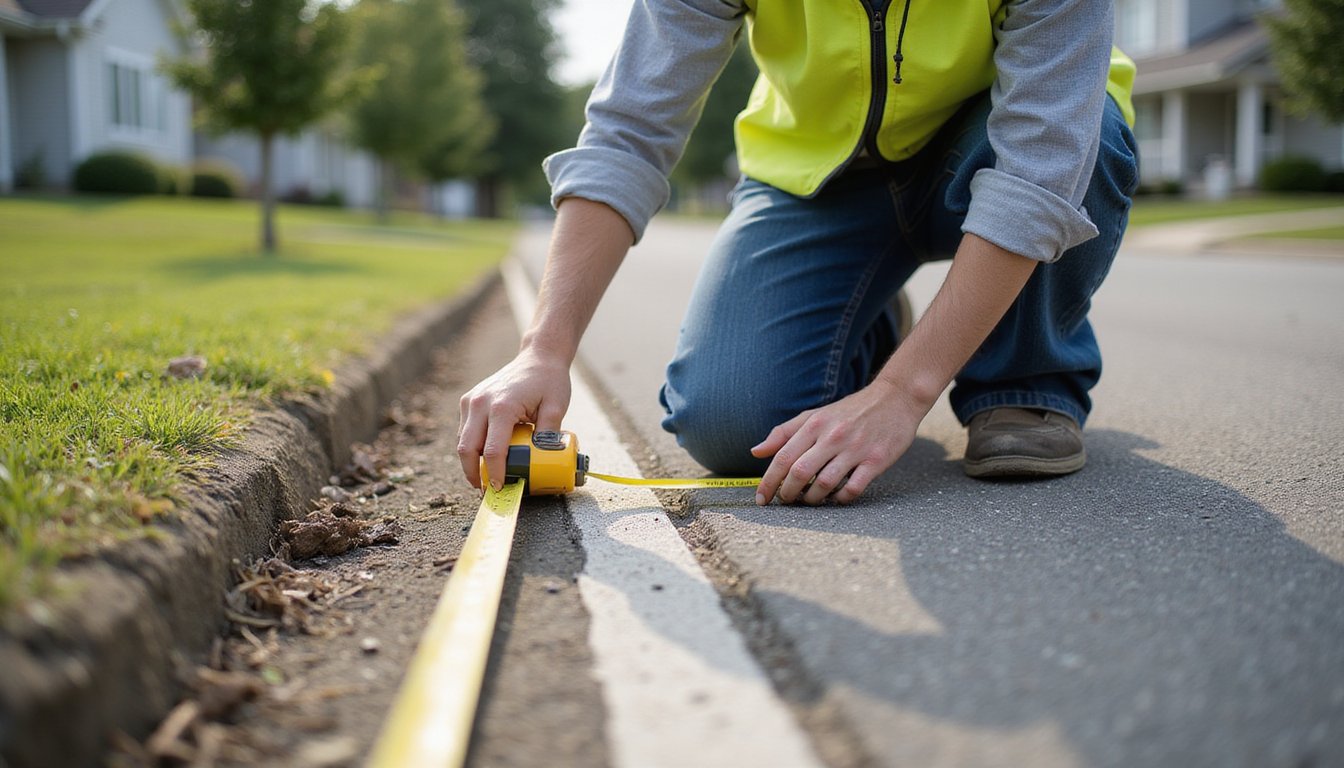
The standard size of a driveway is 10 to 12 feet wide for a single car and 20 to 24 feet wide for two cars, with a length that depends on how far the house sits from the street. Most residential driveways fall between about 200 and 1,000 square feet.
| Driveway Type | Typical Width | Typical Size |
|---|---|---|
| Single car | 10 to 12 ft (9 ft minimum) | 200 to 400 sq ft at 20 to 30 ft long |
| Two car, side by side | 20 to 24 ft | 400 to 700 sq ft at 20 to 30 ft long |
| Three car | 30 to 36 ft | 600 to 1,000 sq ft or more |
| Long single-lane driveway | 10 to 12 ft | Length × width, often 1,000 sq ft or more |
| Turnaround or parking pad | Varies | Add 150 to 400 sq ft |
Wider is easier to use. A two-car driveway at 24 feet leaves room to open doors without stepping onto the lawn, and an extra foot or two on a single-lane driveway keeps tires off the edges.
How Do You Measure Driveway Slope
You measure driveway slope by stretching a level string from the high end to the low end, then measuring how far the string sits above the ground at the low end. That height is the rise, and the string’s length is the run.
- Drive a stake at the top of the driveway and another at the bottom.
- Tie a string to the top stake at ground level and run it to the bottom stake.
- Hang a line level on the string and raise the string on the bottom stake until it reads level.
- Measure from the string down to the ground at the bottom stake. That’s the rise.
- Divide the rise by the horizontal distance between stakes and multiply by 100 to get percent grade.
For example, a 2-foot rise over 40 feet is 2 ÷ 40 × 100 = 5 percent. A driveway needs at least a 2 percent slope, about 1/4 inch per foot, so water runs off. Most should stay under 12 to 15 percent. If yours is steeper, see our guide to the best paving options for steep driveways.
How Much Asphalt or Gravel Does Your Driveway Need
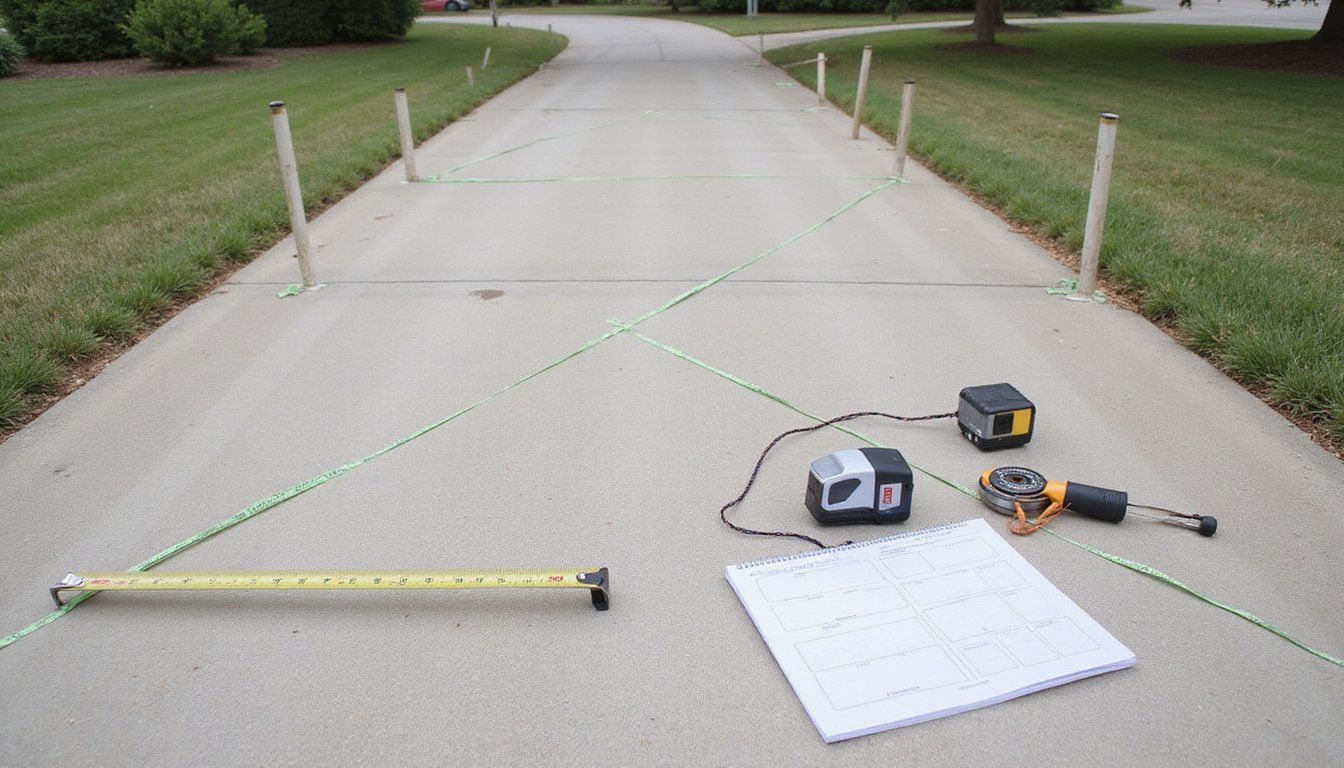
Once you know your square footage, you can estimate materials. Asphalt takes about 0.006 tons per square foot for each inch of compacted thickness. Gravel takes about 1.4 tons per cubic yard.
- Asphalt: Multiply square feet by thickness in inches, then by 0.0062, to get tons. A 600-square-foot driveway at 3 inches thick needs about 11 tons. Our guide on how thick an asphalt driveway should be helps you choose the thickness.
- Gravel: Multiply square feet by depth in feet, divide by 27, then multiply by 1.4 to get tons. Add 10 percent extra. Our gravel driveway cost guide walks through a full example.
- Sealcoat: Divide square feet by the coverage per bucket on the label, and double it for two coats. Our driveway sealcoating cost guide covers pricing.
For resurfacing an existing driveway, see our asphalt overlay cost guide. For pricing new driveways by square foot, see how much it costs to pave a driveway.
What Driveway Measuring Mistakes Should You Avoid
The driveway measuring mistakes to avoid are measuring only one width, forgetting the apron and flares, and ignoring slope and drainage. Each one can throw off an estimate or a material order.
- Measuring one width on a driveway that narrows or widens along its length
- Leaving out the apron, flares, or a walkway connection
- Measuring along a curved edge instead of the center line
- Forgetting areas you plan to add, such as a widening or parking pad
- Skipping the slope, which affects base work, drainage, and price
- Ordering material without extra allowance for compaction and waste
When quotes come in, check that each contractor priced the same square footage. Our list of questions to ask before getting a paving quote helps you compare them.
Get Your Driveway Measured and Quoted
Your own measurements help you budget, but an on-site estimate also accounts for base condition, drainage, and access. V&F Paving can measure your driveway and give you an itemized quote through its driveway paving services. Call (203) 624-2449 or request a free estimate to discuss your driveway size, slope, and paving options.
Frequently Asked Questions
Can You Measure a Driveway With a Phone App?
Phone apps can give a rough measurement. AR measuring apps work for short distances, and satellite map tools can estimate the area of a whole driveway from above. Both can be off by a few feet, especially on long or curved driveways or under trees. Use an app as a quick check, but measure with a tape for anything you’ll use to order material or compare quotes.
How Wide Should a Driveway Be for Two Cars?
A two-car driveway should be at least 20 feet wide, and 22 to 24 feet is more comfortable. That leaves room to open car doors and walk between vehicles without stepping onto the lawn. If your driveway also serves as a walkway to the front door, or you park larger trucks or SUVs, go toward 24 feet.
Does the Driveway Apron Count in the Square Footage?
Yes, include the apron if it’s being paved. The apron is the section between the street and the sidewalk or property line, and it’s often part of a driveway job. Some towns have specific rules for aprons in the public right of way, so note it separately in case it needs a permit or a different material.
Do Paving Contractors Measure the Driveway Themselves?
Yes. Contractors measure the driveway during the estimate visit and check base condition, drainage, and access at the same time. Measuring it yourself first helps you budget, catch quotes that don’t match your numbers, and compare contractors fairly. At V&F Paving, measuring is part of every free estimate.
How Do You Measure a Driveway That’s Being Widened?
Measure the existing driveway and the new section separately. Mark the new edge with stakes and string, measure its length and width, and add it to the total. The new section needs a full base built from scratch, so contractors often price it differently from repaving the existing area. A widening may also need a town permit if it changes the curb cut.