




You’ll follow the same core steps on a driveway or a parking lot: assess crack movement, clean and dry each crack, then fill or seal. Commercial jobs change the scale. They cover more linear footage and often need traffic planning, melters, routers, and hot-applied rubberized sealants meeting ASTM D6690. Yet they often cost less per foot, about $0.90 to $1.50 without routing, versus $2 to $5 on small driveways. Below, you’ll see how equipment, materials, and downtime stack up.
Key Takeaways
- Commercial crack filling covers more linear footage and requires stricter material specifications and traffic planning than residential driveway work.
- Both job types assess crack movement first, then clean and dry cracks with compressed air before applying climate-appropriate material.
- Commercial lots typically need melters for hot-applied rubberized sealants, while driveways may use compressed air, wire brushes, and smaller applicators.
- Heavy commercial traffic calls for flexible rubberized sealants meeting ASTM D6690, while lighter-load driveways may use less-elastic fillers for non-working cracks.
- Commercial work often costs $0.90 to $3.00 per foot, while fixed costs on small driveway jobs can push effective rates to $2 to $5 per foot.
What changes between residential and commercial asphalt crack filling

Commercial asphalt crack filling on parking lots and access roads usually involves more linear footage, more traffic planning, stricter material specifications, and different pricing than residential driveway work, though the goal of sealing out water before cracks widen stays the same. Crack density and layout, not area alone, drive your workload. You’ll also plan around traffic volume, truck percentage, parked vehicles, and business hours. Specifications often call for a hot-applied commercial asphalt crack filler, commonly referencing ASTM D6690. For working cracks, you’ll choose flexible asphalt crack sealing, often with routing. For non-working cracks, simpler asphalt crack filling may work. Pricing shifts too: small residential jobs can cost more per foot because minimum charges dominate. Ask whether quotes include routing, cleaning, mobilization, and traffic management before you compare them.
How do the two jobs compare on scale and method
Residential jobs cover less linear footage than commercial jobs, but both follow the same method: assess crack movement, then rout and seal or fill accordingly. A residential driveway gives you limited linear footage, so mobilization and minimum charges can raise your effective cost per foot. Commercial lots and access roads usually add more footage, but crack density and site layout drive your actual workload.
| Factor | Residential | Commercial |
|---|---|---|
| Typical area | Driveways, small paved areas | Parking lots, access roads |
| Common material | Fillers or hot-applied sealant | Hot-applied sealant, often ASTM D6690 |
| Site planning | Minimal access limits | Traffic, trucks, work zones |
On either job, you always assess crack movement first. Rout and seal working cracks with flexible rubberized sealant. Fill non-working cracks with less-elastic material. Clean and dry every crack with compressed air before application, and match material to your climate.
How does the equipment differ
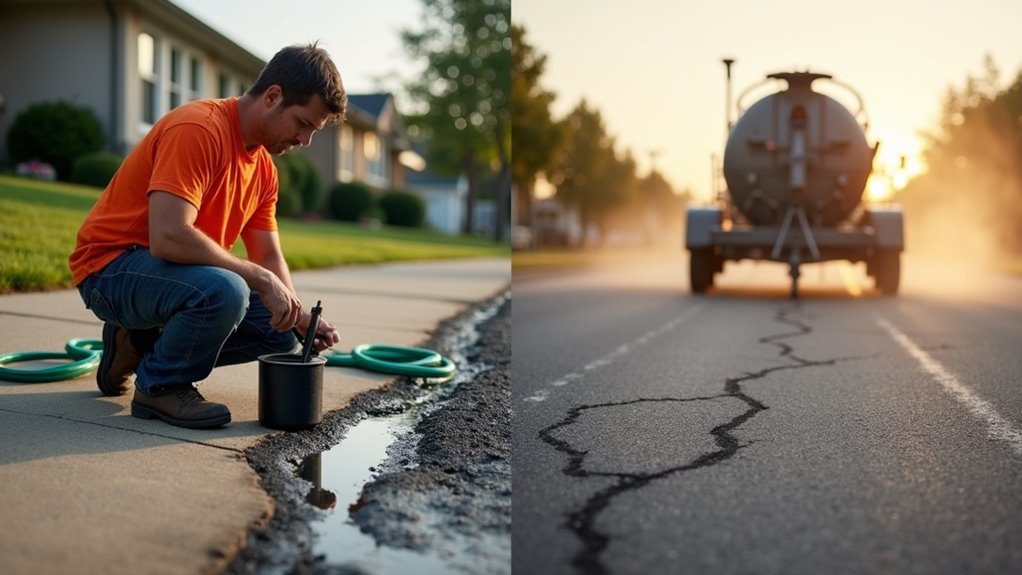
Equipment differs by job scale, material, and traffic, even though the core steps stay the same. You still clean, dry, and place material in every crack. On a driveway, you can often rely on compressed air, a wire brush, and a smaller applicator for filler or sealant. Commercial lots usually require hot-applied rubberized sealants, so you’ll need a melter that heats and places product at its specified temperature. If cracks are working, you’ll add a router to cut reservoirs, plus extra cleanup afterward. Heat lances help dry cracks and clear dust, but you must use them carefully to avoid damaging pavement. Larger sites demand coordinated crews, cones, and work zones that keep active areas separated from traffic.
How do the materials differ for heavy traffic
Heavy traffic calls for hot-applied rubberized sealants, which flex with crack movement and hold up under repeated stress from trucks and steady loads. These sealants are common on commercial lots and access roads. They’re built to expand and contract with working cracks, and many commercial specifications reference ASTM D6690 types.
Residential driveways see lighter loads, so you can often use asphalt emulsion or other less-elastic fillers for non-working cracks. FHWA notes that some asphalt-based materials have limited flexibility, so they aren’t ideal where cracks move under heavy traffic.
Whatever the setting, choose a product with strong adhesion and flow resistance. It should resist softening in summer heat and stay flexible in winter cold. Check traffic volume and truck percentage before you finalize your material.
How does cost and downtime compare
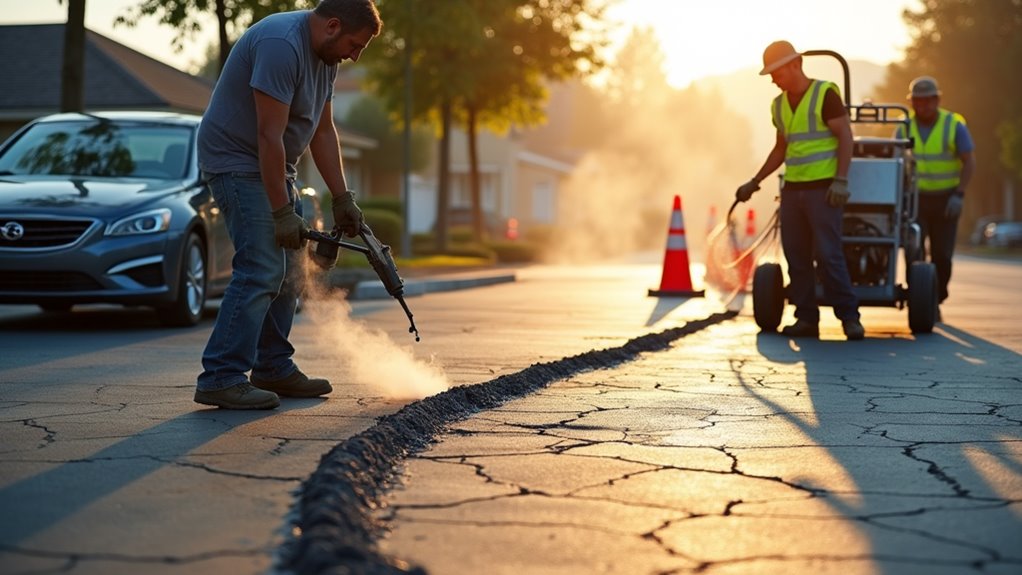
Commercial jobs often cost less per foot than residential work despite covering far more linear footage, and downtime for both depends on the product’s cure or set time and site conditions, not job size. Mobilization and minimum charges spread across thousands of feet, so you’ll typically see roughly $0.90, $1.50 per linear foot without routing and $1.50 to $3.00 with routing. On a small driveway, those fixed costs can push your effective rate to $2 to $5 per foot.
When you compare quotes, confirm whether they include routing, cleaning, mobilization, and traffic management.
You can usually block off a driveway briefly, but a commercial lot needs phased work zones that keep traffic, parked vehicles, and customer access moving. Reopen each area only when the product instructions and project requirements allow it.
Why do commercial lots need a different approach
Commercial lots need a different approach because they carry heavier, more frequent traffic, including delivery trucks, so you’ll need to factor traffic volume, truck percentage, and pavement classification into your treatment plan. Phased work zones are only part of the difference. Assess each crack’s movement first. Working cracks usually call for routing and a flexible hot-applied rubberized sealant rather than a less-elastic filler. Many commercial specifications reference ASTM D6690 types, so check yours before you order material. Your crack density and site layout, not just square footage, drive the workload. You’ll also schedule around parked vehicles, business hours, and customer access while keeping active areas separated from traffic. Finally, confirm that your estimate states whether routing, cleaning, mobilization, and traffic management are included, so you can compare competing bids accurately.
What should guide your choice of crack filling service
Your pavement’s conditions, not the service label, should guide your choice of crack filling service. Examine crack type, width, density, and movement. If cracks expand and contract with temperature, you’ll need flexible hot-applied sealant, often with routing to create a reservoir. Non-working cracks may only need less-elastic filling. Match materials to your climate so they resist softening in heat and stay flexible in cold.
Your site’s demands also matter. Heavy truck traffic, business hours, and customer access affect material choice, scheduling, and work zones. Ask contractors to separate crack filling from crack sealing in their quotes and state whether routing, cleaning, mobilization, and traffic management are included. Confirm they’ll work on clean, dry pavement at 40°F and rising, and reopen traffic only per product instructions.
Match Crack Repair to the Property
A home driveway and a high-traffic commercial lot do not face the same wear, traffic loads, or maintenance demands. V&F Paving provides commercial crack filling and parking lot repair along with residential driveway maintenance throughout Connecticut. Call (203) 624-2449 or contact the team to schedule the right service for your property.
Frequently Asked Questions
Can Homeowners Safely Fill Driveway Cracks Themselves Instead of Hiring Professionals?
Yes, you can usually fill small, non-working driveway cracks yourself. Clean debris with compressed air, make sure the crack’s dry, and work when it’s at least 40°F and rising. Use cold-applied asphalt emulsion filler, and follow the product’s cure time before driving on it. If cracks expand and contract, you’ll get better results from a pro who routes them and applies hot rubberized sealant. Avoid heat lances; they can damage pavement.
How Often Should Asphalt Cracks Be Inspected After Filling or Sealing?
You should inspect treated cracks at least once a year, and checking in spring and fall works well because those are also favorable sealing windows. Look for adhesion loss, sealant pulling away from crack edges, softening or tracking in heat, and brittleness in cold. You’ll want closer checks on commercial lots with heavy truck traffic. If you used less-flexible filler on working cracks, expect earlier failure and plan prompt resealing.
Can Crack Filling Be Done in Winter or During Rainy Seasons?
Yes, but only under the right conditions. You can fill non-working cracks in winter if your product and project specification allow it, but you shouldn’t work on wet pavement. FHWA recommends dry pavement and air temperatures of at least 4°C (about 40°F) and rising. During rainy seasons, wait for dry windows, blow cracks clean with compressed air, and use a heat lance carefully to dry them without damaging the asphalt.
When Are Cracks Too Severe for Filling and Require Pavement Replacement?
You’ve likely moved past filling when cracks are dense, interconnected, or show structural failure, such as alligator patterns, potholes, rutting, or crumbling edges. Sealing works best on isolated cracks with sound pavement around them. Before you choose a treatment, assess crack type, width, density, and severity. If cracking reflects base or subgrade problems, you’ll need patching, overlay, or replacement. On commercial lots, heavy truck traffic can accelerate that replacement decision.
Does Crack Sealing Affect Future Sealcoating or Line Striping Schedules?
Yes, it does. You’ll typically seal cracks first, then sealcoat and stripe, so crack work sets the start of your schedule. Cure or set time depends on the product and conditions, so follow the manufacturer’s instructions before you apply coatings or paint. On commercial lots, you’ll also coordinate traffic, parked vehicles, and customer access, so bundling all three tasks into one closure can reduce disruption and repeated equipment mobilization costs.