
You’ll choose resurfacing when your asphalt shows surface-level deterioration but maintains a stable, well-compacted subbase without moisture intrusion. This cost-effective rehabilitation option runs $1-$3 per square foot and extends pavement life by 10-15 years. However, you’ll need full replacement when structural deficiencies like alligator cracking, base failure, or recurring potholes compromise the foundation. Understanding the key indicators that distinguish surface damage from structural compromise will help you make the most cost-effective decision.
Resurface or Replace? How to Decide
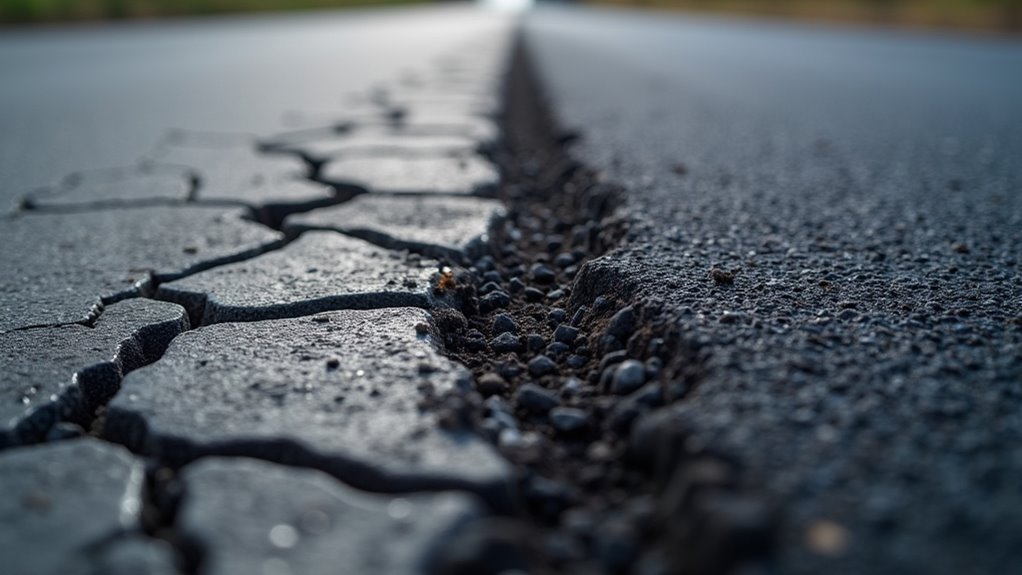
When your asphalt shows signs of deterioration, you’ll face a critical decision that impacts both your budget and pavement longevity. Your pavement investment decision hinges on accurate damage assessment and structural evaluation.
Choosing between resurfacing and replacement comes down to one thing: the condition of your pavement’s foundation.
Start by inspecting your existing base for stability. If you’re dealing with minor surface cracks and cosmetic wear, resurfacing offers a cost-effective solution. However, deep cracks, extensive potholes, or recurring repairs signal base failure requiring full replacement.
Consider your pavement rehabilitation comparison carefully. Resurfacing adds 8-15 years when the foundation remains sound. Pavement reconstruction methods deliver 20-30 years through complete base rebuilding. Additionally, applying sealant every 2-3 years helps protect your investment against weather damage and extends overall pavement life.
Evaluate drainage issues and load requirements. Severe weather damage or subgrade problems won’t resolve through overlay alone. A professional assessment guarantees you’ll select the suitable rehabilitation strategy for your specific conditions.
How Pavement Age Affects Your Choice
Your pavement’s age serves as a primary indicator for determining whether resurfacing or replacement makes structural and financial sense. When asphalt remains under 20 years old and maintains sound base integrity, resurfacing typically provides cost-effective life extension of 10 to 15 additional years. Once pavement exceeds two decades, accumulated deterioration often compromises the sub-base, making full replacement the more economical long-term investment. Additionally, high-traffic areas experience accelerated wear and tear, which may shorten this timeline and require replacement sooner than pavement age alone would suggest.
Resurfacing Under 20 Years
How do you determine whether your asphalt pavement qualifies for resurfacing rather than full replacement? When your pavement’s under 20 years old, you’ll typically find resurfacing delivers ideal cost-effectiveness compared to complete reconstruction.
Your structural condition serves as the primary decision factor. If less than 25-30% of your surface requires repairs and your foundation remains sound, resurfacing presents the logical choice. Minor surface wear without deep structural compromise makes overlay installation viable.
You can expect significant lifespan extension—typically 10-15 additional years—when you resurface pavement with an intact sub-base. This approach requires less labor, fewer materials, and minimizes operational downtime for commercial properties. The resurfacing process involves cleaning, tack coat application, new asphalt laying, and compaction to ensure proper adhesion and durability.
Budget constraints often favor resurfacing for younger pavements. You’ll preserve capital while achieving improved aesthetics, enhanced safety, and extended service life through proper maintenance protocols like sealcoating.
Replacement After Two Decades
After two decades of service, asphalt pavement typically reaches its design life threshold and demands a different maintenance calculus. You’ll encounter structural base degradation that resurfacing can’t address effectively. Full-depth pavement replacement becomes your ideal solution when asphalt deterioration phases progress beyond surface-level distress. After two decades of service, asphalt pavement typically reaches its design life threshold and demands a different maintenance calculus. At this stage, a thorough asphalt evaluation will often reveal structural base degradation that resurfacing can’t address effectively. Full-depth pavement replacement becomes your ideal solution when asphalt deterioration phases progress beyond surface-level distress.
| Indicator | Recommended Action |
|---|---|
| Base layer failure | Full reconstruction |
| Extensive alligator cracking | Remove and rebuild |
| Deep rutting patterns | Sub-base replacement |
| Multiple failed repairs | Complete removal |
| Compromised drainage | Full-depth restoration |
Your pavement lifecycle planning should account for cumulative traffic stress and material oxidation that accelerate post-20-year decline. Heavy commercial loads compound age-related wear, making overlay applications ineffective. Recycled asphalt pavement integration during replacement reduces costs while maintaining structural integrity for your next service cycle.
Asphalt Resurfacing vs. Replacement: Cost Breakdown
Budget constraints often drive the resurfacing versus replacement decision, making accurate cost analysis essential before committing to either approach. When conducting a resurfacing cost comparison, you’ll find overlay projects range from $1 to $3 per square foot in the US, while UK tarmac resurfacing runs £20–£35 per m².
Your replacement cost analysis reveals substantially higher upfront investment—$4 to $15+ per square foot domestically, or £45–£70 per m² for UK tarmac replacement. A typical 30m² driveway costs £600–£1,500 for resurfacing versus £1,350–£3,600+ for full replacement.
However, the asphalt resurfacing vs replacement equation shifts when you factor lifespan. Replacement delivers 15–20+ years of service compared to resurfacing’s 5–15 years, often proving more cost-effective per year of pavement life.
How Long Does Each Option Actually Last?
When evaluating pavement longevity, you’ll find substantial performance gaps between resurfacing and full replacement that directly impact your maintenance planning cycle.
A properly installed asphalt overlay system delivers 8-15 years of service life, with ideal conditions extending overlay longevity to 15 years. Your resurfacing lifespan depends heavily on the existing base’s structural integrity and traffic volumes.
Full replacement outperforms overlays considerably, delivering 15-25 years for commercial applications and potentially 20-30 years for residential installations with proper maintenance protocols.
- Overlay approach: You’ll achieve 10-15 years before repeat intervention becomes necessary
- Complete reconstruction: Expect 15-25 years of structural performance under normal traffic conditions
- Maintenance-enhanced replacement: Proactive sealcoating and crack filling push lifespans beyond 25 years
Signs Your Asphalt Only Needs Resurfacing
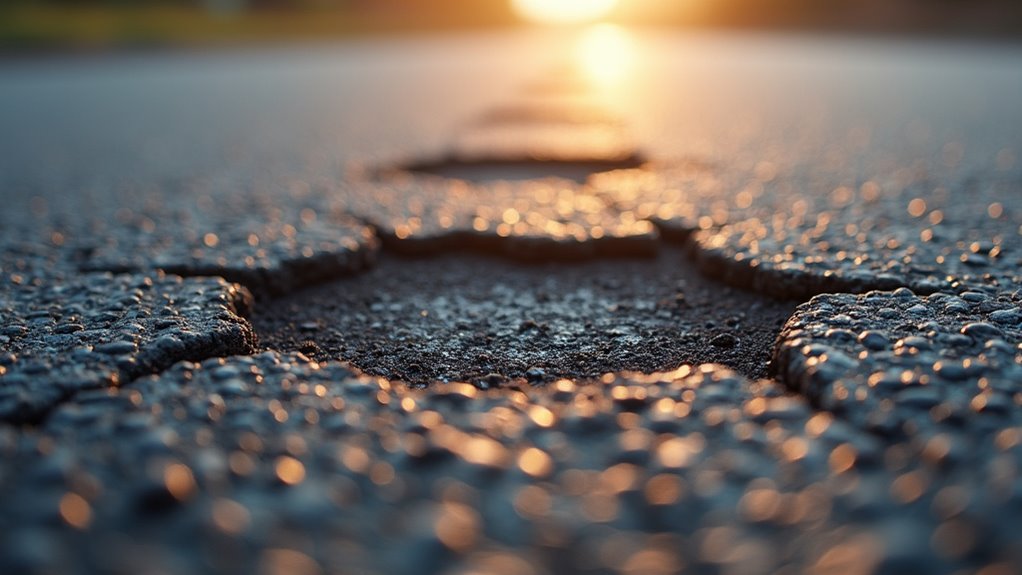
Your asphalt likely qualifies for resurfacing when damage remains confined to surface-level cracking without penetrating the structural base layer. If core samples reveal a stable, well-compacted subbase with no evidence of moisture intrusion or material degradation, an overlay can restore performance at a fraction of replacement cost. Pavements under twenty years old with intact foundations typically respond well to resurfacing, extending service life by another decade or more.
Surface Cracks Only
Surface cracks serve as the earliest diagnostic indicators that your pavement requires intervention before structural compromise occurs. When you notice hairline fractures confined to the wearing course, you’re dealing with cosmetic damage that responds well to resurfacing techniques. These cracks haven’t penetrated your base layer, meaning the foundational integrity remains intact.
Your repair strategy depends on crack severity:
- Hairline cracks under half-inch: Apply crack sealing to prevent water infiltration and freeze-thaw expansion
- Moderate surface deterioration: Sealcoating restores protective oils and blocks UV oxidation damage
- Widespread shallow cracking: The mill and overlay process removes damaged material and installs fresh asphalt
Acting promptly on surface-only damage prevents costly full-depth reconstruction. If cracks remain isolated to the top layer without alligator patterns, resurfacing delivers cost-effective restoration.
Stable Base Condition
Beyond surface-level cracking, base layer stability determines whether resurfacing will succeed or fail prematurely. Your sub-base evaluation should confirm the absence of sinking, soft spots, or lateral movement beneath the existing surface. When you walk or drive across the pavement, it should feel firm and unyielding without noticeable dips or depressions.
Pavement structural integrity depends on a stable foundation that won’t shift under new overlay materials. You’ll want to verify that water drains efficiently without pooling, as proper drainage prevents moisture from weakening the subgrade over time. Check for shallow, limited potholes rather than deep penetrations that indicate base compromise.
Base layer stability supports long-term resurfacing success. If your crushed aggregate base remains intact with good lateral support, you’re positioned for overlay application rather than costly full-depth replacement.
Pavement Under Twenty Years
Pavement age serves as a primary indicator when distinguishing between resurfacing candidates and replacement projects. When your asphalt hasn’t reached the twenty-year threshold, you’re likely dealing with a prime resurfacing candidate. Understanding asphalt durability expectations helps you make cost-effective decisions—driveways typically last 20-25 years with proper maintenance, while parking lots endure 15-25 years depending on traffic volume.
Your driveway resurfacing vs rebuild decision becomes straightforward when evaluating these conditions:
- Surface shows only minimal cracking without alligator patterns indicating base failure
- No rutting or deformation appears in wheel paths from traffic loads
- Oxidation remains mild with manageable color fading rather than structural degradation
A parking lot resurfacing comparison reveals that overlays extend functional life 10-15 years when applied to structurally sound surfaces under twenty years old.
When Full Replacement Is Your Only Option
When structural deficiencies extend below the wearing surface, resurfacing won’t restore pavement integrity—you’ll need full replacement.
A structural pavement evaluation reveals conditions that demand complete reconstruction. Large potholes covering significant areas, deep alligator cracking, and recurring repairs that won’t hold indicate your pavement has reached end of service life. These symptoms signal base failure that overlay applications can’t address.
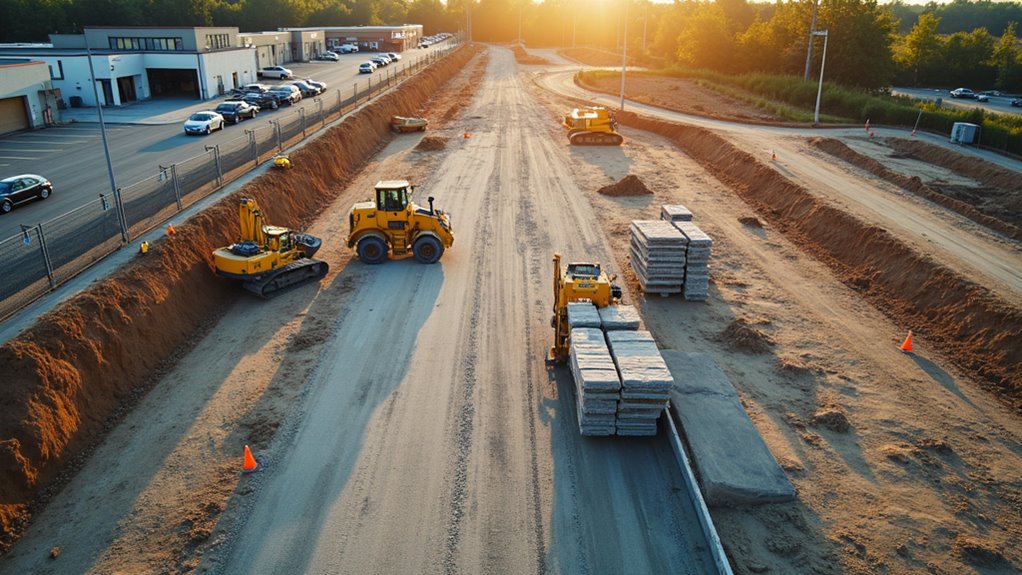
Pavement foundation instability requires the full pavement tear-out process. Contractors demolish existing asphalt and compromised base materials using milling equipment or excavators. They’ll assess subgrade soil conditions, replace unsuitable materials with new gravel, and proof roll to verify stability under load.
The reconstruction sequence includes installing compacted gravel base, applying binder course, and finishing with surface asphalt—creating a completely renewed pavement structure.
What Happens During Asphalt Resurfacing?
The resurfacing process follows a systematic sequence that restores pavement functionality without full-depth reconstruction. You’ll first need a detailed inspection to assess damage extent and confirm your existing base remains structurally sound. Once verified, crews clean the surface thoroughly and allow 24 hours for complete drying.
Resurfacing restores pavement performance through systematic inspection, surface preparation, and proper drying—without costly full-depth reconstruction.
- Milling machines grind the damaged top layer, creating a uniform bonding surface while maintaining proper drainage grades.
- Tack coat application seals the bond between old and new layers, preventing separation and moisture intrusion.
- Hot mix asphalt installation meets asphalt thickness standards of 1.5-2 inches, followed by heavy roller compaction.
Your resurfacing benefits analysis should confirm adequate pavement load-bearing capacity before proceeding. This approach delivers renewed performance without the expense of full reconstruction.
What Happens During Full Asphalt Replacement?
When your asphalt has deteriorated beyond surface-level damage, full replacement becomes the only viable solution for restoring structural integrity. You’ll need to complete three critical phases: removing all existing pavement down to the sub-base, inspecting and rebuilding the foundation layers, and installing new binder and surface courses. This thorough approach addresses failures that resurfacing can’t correct, giving you a pavement system rebuilt from the ground up.
Complete Pavement Removal Process
Full asphalt replacement begins with systematic demolition of the existing pavement structure down to the sub-base level. During demolition and removal, heavy milling machines grind deteriorated asphalt for recycling while excavators clear debris. You’ll need professional equipment—this isn’t DIY territory.
Once cleared, grading and sloping establishes proper drainage contours using laser transits and automatic graders. This prevents water pooling that compromises structural integrity. Sub-base installation follows, where crews compact crushed aggregate to create a stable foundation that resists shifting and frost heave.
- Milling machines pulverize old pavement into recyclable material
- Laser-guided graders establish precise drainage slopes
- Compacted crushed stone forms a frost-resistant foundation
You’re fundamentally rebuilding from the ground up, ensuring every layer meets load-bearing specifications before proceeding to binder and surface course application.
Foundation Inspection and Rebuilding
After clearing deteriorated pavement down to the sub-base, foundation inspection determines whether existing materials can support new asphalt or require complete rebuilding. You’ll need subgrade evaluation to identify soil composition issues that could transfer movement to your new pavement, causing premature potholes and cracking.
Contractors assess foundation stability through core sampling and density testing, checking for weak underlying layers that compromise structural integrity. Geotechnical analysis reveals whether soil properties can handle anticipated traffic loads.
When rebuilding becomes necessary, base preparation involves compacting soil and adding crushed stone for structural support. Excavation typically reaches 8-12 inches to accommodate proper base and asphalt thickness. You’ll want utility lines located before foundation work begins to prevent costly damage. This comprehensive approach guarantees your replacement pavement delivers maximum lifespan performance.
New Asphalt Layer Installation
New asphalt layer installation follows a systematic sequence that transforms your prepared foundation into finished pavement. After completing the milling process to establish proper elevation and surface texture, contractors apply a tack coat application to create essential bonding between layers. This liquid asphalt emulsion prevents delamination and safeguards structural continuity.
During new asphalt laying, crews spread hot mix asphalt evenly across the prepared surface using specialized paving equipment. Heavy rollers compact the material, eliminating air voids that compromise durability.
- Hot mix asphalt spread at temperatures between 275-300°F for ideal workability
- Steel drum rollers applying multi-ton pressure to achieve target density
- Fresh black surface shifting from malleable material to hardened pavement
You’ll need to restrict traffic during initial curing to protect your investment’s integrity.
Hidden Costs That Could Flip Your Decision
Upfront price tags rarely tell the full story when comparing resurfacing to replacement. You’ll spend $1 to $3 per square foot on overlays versus $4 to $15 for full reconstruction, but your pavement structural rating determines actual long-term expenses.
When you resurface over compromised bases, you’re masking foundational defects that accelerate failure. Repeated crack filling and patching—ranging from $100 to $1,000 per repair—accumulate quickly when underlying problems persist. Your pavement asset management strategy must account for these compounding costs.
Consider pavement rebuild considerations beyond materials: extended downtime disrupts business operations, safeguard expenses reach thousands during projects, and disposal fees add labor expenses. If cumulative repairs approach replacement thresholds, you’ve reached the financial tipping point where reconstruction delivers superior lifecycle value.
Quick Checklist: Resurface or Replace Your Asphalt?
Making the right call between resurfacing and replacement requires a systematic evaluation of your pavement’s current state. Apply these pavement engineering principles to determine your ideal path forward.
Resurfacing Suitability Criteria:
- Your asphalt is under 20 years old with a structurally sound base
- Damage remains surface-level without deep cracks or widespread potholes
- No evidence of foundation erosion or drainage system failure
When weighing surface renewal vs reconstruction, consider your timeline and budget constraints. Resurfacing delivers 8-15 years of extended life at lower upfront costs. However, if you’re experiencing recurring repairs that won’t hold, you’re likely facing foundational issues that overlay applications can’t resolve.
Complete replacement addresses subgrade deficiencies and provides 20-30 years of structural performance. Choose reconstruction when underlying damage compromises long-term pavement integrity.
Frequently Asked Questions
Can Resurfacing Be Done Over Concrete or Only Existing Asphalt Surfaces?
You can resurface over concrete, not just existing asphalt. You’ll need to properly prepare the concrete surface by cleaning it, repairing cracks and defects, and applying a tack coat for adhesion. Milling creates a uniform base that strengthens the bond. For residential applications, you’ll want 1.5-2 inches of asphalt thickness. This approach works best when your concrete shows limited vertical movement and maintains structural integrity underneath.
Does Resurfacing Affect Existing Drainage Systems or Parking Lot Slopes?
Resurfacing shouldn’t affect your existing drainage systems or parking lot slopes when properly carried out. You’ll maintain the original 1-2% grade that directs surface runoff toward catch basins and drainage points. Since you’re applying a thin overlay, you won’t disturb subsurface pipes or permeable base materials. However, poor execution can cause temporary pooling if slopes aren’t matched precisely. Guarantee your contractor clears drains pre-resurfacing and maintains proper grading to preserve drainage integrity.
What Weather Conditions Are Required for Successful Asphalt Resurfacing or Replacement?
You need air temperatures between 50°F and 90°F, with the asphalt mixture maintaining at least 175°F during placement. Ground temperatures should reach 60°F minimum and be rising. You’ll want humidity below 85% and a dry forecast—no precipitation for 48 hours post-installation guarantees proper curing and bonding. Summer offers ideal conditions with consistent warmth and extended daylight, while winter’s sub-50°F temperatures make resurfacing or replacement operations impractical.
How Soon Can Vehicles Drive on Newly Resurfaced or Replaced Asphalt?
You should wait 48-72 hours before driving passenger vehicles on newly resurfaced asphalt. Light foot traffic is acceptable after 24 hours of curing. Heavy trucks and equipment require 14+ days before surface contact to prevent permanent deformations. Avoid parking in the same spot for 7-10 days to eliminate indentation risk. Full curing takes 6-12 months, so you’ll want to maintain controlled speeds during initial traffic application.
Will Resurfacing Change the Height of My Pavement Relative to Curbs?
Yes, resurfacing adds 2-3 inches of asphalt overlay, raising your pavement above its original elevation. This creates height differentials at curb conversions, reduces effective curb height, and causes recessed utility covers. You’ll also face ADA compliance issues at curb ramps. However, edge milling eliminates these problems by grinding the pavement edges before overlay application. This process restores original elevations, maintains proper drainage flow, and guarantees smooth transitions at curbs and gutters.