

Hot mix asphalt (HMA) is what you’ll find beneath most highways and parking lots—a blend of aggregates (92-97% by weight) bound together with heated asphalt cement. You’re working with material manufactured at 300-350°F, which guarantees proper coating and workability during placement. HMA serves as the industry standard for permanent paving because it’s 100% recyclable and delivers proven durability. The sections below cover the critical specifications that determine successful application. Hot mix asphalt (HMA) is what you’ll find beneath most highways and parking lots—a blend of aggregates (92–97% by weight) bound together with heated asphalt cement. When comparing cold mix asphalt vs hot mix asphalt, HMA stands out for its superior coating, density, and long-term performance. You’re working with material manufactured at 300–350°F, which guarantees proper coating and workability during placement. HMA serves as the industry standard for permanent paving because it’s 100% recyclable and delivers proven durability. The sections below cover the critical specifications that determine successful application.
What Is Hot Mix Asphalt?
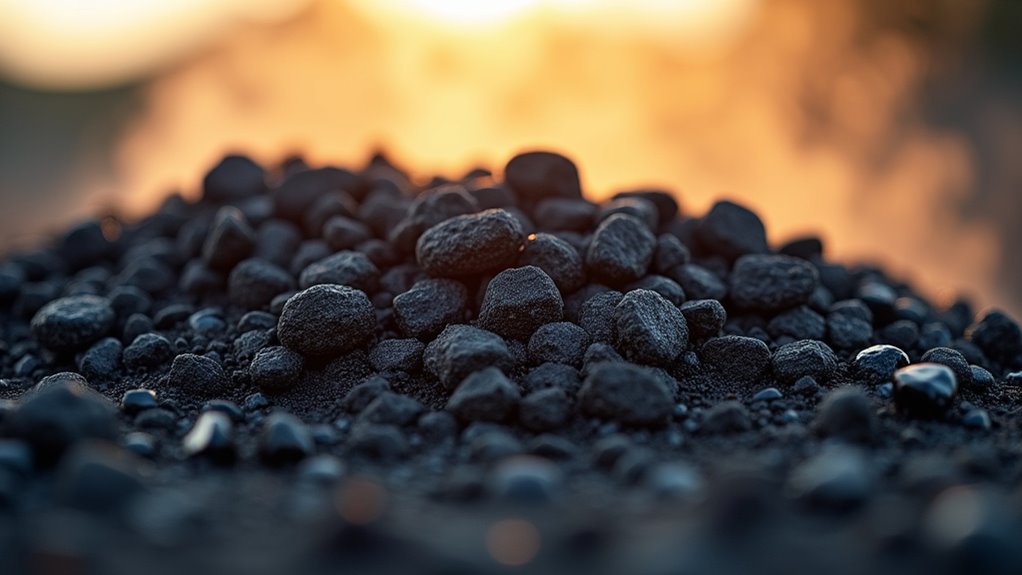
Hot mix asphalt (HMA) is a blend of aggregate and asphalt cement manufactured at elevated temperatures between 300–350°F to achieve proper coating, workability, and compaction. You’ll find this material serves as the industry standard for permanent paving applications, from interstate highways to commercial parking lots.
The production process begins at a central mixing plant where aggregates are dried, heated, and uniformly coated with asphalt cement. This elevated temperature guarantees the binder achieves optimal ideal fluidity, allowing complete aggregate coverage and creating a dense, durable mixture.
HMA stands as the most widely used asphalt type in construction due to its proven performance characteristics. It’s 100% recyclable, making it the world’s most recycled product while delivering resistance to heavy traffic loads and extreme weather conditions. This durability makes HMA the preferred choice for airport runways where surfaces must withstand constant heavy use.
What Goes Into Hot Mix Asphalt?
When you’re working with hot mix asphalt, you’re dealing with a precise combination of materials that must meet strict performance standards. Coarse and fine aggregates make up over 90% of the mix by weight, providing the structural backbone and load-bearing capacity your pavement needs. The asphalt binder, a crude oil derivative heated to 200°F during production, coats these aggregates to create the cohesion, flexibility, and durability that define quality HMA. Air voids within the mix allow the pavement to expand and contract with temperature changes while preventing damage from freezing and thawing cycles. When you’re working with hot mix asphalt, you’re dealing with a precise combination of materials that must meet strict performance standards. Coarse and fine aggregates make up over 90% of the mix by weight, providing the structural backbone and load-bearing capacity your pavement needs. The asphalt binder, a crude oil derivative heated to 200°F during production, coats these aggregates to create the cohesion, flexibility, and durability that define quality HMA. If you’re comparing what is cold mix asphalt used for, you’ll notice it typically serves temporary repairs rather than full-structure paving. Air voids within the mix allow the pavement to expand and contract with temperature changes while preventing damage from freezing and thawing cycles.
Aggregate Structure and Composition
Aggregates form the structural backbone of hot mix asphalt, comprising 92-97% of the total mixture by weight. You’ll find these materials consist of crushed stone, gravel, sand, and mineral dust that work together to provide stability and load-bearing capacity.
Aggregate gradation determines how particle sizes distribute within your mixture:
- Coarse aggregate includes larger stone particles that carry the majority of traffic loads
- Fine aggregate (sand and mineral dust) fills voids between coarse particles, creating cohesion with the asphalt binder
- Proper size distribution guarantees ideal compaction and prevents material segregation during placement
Your aggregate’s surface texture and particle shape directly impact performance. Irregular, crushed faces enable particles to interlock, providing greater stability. Abrasion resistance helps aggregates maintain structural integrity under heavy traffic and extreme weather conditions. The asphalt binder that coats these aggregates displays excellent waterproofing and binding properties, ensuring the mixture remains durable and cohesive over time.
Asphalt Binder Components
While aggregates provide the structural framework of hot mix asphalt, the asphalt binder serves as the critical binding agent that holds the entire mixture together. This viscous liquid, also known as bitumen, is a derivative of crude oil produced during the petroleum refining process.
You’ll find that the binder functions as the glue coating each aggregate particle uniformly when heated. It binds rock, sand, and fine particles into a cohesive, durable mass. Unlike rigid concrete binders, asphalt binder provides flexibility that allows pavement to adapt to temperature fluctuations and traffic loads.
Manufacturers often add polymers and modifiers to enhance performance characteristics. These additives increase elasticity, reduce rutting, improve moisture resistance, and strengthen adhesion between the binder and aggregates—ensuring your pavement meets specific environmental and traffic demands.
Where Hot Mix Asphalt Performs Best
Hot mix asphalt delivers ideal performance across demanding environments where durability matters most. You’ll find it excels in high-traffic road applications, extreme climate conditions ranging from desert heat to freezing winters, and heavy load pavements that require resistance to rutting and structural fatigue. Understanding these performance characteristics helps you select the right asphalt solution for your specific project requirements.
High-Traffic Road Applications
Because HMA combines 95% aggregate with 5% bitumen binder, it delivers the structural capacity needed for highways, arterials, and other high-volume roadways subjected to continuous heavy loads.
Hot-mix asphalt resists deformation and rutting where heavy vehicles travel frequently. Performance-graded binders are tailored to match expected traffic loads, while polymer-modified mixes enhance elasticity for repeated stress cycles. At high-traffic intersections, you’ll find superior rut resistance from consistent density and minimal water penetration.
Key performance characteristics include:
- Dense, impermeable structure that reduces damage from traffic-induced wear and moisture infiltration
- Optimal compaction targets achieving stability under dynamic loading conditions
- Higher crushed aggregate content specified for intersection zones to counter permanent deformation
This combination extends pavement life expectancy while meeting strict design criteria for void content and structural stability.
Extreme Climate Conditions
Extreme temperature swings, freeze-thaw cycles, and rising groundwater levels demand pavement systems that won’t crack, rut, or degrade prematurely.
Hot asphalt delivers climate-specific performance through its dense, impermeable structure. In high-temperature regions, you’ll find HMA resists softening and rutting when production occurs between 150–180°C. Cold climates benefit from HMA’s thermal crack resistance, while its water impermeability protects against freeze-thaw damage.
Coastal areas require increased HMA layer thickness of 7–32% to compensate for rising groundwater and temperature fluctuations. You can customize binder formulations with warm mix additives to address regional conditions.
Climate modeling indicates you’ll need thickness adjustments to maintain 85% reliability under warming scenarios. HMA’s quick setting time—road ready within hours—enables faster recovery from weather-related damage across all extreme environments.
Heavy Load Pavements
Beyond climate resilience, HMA’s engineered density makes it the preferred choice for pavements subjected to punishing wheel loads. Hot mix asphalt withstands wheel stresses exceeding 140 psi and handles loads greater than 7,000 lbs without structural compromise. You’ll find it specified for facilities accommodating over 50 million truck passes throughout their service life.
When designing for heavy load applications, consider these performance benchmarks:
- Marshall mix designs achieve stability of 12.5 kN, surpassing the 8.006 kN minimum threshold
- Superpave gyratory compaction targets 96% Gmm at 125 gyrations for ideal densification
- Binder film thickness of 9–10 µm reduces moisture susceptibility under repeated loading
For any high-traffic area requiring resistance to rutting, fatigue cracking, and permanent deformation, properly designed HMA delivers measurable performance advantages over alternative materials.
How Hot Mix Asphalt Gets Made and Placed
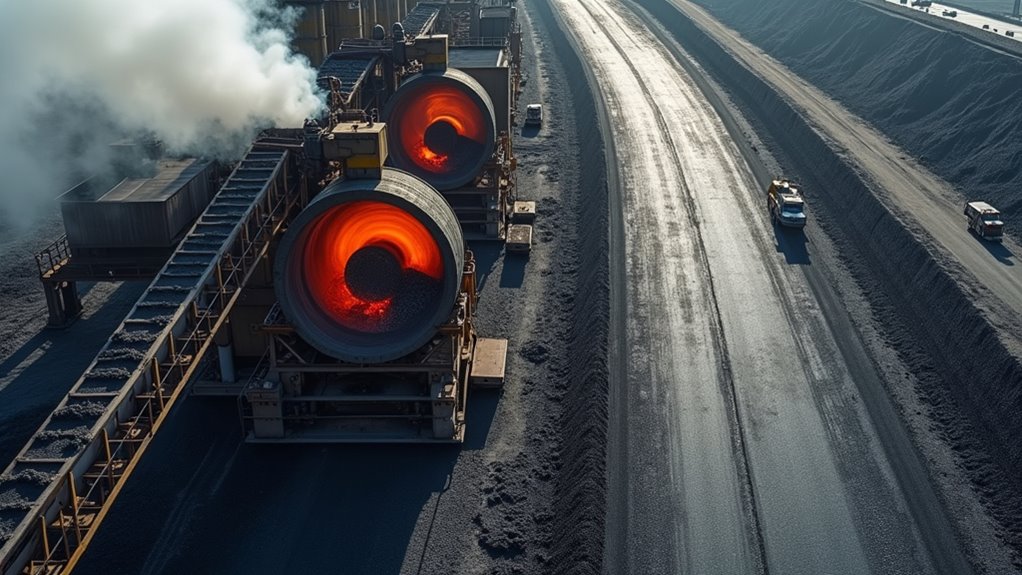
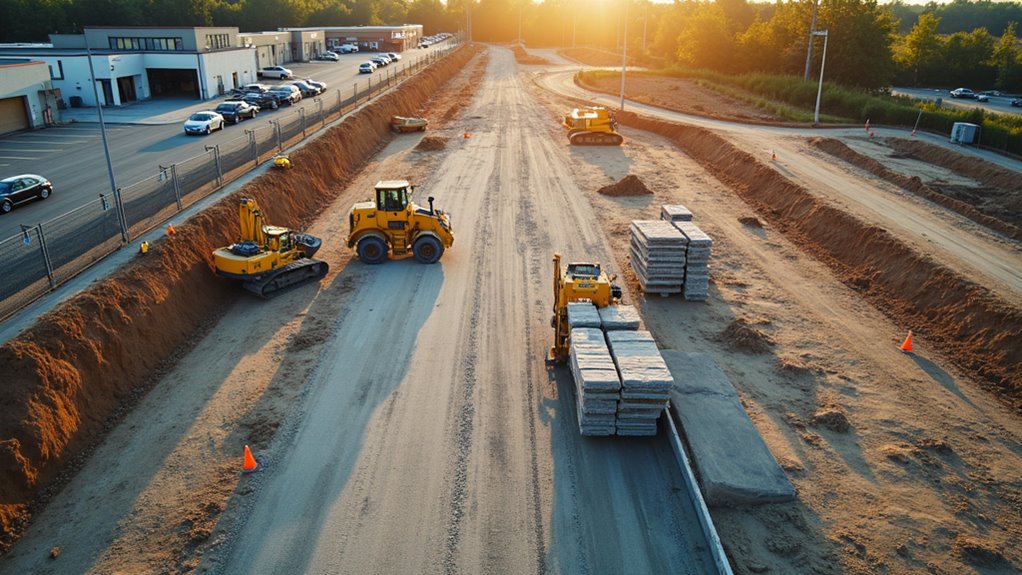
Before hot mix asphalt reaches your driveway or highway, it undergoes a precisely controlled manufacturing process at either batch or drum-mix plants. Cold aggregates are stockpiled by size, then fed into rotary dryers where drying and heating occurs at 302°F to 356°F. This removes moisture and prepares materials for coating.
After screening, heated aggregates move to hot bins for storage. The weighing phase guarantees pre-programmed ratios of aggregates, filler, and binder are exact. During bitumen addition, asphalt cement heated to 155-160°C coats the aggregates. Mixing in a pug mill takes 30-45 seconds for batch plants.
Trucks transport the finished mix to your site, where pavers place it and crews compact it at 220°F-290°F before cooling.
Why Temperature Control Makes or Breaks HMA
The production and placement process described above succeeds or fails based on one variable: temperature. You’ll find that temperature viscosity relationships directly determine workability—higher temperatures lower viscosity for proper aggregate coating, while cooling increases stiffness and impedes compaction.
Temperature controls everything in HMA placement—it determines whether your pavement achieves structural integrity or fails prematurely.
Temperature monitoring occurs at three critical stages:
- At the plant: Verify mixing temperatures reach 275–350°F
- During transport: Track temperature loss of 10–50°F depending on distance and conditions
- Before compaction: Confirm mat temperature stays above 185°F minimum threshold
When you apply HMA below critical thresholds, you’ll experience weak bonding and premature cracking. Overheating causes raveling and reduced pavement lifespan. Ambient temperatures below 50°F prohibit application entirely. These parameters aren’t suggestions—they’re engineering requirements that determine your pavement’s structural integrity.
How to Match HMA Mix Type to Your Application
How do you select the right HMA mix when each type serves distinct structural and performance functions? You’ll need to evaluate traffic volume, climate conditions, and pavement layer requirements before specifying materials.
Dense-graded HMA delivers versatility across driveways, highways, and high-traffic zones with its impermeable structure. Stone matrix asphalt costs 20-25% more but provides superior deformation resistance for interstates through stone-on-stone contact. Warm mix asphalt extends your paving season in cooler climates while reducing emissions.
| Mix Type | Best Application |
|---|---|
| Dense-Graded | All pavement layers, general use |
| Stone Matrix | High-volume interstates, surface courses |
| Open-Graded | Wet weather friction courses |
| Warm Mix | Cold climate paving, extended hauls |
| Cold Mix | Emergency pothole repairs, low-traffic roads |
Frequently Asked Questions
How Long Does Hot Mix Asphalt Need to Cure Before Vehicles Can Drive on It?
You’ll need to wait 48-72 hours before driving passenger vehicles on new hot mix asphalt. Initial surface hardening occurs within 24-48 hours under ideal conditions (70-80°F with 40-70% humidity). Cold or humid weather can extend this timeline to one week. For heavy vehicles, you should wait 14+ days, while standard vehicle parking requires 5-7 days. Complete curing through oxidation takes 6-12 months.
Can Hot Mix Asphalt Be Applied in Rainy or Cold Weather Conditions?
You shouldn’t apply hot mix asphalt during rainy or cold weather conditions. Rain accelerates cooling by up to 99%, traps moisture that causes cracking, and prevents proper bonding between layers. For cold weather, pavement temperatures must reach at least 60°F and rising, with HMA serving as the industry standard only above 40°F. If rain starts unexpectedly, you’ll need to halt work immediately and wait for moisture-free conditions. You shouldn’t apply hot mix asphalt during rainy or cold weather conditions. If you’re evaluating how hot is asphalt when paving, weather exposure is a critical factor because rain accelerates cooling by up to 99%, traps moisture that causes cracking, and prevents proper bonding between layers. For cold weather, pavement temperatures must reach at least 60°F and rising, with HMA serving as the industry standard only above 40°F. If rain starts unexpectedly, you’ll need to halt work immediately and wait for moisture-free conditions.
What Is the Typical Lifespan of a Hot Mix Asphalt Pavement Surface?
You can expect hot mix asphalt pavement to last 10 to 25 years under typical conditions. Your specific lifespan depends on traffic volume, climate, and maintenance practices. Residential driveways achieve up to 25 years, while high-traffic highways require resurfacing every 10-15 years. Without routine maintenance, structural integrity drops to 55% after 20 years. You’ll maximize longevity by sealing within the first year and addressing cracks before year 15.
How Much Does Hot Mix Asphalt Cost Compared to Other Paving Materials?
You’ll pay $100-165 per ton for HMA nationally, roughly $10-15 more per ton than cold mix asphalt. Installed costs average $3-7 per square foot, compared to recycled asphalt at $0.20-0.75 per square foot. Porous asphalt runs higher at $6.20-8.75 per square foot installed. Regional variations profoundly impact pricing—West Coast installations reach $6-10 per square foot, while Southeast regions offer the lowest rates at $3-6 per square foot.
Can Damaged Hot Mix Asphalt Be Repaired Without Replacing the Entire Surface?
Yes, you can repair damaged hot mix asphalt without full replacement using two primary methods. Infrared heating softens existing pavement 1.5 to 2.5 inches deep, allowing new HMA to thermally bond with the original material—eliminating cold joints where water infiltrates. This process takes 20 to 30 minutes and costs $2 to $6 per square foot. Cut-and-replace repairs target localized failures, delivering 15- to 20-year service life with proper execution.