
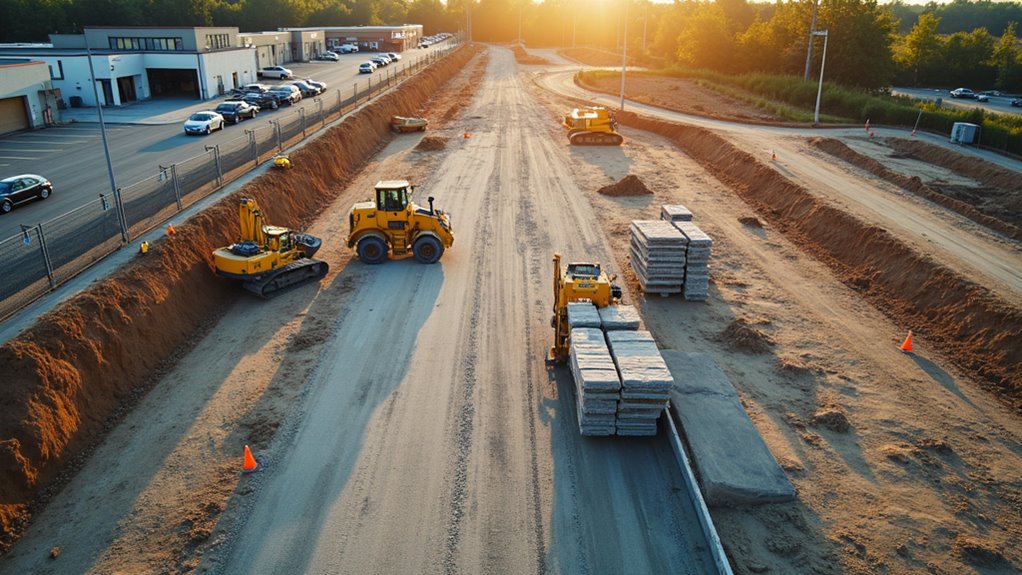

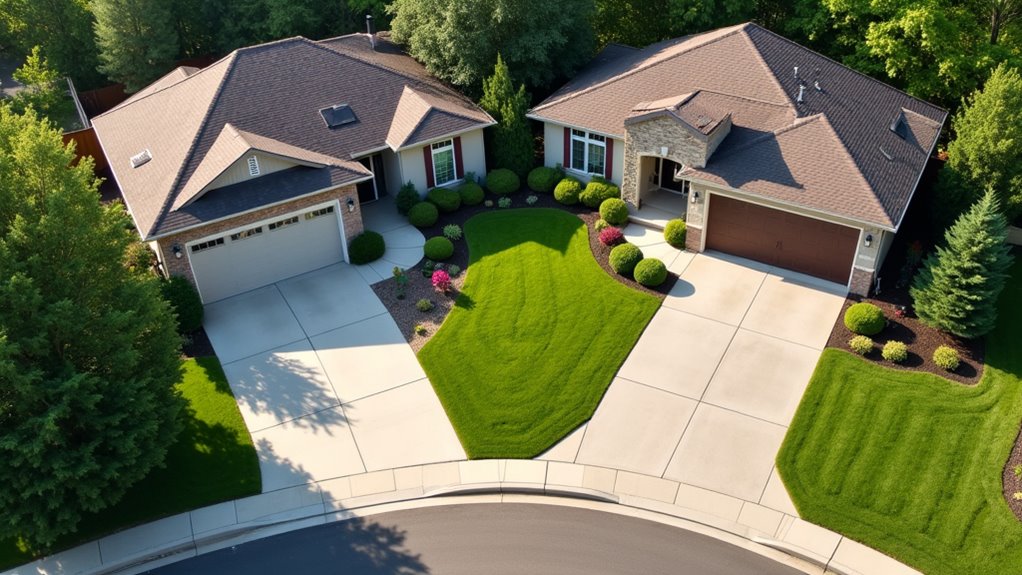
Cold mix asphalt combines bitumen emulsion (1-10%) with unheated mineral aggregates (88-95%) to create a workable patching material you can apply at ambient temperatures above 40°F. It hardens through mechanical compaction and natural curing rather than heat, reaching full strength in up to 90 days. You’ll find it’s ideal for emergency pothole repairs, utility cuts, and low-traffic residential streets. Understanding its composition and limitations helps you determine when it’s your best solution. Cold mix asphalt combines bitumen emulsion (1–10%) with unheated mineral aggregates (88–95%) to create a workable patching material you can apply at ambient temperatures above 40°F. If you’re planning cold patch asphalt driveway repair, understanding this composition explains why the material is best suited for temporary or localized fixes. It hardens through mechanical compaction and natural curing rather than heat, reaching full strength in up to 90 days. You’ll find it’s ideal for emergency pothole repairs, utility cuts, and low-traffic residential streets. Understanding its composition and limitations helps you determine when it’s your best solution.
What Is Cold Mix Asphalt?
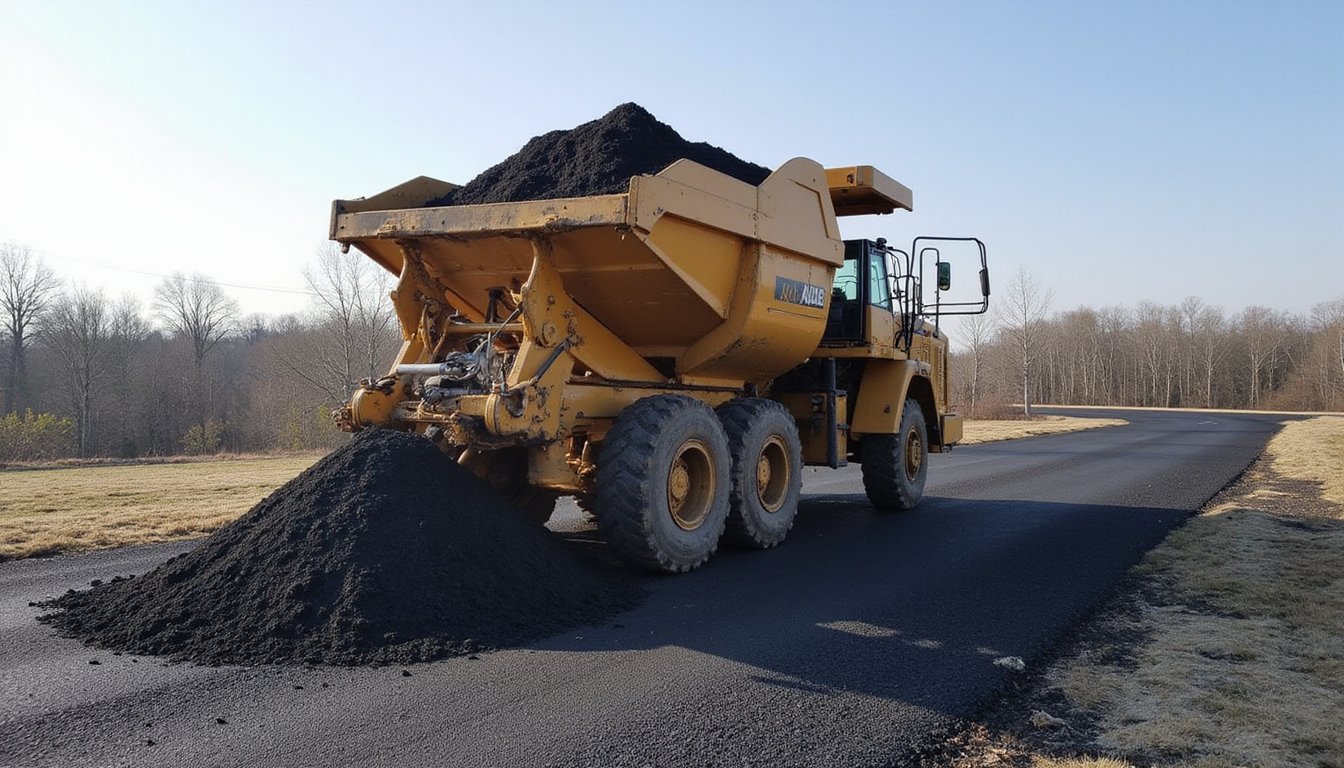
Cold mix asphalt is a paving material that combines bitumen emulsion or cutback asphalt with unheated mineral aggregates, producing a workable mixture at ambient temperatures. Unlike hot mix alternatives, you don’t need to heat the components during production or application, making asphalt cold mix considerably more accessible for field operations.
The emulsification process suspends bitumen in water with specialized emulsifiers, allowing cold asphalt to remain pliable without thermal treatment. You’ll find this material classified under IRC SP:100 standards, which specify mix designs based on intended use, climate conditions, and aggregate properties.
Cold mix asphalt serves as the simplest paving type available, offering you flexibility for repairs without requiring specialized heating equipment or controlled plant conditions. This makes it ideal for pothole repairs, temporary road fixes, and residential driveways where quick completion is essential.
What’s in Cold Mix Asphalt?
| Component | Typical Content | Primary Function |
|---|---|---|
| Aggregates | 88-95% | Load distribution |
| Bitumen Emulsion | 1-10% | Binding adhesion |
| Additives | 1-3% | Workability enhancement |
The aggregates—crushed stone, sand, gravel, and slag—comprise the bulk of the mixture and handle load transfer. Your bitumen emulsion disperses in water with emulsifying agents, providing flexibility and aggregate adhesion. Additives boost moisture resistance and anti-aging properties while improving deformation resistance under traffic loads.
How Cold Mix Asphalt Hardens Without Heat
Unlike hot mix asphalt that relies on thermal processes to achieve bonding, cold mix asphalt hardens through a combination of mechanical compaction and natural curing. When you apply a cold asphalt mix, compaction removes air voids and initiates the setting process. Hand tampers or plate compactors compress the material, promoting adhesion to existing pavement surfaces. Insufficient compaction can result in a loose and vulnerable patch that fails prematurely.
Natural curing typically solidifies the patch within one to two days, though full strength development requires up to 90 days. You can accelerate hardening by applying cement dust followed by multiple compactor passes, reducing cure time to approximately 30 days. Temperature plays a critical role—applications above 40°F guarantee optimal bonding. Vehicle traffic over the repair area provides additional compaction, with heavier loads delivering more effective compression and faster stabilization.
Cold Mix vs. Hot Mix Asphalt: Key Differences
Understanding how cold mix asphalt cures naturally leads to a fundamental question: when should you choose cold mix over hot mix asphalt?
The differences are substantial. Hot mix asphalt requires production temperatures between 300-350°F, while cold mix asphalt—sometimes called cold tar mix—remains workable at ambient temperatures. This temperature distinction directly impacts structural performance. The differences are substantial. Hot mix asphalt requires production temperatures between 300–350°F, while cold mix asphalt—sometimes called cold tar mix—remains workable at ambient temperatures. Understanding what is hot mix asphalt used for helps explain why this temperature distinction directly impacts structural performance.
What is cold mix asphalt’s primary limitation? It’s durability. Hot mix delivers superior aggregate coating and compaction density, making it suitable for high-traffic roads and highways. Cold asphalt’s lower aggregate-to-binder ratio creates reduced load-bearing capacity and increased susceptibility to cracking. What is cold mix asphalt’s primary limitation? It’s durability. When comparing cold mix vs hot mix, hot mix delivers superior aggregate coating and compaction density, making it suitable for high-traffic roads and highways. Cold asphalt’s lower aggregate-to-binder ratio creates reduced load-bearing capacity and increased susceptibility to cracking.
What is cold asphalt best suited for? You’ll find it excels in emergency repairs, cold weather applications, and remote locations lacking hot mix facilities. Hot mix remains the standard for permanent, load-bearing installations. Additionally, hot mix asphalt installation requires the outside temperature to be 40°F or higher, which further limits when permanent repairs can be made.
What Cold Mix Asphalt Costs Compared to Hot Mix
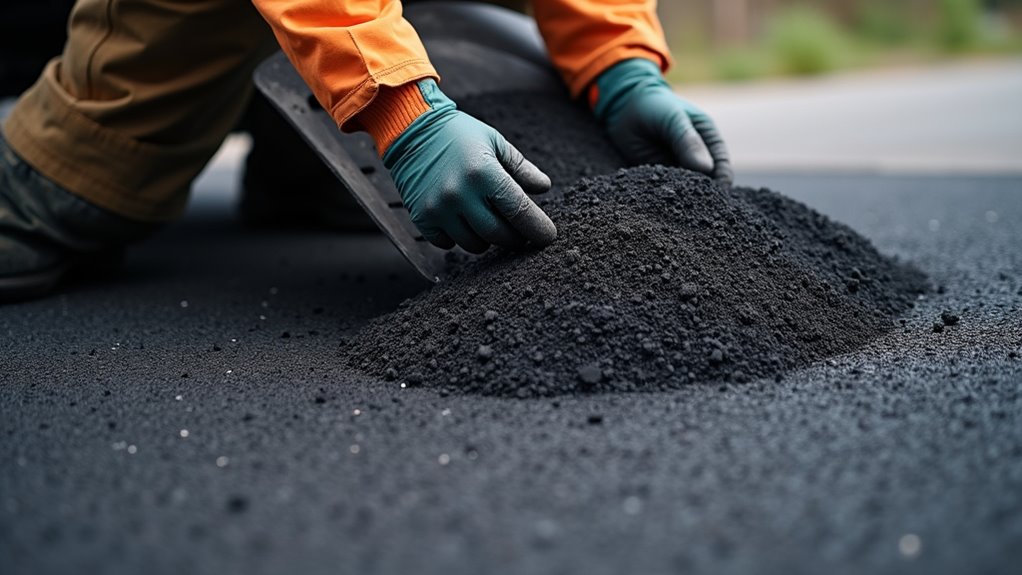
When comparing material costs alone, cold mix asphalt runs $90–$175 per ton versus hot mix‘s $40–$100 per ton—a premium of 50–100% attributable to proprietary oils and polymers that maintain workability at ambient temperatures.
However, installed costs tell a different story. Cold patch repairs cost $2–$5 per square foot, while hot mix saw-cut patches range $2.50–$8.00 per square foot. You’ll eliminate mobilization expenses exceeding $100,000 for pavers and rollers, plus crew costs reaching hundreds per hour.
The lifecycle equation shifts further when you factor high-performance polymer-modified cold mix lasting 5–10+ years versus conventional cold patch’s 3–12 month lifespan. You’re fundamentally trading higher material costs for reduced labor, equipment, and re-patching cycles—potentially eliminating 5–10 repair cycles over the pavement’s service life.
When to Use Cold Mix Instead of Hot Mix
Cost savings matter, but the decision to use cold mix versus hot mix ultimately depends on application context.
You’ll find cold mix performs best for emergency repairs and temporary pothole patches where you need immediate results without specialty heating equipment. It’s your go-to solution for utility cut patching in low-traffic areas and works effectively on residential streets, driveways, and rural roads that don’t face heavy loads.
Cold mix applies at ambient temperatures between 10-25°C, making it suitable when hot mix’s 40°F minimum threshold isn’t achievable. You can also use it in damp conditions and remote locations lacking hot plant access.
However, reserve hot mix for permanent repairs and high-traffic surfaces. Cold mix’s lower aggregate-to-binder ratio limits durability to weeks or months, not years.
Common Applications for Cold Mix Repairs
Cold mix asphalt serves five primary repair categories, each defined by load requirements and surface type.
Cold mix asphalt adapts to every repair scenario—from high-traffic runways to quiet garden paths.
Pothole and Surface Repairs
You’ll apply cold mix directly into cleaned potholes on roads, airport runways, taxiways, and aprons. Compact the material thoroughly to prevent displacement under traffic loads.
Wheel Rutting Corrections
Fill depressions caused by repeated vehicle pressure. The material levels grooves and restores even pavement profiles without heavy equipment.
Utility Cut Restoration
After underground pipe or cable work, you can backfill excavations immediately. This allows rapid traffic reopening around sewer lines and inspection chambers.
Parking Lots and Driveways
Use cold mix for crack repairs and pothole patches in low-traffic areas. It’s suitable for DIY applications on residential and commercial surfaces.
Pedestrian Pathways
Repair sidewalks, park paths, and crossings where load demands remain minimal.
How to Apply Cold Mix Asphalt Correctly
Before you begin any cold patch repair, you’ll need to assemble the proper materials and equipment to guarantee specification-compliant results. Gather your cold patching material, shovel, scraper, plate compactor or roller, broom, and safety signage. Use ground-penetrating radar or visual inspection to assess pothole depth and extent.
Start by clearing all debris, gravel, mud, and ice from the repair area. If the pit exceeds 5cm depth, you’ll need to excavate in layers not exceeding 5cm each. Trim edges vertically using a cutter or milling machine, then mill down to solid foundation. Apply emulsified asphalt primer evenly across the pit bottom and sides to ascertain proper adhesion.
For material stored beyond typical periods, mix for 1-2 minutes before application to restore uniformity.
How Long Does Cold Mix Asphalt Lasts
You can expect cold-mix asphalt to last between 6 months and 2 years, depending on traffic loads, weather exposure, and installation quality. High-traffic areas like commercial parking lots typically see breakdown within 6 to 12 months, while low-traffic residential applications approach the 2-year mark when properly compacted. Regular maintenance, including crack sealing and seal coating, considerably extends performance and delays the need for hot mix replacement.
Typical Lifespan Expectations
When evaluating cold mix asphalt for pavement repairs, you’ll find that lifespan varies considerably based on product formulation and application conditions. Standard cold patch products typically deliver 1 to 2 years of service life, though many installations fail after a single season.
In high-traffic zones like commercial retail centers, expect performance windows of 6 to 12 months. Improper application techniques can reduce this to just 3 months before failure occurs.
Polymer-modified formulations substantially extend durability. These enhanced products achieve 3 to 5 years with proper installation, while high-performance variants reach 5 to 10+ years—approaching hot mix asphalt patch longevity. Polymer-enhanced binders resist cracking under extreme weather conditions and heavy loading cycles.
For comparison, traditional hot mix asphalt systems provide 15 to 30 years of service, establishing the benchmark for permanent pavement solutions.
Factors Affecting Durability
How long your cold mix asphalt repair actually lasts depends on five interconnected factors that determine whether you’ll get 6 months or 10+ years of service.
| Factor | Performance Impact |
|---|---|
| Aggregate Grading | <10% air voids after rolling maximizes density |
| Binder Content | 4% emulsion extends fatigue life by 49.34% |
| Moisture Resistance | TSR >85% with cement addition prevents stripping |
| Climate Exposure | Freeze-thaw cycles accelerate cracking |
| Traffic Loading | Stiffness reaches 101% of hot mix under traffic |
You’ll achieve ideal durability when you control void content, select nano-modified or polymer-enhanced binders, and apply repairs during favorable weather conditions. Field trials demonstrate cold mix maintains structural integrity for 15+ years when gradation and binder ratios align with site-specific load demands.
Maintenance Extends Performance
Cold mix asphalt repairs typically deliver 1 to 2 years of service life, though actual performance spans from 3 months to 3+ years depending on installation quality and traffic exposure. Low-traffic applications with proper compaction reach the upper range, while high-traffic commercial lots experience breakdown within 6 to 12 months.
You’ll extend patch longevity through systematic maintenance protocols. Conduct regular surface inspections to identify cracking, water pooling, or aggregate loosening early. Seal cracks immediately to prevent water infiltration and subgrade damage. Apply sealcoating every 2 to 3 years to protect against UV degradation and moisture penetration.
Monitor repaired areas during the initial weeks post-installation to verify stability. When cold patch upkeep no longer meets performance requirements, switch to hot mix asphalt overlay for permanent, load-bearing durability.
Where Cold Mix Asphalt Falls Short
Cold mix asphalt won’t support heavy traffic loads due to its lower aggregate-to-binder ratio, which reduces density and structural capacity below hot mix standards. You’ll also face a shorter service life because the material’s susceptibility to cracking and displacement means you’ll need to replace patches with hot mix sooner than expected. The weather-sensitive curing process further compounds these issues, as rain, snow, or temperature fluctuations can delay setting and compromise the final bond strength.
Limited Load-Bearing Capacity
When comparing structural performance metrics, hot mix asphalt consistently outperforms cold mix in load-bearing applications. You’ll find Marshall stability values considerably lower in cold mix formulations, with statistical t-tests confirming this difference at p < 0.05. Cold mix achieves tensile strengths around 1.9 MPa with additives, compared to 2.4 MPa for standard hot mix controls.
You shouldn’t specify cold mix for roads exceeding 5,000–10,000 AADT without cement additives or other optimizations. The material’s lower early strength compromises performance under heavy axle loads and repeated traffic cycles. Even optimized mixtures reaching resilient modulus values of 2,510 MPa after 12 weeks remain application-limited.
For adequate load transfer, you’ll need angular crushed aggregate with LA abrasion values below 25%, though this still won’t match hot mix reliability for heavy-load conditions.
Shorter Lifespan Expected
Because cold mix asphalt relies on cutback or emulsified binders rather than heated petroleum cement, you’ll experience considerably reduced service life compared to conventional hot mix installations. Standard cold patches typically last 6 to 12 months under moderate traffic conditions, while hot mix achieves 15 to 30 years of service life.
Your application’s durability depends heavily on traffic loading and environmental exposure. High-traffic commercial areas see failure within 6 to 12 months, whereas low-traffic private driveways can extend toward 2 years. Freeze-thaw cycles and moisture infiltration accelerate binder degradation markedly.
Polymer-modified cold mix formulations offer improved performance, lasting 3 to 5 years with proper installation techniques. However, you should treat conventional cold patch as a temporary solution requiring replacement within one season or until permanent repairs are feasible.
Weather-Sensitive Curing Process
Unlike hot mix asphalt that cures through simple cooling, cold mix asphalt relies on solvent evaporation and emulsion breaking—processes that weather conditions directly control.
You’ll face significant curing delays when temperatures drop below 50°F or humidity rises. Under optimal conditions, cold mix achieves traffic-ready status within 24-48 hours. However, cold or humid weather extends this window to seven days for full hardening. The Federal Highway Administration notes that low temperatures cause premature failures when you don’t account for these extended cure times.
Moisture sensitivity compounds the problem. You must guarantee surfaces remain clean and dry—rain or frost conditions postpone application entirely. During curing, the material stays malleable and can’t handle traffic loads, forcing extended closures in high-traffic zones where downtime creates operational challenges.
Frequently Asked Questions
Can Cold Mix Asphalt Be Recycled or Reused After Removal?
Yes, you can recycle cold mix asphalt after removal. You’ll recover up to 100% of the material through crushing and screening processes. The reclaimed asphalt pavement (RAP) you obtain combines with virgin asphalt and aggregate to create new mixtures. You can use this recycled material for base courses, wearing courses, or roadbases. RAP’s actually the most recycled material in North America, enabling complete roadway asphalt reuse through cold recycling methods.
Does Cold Mix Asphalt Produce Harmful Fumes During Application?
Cold mix asphalt produces minimal fumes during application since you don’t heat it like hot mix. However, you’ll still encounter some fume generation that can cause upper respiratory irritation and eye discomfort. You should always work outdoors or in well-ventilated areas and wear appropriate protective equipment. If you’re concerned about emissions, you can select VOC-free cold mix products that release no harmful fumes during application or curing.
What Happens if Cold Mix Asphalt Gets Wet Before Fully Curing?
If cold mix asphalt gets wet before fully curing, you’ll face significant performance issues. Moisture loosens the bond between the binder and aggregate, weakening overall pavement strength. You’ll experience extended curing times—potentially five days to a week or more in humid conditions. Water infiltration increases your risk of raveling, cracking, and pothole formation during freeze-thaw cycles. You’ll also see compromised adhesion that reduces long-term load-bearing capacity and durability.
Can Vehicles Drive Over Cold Mix Asphalt Immediately After Application?
Yes, you can drive vehicles over cold mix asphalt immediately after compaction. The pre-mixed emulsion binder allows the surface to support traffic without the 24-48 hour wait hot mix requires. You’ll want to limit loads to passenger vehicles initially, as heavy trucks can cause indentations before full curing at 30 days. For ideal results, make sure you’ve applied thin layers and temperatures remain between 50-90°F to expedite initial set.
Does Cold Mix Asphalt Require Special Storage Conditions to Remain Workable?
Yes, you’ll need to maintain specific storage conditions to keep cold mix asphalt workable. Store your material between 10℃-35℃ in dry, well-ventilated areas away from direct sunlight and ignition sources. You should use moisture-proof bags and keep containers sealed to preserve adhesion properties. During cold seasons, maintain storage above +10℃ for ideal workability. Properly stored in sealed containers, your material remains usable for 12 months, with stockpiles workable for 6 months.