

Fresh asphalt leaves the plant between 275°F and 350°F, hot enough to cause severe burns on contact. You’ll need to maintain temperatures between 220°F and 290°F during compaction, with 185°F serving as the critical cutoff where the mix stiffens and won’t achieve proper density. Polymer-modified mixes require even higher temperatures—typically 15°F to 25°F above standard binders. Understanding these temperature windows and what affects them will help you achieve lasting pavement performance. Fresh asphalt leaves the plant between 275°F and 350°F, hot enough to cause severe burns on contact. If you’re studying what is hot mix asphalt, understanding these thermal ranges is essential for safe handling and proper compaction. You’ll need to maintain temperatures between 220°F and 290°F during compaction, with 185°F serving as the critical cutoff where the mix stiffens and won’t achieve proper density. Polymer-modified mixes require even higher temperatures—typically 15°F to 25°F above standard binders. Understanding these temperature windows and what affects them will help you achieve lasting pavement performance.
How Hot Is Asphalt? Key Temperatures to Know

When you’re working with hot mix asphalt, understanding precise temperature thresholds determines whether your pavement will last decades or fail within months. The ideal asphalt paving temperature ranges between 220°F and 290°F during installation, allowing proper shaping and compression.
Your mix should arrive on-site between 275°F and 300°F, accounting for heat loss during transport. For hot bitumen driveways and commercial applications, you’ll need to complete compaction before the material drops below 185°F—the critical cutoff where the mix stiffens and prevents adequate density. Cold asphalt that isn’t properly compacted leaves air pockets that can expand and cause cracks over time.
The asphalt installation temperature requirements don’t stop at the material itself. You must verify ambient air temperatures reach at least 50°F and rising, while ground base temperatures should meet the same minimum threshold for standard lifts under two inches.
Asphalt Temperature at the Plant: 275°F to 350°F
When you’re producing hot mix asphalt, you’ll typically operate within a 300°F to 350°F range to guarantee the asphalt cement fully liquefies and coats aggregates for ideal bonding. If you’re working with polymer-modified HMA, you’ll need to target the higher end at 285°F to 320°F to accommodate the modified binder’s viscosity requirements. By the time the mix leaves the plant, temperatures typically range from 275°F to 325°F, providing you the workability needed for transport and placement. During transport, the temperature may drop 50-100 degrees Fahrenheit, which is why contractors use insulated trucks to maintain optimal heat levels.
Hot Mix Production Ranges
Hot mix asphalt production demands precise temperature control at the plant, with standard HMA manufactured between 300°F and 350°F. At these elevated temperatures, the asphalt cement liquefies completely, allowing it to coat aggregates thoroughly and uniformly. You’ll find that specialized plants heat both the binder and aggregates to this range, ensuring ideal workability during the mixing process.
Understanding how hot is asphalt at discharge helps you plan your paving operations effectively. What is hot mix when it leaves the plant? Typically, the mixture exits between 275°F and 325°F, arriving at your job site between 275°F and 300°F. You should maintain temperatures above 260°F upon delivery for proper spreading, with 285°F serving as the standard minimum for HMA applications. If the mix temperature drops below approximately 185°F before final compaction, the asphalt becomes too stiff to compact properly.
Polymer Modified Temperature Requirements
Polymer-modified asphalt demands higher production temperatures than conventional HMA, with plant discharge ranging from 275°F to 350°F depending on the modifier type. You’ll need to increase your standard binder temperatures by 15°F to 25°F when working with polymer modifications. For high-modulus PMA, target 300°F behind the screed to achieve proper compaction.
Your mixing approach matters greatly. When preparing EVA-modified asphalt, you’ll mix at 170°C (338°F) using high shear at 3000 rpm for 30 minutes, followed by 20 minutes of curing. For Novophalt and Styrelf products, don’t exceed 180°C to prevent blue smoke generation.
VDOT caps hot-mix plant temperatures at 177°C (351°F) for modified binders. You’ll achieve ideal compaction when temperatures reach 140°C to 145°C (284°F–293°F) for modified binder applications.
Why Asphalt Cools During Transport
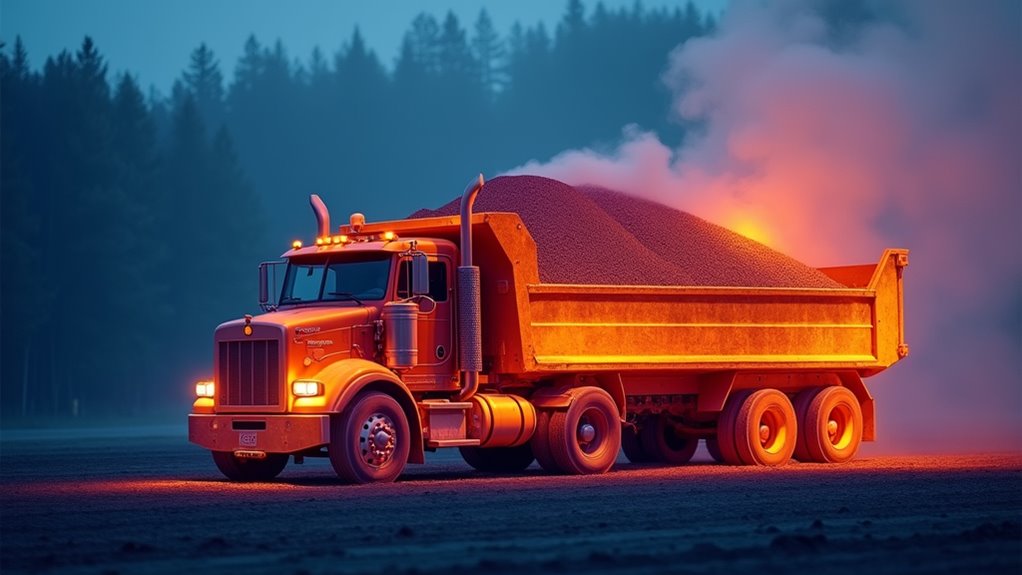
From the moment hot mix asphalt leaves the plant, it begins losing heat through multiple pathways that directly affect your paving results.
Distance from the plant ranks as a primary factor—every additional minute of transport reduces mixture temperature. Traffic delays compound this issue, requiring you to monitor heat loss continuously and synchronize delivery rates with actual paving operations.
Weather conditions accelerate cooling tremendously. Wind velocity ranks among the most critical factors influencing cooling rates, while cold and rainy conditions lower surface temperatures rapidly. You’ll find that warmer ambient conditions extend your working time considerably.
Ground contact also pulls heat away from your mix. When you pave over cool soil or existing surfaces, the asphalt stiffens faster due to thermal conductivity differences. Thin lifts cool especially quickly because of their relatively small mass.
Ideal Temperature Range for Laying Asphalt
When you’re laying hot mix asphalt, you’ll need to maintain material temperatures between 275°F and 290°F to guarantee proper workability and strong surface bonding. Your ambient air temperature should be at least 50°F and rising, with perfect conditions falling between 50°F and 90°F to prevent premature cooling or heat-related curing issues. The compaction window narrows quickly once temperatures drop below 220°F, so you’ll need to coordinate rolling operations while the mix remains pliable enough to achieve target density. When you’re laying hot mix asphalt, you’ll need to maintain material temperatures between 275°F and 290°F to guarantee proper workability and strong surface bonding. Understanding cold mix asphalt vs hot mix asphalt helps explain why temperature control is so critical for hot mix performance. Your ambient air temperature should be at least 50°F and rising, with perfect conditions falling between 50°F and 90°F to prevent premature cooling or heat-related curing issues. The compaction window narrows quickly once temperatures drop below 220°F, so you’ll need to coordinate rolling operations while the mix remains pliable enough to achieve target density.
Optimal Laying Temperature Range
Achieving proper asphalt compaction requires maintaining specific temperature ranges throughout the installation process. When hot mix asphalt arrives at your job site, it’s typically between 275°F and 300°F. You’ll need to keep the mix within 275°F to 350°F during paving to guarantee proper bonding.
For initial rolling, maintain mix temperatures between 220°F and 290°F. Don’t let the asphalt drop below 185°F before final compaction—once it falls below this threshold, the material becomes too stiff to compact effectively.
Your compaction window exists while the mix cools from approximately 275°F down to 175°F. Layer thickness directly impacts this timeframe; thinner lifts cool faster, giving you less working time. Monitor wind speed and ground temperature closely, as these factors accelerate cooling and can shrink your available compaction window.
Ambient Temperature Requirements
Beyond mix temperature alone, ambient conditions directly determine whether your paving project succeeds or fails. You’ll need a minimum ambient temperature of 50°F and rising for proper asphalt installation and compaction. When temperatures drop below this threshold, your asphalt cools too rapidly, preventing adequate compaction and creating weak, brittle pavement.
Your ideal ambient range sits around 70°F or higher for excellent results. While you can pave down to 50°F, you’ll experience faster cooling and lower density outcomes. Ground surface temperature matters equally—use an infrared thermometer to verify it reaches at least 50°F before starting.
Don’t overlook wind effects. High wind speeds accelerate cooling rates dramatically, especially near the 50°F minimum. You may need warmer ambient conditions to maintain sufficient working time during windy installations.
Compaction Workability Window
Your compaction workability window—the critical 15 to 30 minutes when asphalt remains pliable enough for effective rolling—determines whether you’ll achieve target density or face premature pavement failure.
During this window, you must maintain temperatures between 275°F and 300°F for standard binders. Once asphalt drops below 194°F–212°F, compaction becomes ineffective, and you’ll trap air voids that compromise structural integrity.
Factors affecting your workability window:
- Lift thickness: Thicker lifts retain heat longer, extending available compaction time
- Base temperature: Cold bases below 50°F draw heat rapidly from the mat
- Wind exposure: Accelerates surface cooling, shrinking your operational timeframe
- Transportation delays: Every minute in transit reduces your on-site working time
Polymer-modified binders require 15°F–25°F higher temperatures to achieve ideal viscosity for compaction.
What Happens When Asphalt Gets Too Cold?
Cold weather creates substantial challenges for asphalt pavement, triggering a process called thermal contraction that puts internal stress on the material. As temperatures drop, your pavement shrinks and becomes rigid, causing existing cracks to widen and new fractures to develop.
Freeze-thaw cycles accelerate deterioration rapidly. Water infiltrates cracks when temperatures rise above freezing, then expands when it freezes again. This repeated cycle crumbles the asphalt from within, creating potholes and structural weakening throughout the base layers.
Your asphalt binder also suffers in cold conditions. It becomes brittle and prone to cracking while oxidation accelerates damage. You’ll notice the surface lightening from black to grey as the material dries out.
Paving below 50°F risks poor compaction and raveling, ultimately increasing your long-term maintenance costs considerably.
What Happens When Asphalt Gets Too Hot?

Excessive heat damages asphalt just as severely as cold temperatures, though the failure mechanisms differ substantially. When you expose pavement to extreme heat, the binder oils burn off, causing embrittlement and weakened cohesion between aggregate particles. You’ll notice the surface becomes pliable, making it susceptible to deformation under traffic loads.
Heat destroys asphalt differently than cold—burning off binder oils and leaving pavement brittle yet pliable under traffic loads.
Key heat-related failures include:
- Rutting development – Softened asphalt forms permanent grooves under heavy vehicle traffic
- Binder degradation – Overheating destroys binding agents, reducing pavement lifespan
- Thermal cracking – Repeated expansion and contraction cycles create surface fissures
- Pothole progression – Cracks allow water infiltration, which erodes the weakened base structure
You must monitor installation temperatures carefully. Overheated mix won’t achieve proper compaction, compromising structural integrity from day one.
Why Compaction Temperature Determines Pavement Life
Proper compaction temperature consistently determines whether your pavement lasts 15 years or 25 years. When your roller reaches the mat before substantial temperature drop, you’ll achieve up to 4% density increase—translating to 50% greater lab fatigue life and a conservative 25% field service life extension.
You must maintain mix temperatures between 275°F and 300°F during placement for ideal workability. Once asphalt drops below 220°F, compaction becomes ineffective; below 175°F, you’re fundamentally wasting roller passes.
Here’s the critical metric: increasing in-place density from 92% to 93% extends overlay service life by 10%. That single percentage point transforms an 18-year pavement into a 20-year asset.
Temperature controls viscosity. Higher temperatures maintain lower viscosity, extending your compaction window and ensuring proper aggregate bonding.
How to Measure Asphalt Temperature On-Site
Maintaining ideal compaction temperatures requires accurate field measurement—you can’t control what you don’t measure. You’ll need the right tools matched to each phase of your paving operation.
Essential Temperature Measurement Methods:
- Infrared thermometers – Provide instant, non-contact surface readings during placement; use calibrated industrial-grade models for temperatures above 115°C in post-paver zones
- Thermal imaging cameras – Capture real-time temperature variations across the entire surface, helping you identify hot spots or cooling areas that affect compaction quality
- Embedded thermocouples – Deliver continuous internal temperature data with higher accuracy than surface-only methods throughout the curing process
- Heavy-duty digital probes – Measure mix temperatures above 150°C at the plant and maintain truck loads above 135°C during transport
Combine multiple methods and use data loggers to record intervals for pattern analysis.
Best Weather Conditions for Asphalt Paving
Weather conditions directly determine whether your asphalt achieves target density and long-term durability. You’ll need ambient temperatures at minimum 50°F and rising, with ideal installation occurring between 50-85°F. For best results, aim for 70°F or higher to maximize working time before the mix cools.
Schedule your projects from late spring through early fall when conditions remain stable. Summer represents peak paving season due to consistent warmth, while early to mid-fall offers suitable 60-80°F daytime temperatures.
You must avoid paving below 40°F—cold ground pulls heat from the mix, preventing proper adhesion and causing premature failure. Monitor nighttime temperatures, ensuring they stay above 50°F post-paving for adequate curing. Check forecasts for three consecutive dry days above 50°F before starting any project.
Frequently Asked Questions
Can You Pave Asphalt at Night When Temperatures Drop Significantly?
You can pave asphalt at night, but you’ll face significant challenges when temperatures drop below 50°F. Cold ambient and ground temperatures cause your hot mix to cool rapidly, reducing your compaction window before the material stiffens below 185°F. Consider using Warm Mix Asphalt (WMA), which requires lower application temperatures and extends your working time. Always monitor conditions with infrared thermometers to guarantee proper bonding and density.
How Long Does Freshly Laid Asphalt Stay Hot to Touch?
Freshly laid asphalt stays hot to touch for several hours after placement, though exact timing depends on lift thickness and ambient conditions. You’ll find two-inch lifts cool below 160°F within minutes after final rolling, while thicker lifts retain internal heat for hours. In temperatures above 80-90°F, surface cooling can take considerably longer. You shouldn’t allow foot traffic until 24 hours after initial setting for safety. Freshly laid asphalt stays hot to the touch for several hours after placement, though exact timing depends on lift thickness and ambient conditions. When comparing cold patch vs hot patch asphalt, heat retention is one of the key performance differences to understand. You’ll find two-inch lifts cool below 160°F within minutes after final rolling, while thicker lifts retain internal heat for hours. In temperatures above 80–90°F, surface cooling can take considerably longer. You shouldn’t allow foot traffic until 24 hours after initial setting for safety.
Does Asphalt Temperature Affect Its Color When Fully Cured?
Yes, asphalt temperature directly affects your pavement’s final cured color. When you’re working with hot-mix asphalt, higher ambient temperatures slow the cooling and oxidation process, which delays the color shift from deep black to gray. You’ll notice faster color development in cooler conditions because the asphalt cures more rapidly. The oxidation that causes this lightening actually reinforces your pavement’s binder, so appropriate temperature control during installation guarantees ideal long-term resilience.
Can Rain Damage Asphalt if It Falls During the Cooling Process?
Yes, rain can severely damage asphalt during the cooling process. When rainfall hits fresh pavement, it accelerates cooling by up to 99%, trapping steam that condenses into water and causes cracking. You’ll also see water seeping into the substructure, softening the base and preventing proper compaction. The moisture prevents adequate bonding between layers, creating weak spots. If you’re paving during heavy rain, you’ll likely need to remove and replace the affected sections.
How Soon Can Vehicles Drive on Newly Paved Asphalt Surfaces?
You should wait a minimum of 24 to 72 hours before driving vehicles on newly paved asphalt surfaces. Light foot traffic is typically safe after 24 hours, while driving requires at least 48 hours—extending up to 7 days depending on weather conditions, asphalt thickness, and temperature at installation. For hot mix asphalt that’s been properly rolled, you can allow light vehicles after 1-3 hours, though you’ll want contractor confirmation first.