


ADA parking violations expose you to serious risk. If your spaces don’t meet width, access aisle, or van-accessible requirements, you’re vulnerable to “drive-by” plaintiffs who file suit for attorney fees ranging from $50,000 to $200,000. You’ll likely settle between $10,000 and $30,000, plus face federal civil penalties up to $75,000 for a first violation. Non-compliance also erodes customer trust and drives away business. Understanding how these risks unfold can help you protect yourself.
Key Takeaways
- Common violations include insufficient space widths, undersized access aisles, striping into travel lanes, and missing required van-accessible spaces.
- “Drive-by” plaintiffs scan parking lots for violations, then file federal lawsuits without proving actual damages or personal injury.
- Settlements typically range from $10,000 to $30,000, while full litigation attorney fees can reach $50,000 to $200,000.
- Federal civil penalties reach up to $75,000 for a first violation and $150,000 for each subsequent violation, compounding across multiple spaces.
- Non-compliance erodes customer trust, invites advocacy-group scrutiny, and deters disabled patrons, causing lost business that compounds over time.
What counts as ADA parking violations
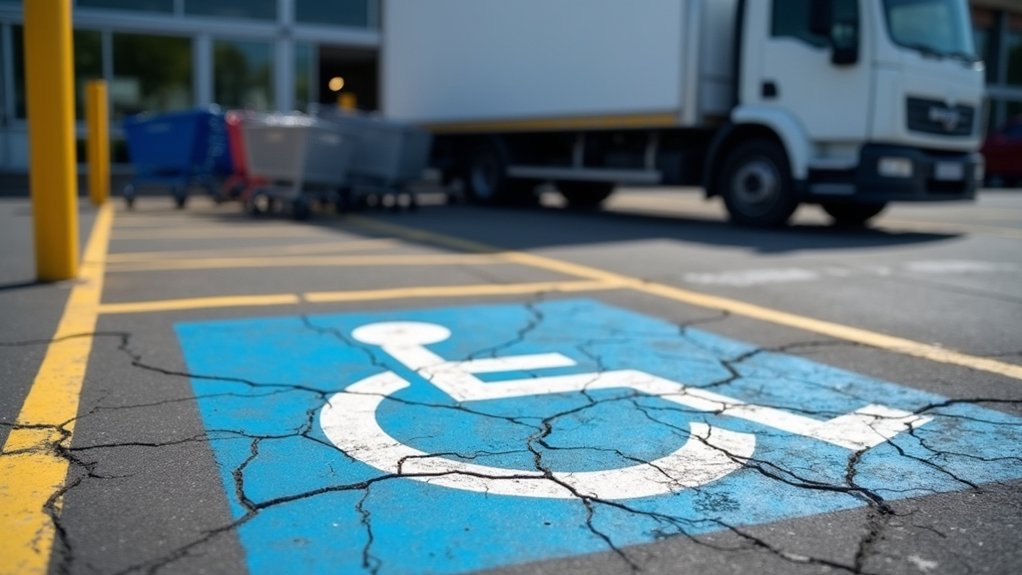
ADA parking violations occur when your accessible spaces fall short of mandatory dimensions. Each accessible space must measure at least 8 feet (96 inches) wide with a 5-foot access aisle. Van-accessible spaces require 8-foot widths with 8-foot aisles, or 11-foot widths with 5-foot aisles. You must provide one van-accessible space for every six accessible spaces. Striping extending into travel lanes constitutes a violation regardless of width or signage, and missing van-accessible spaces trigger a handicap parking violation fine reaching thousands to tens of thousands of dollars. Insufficient space counts based on lot size also expose you to an ADA parking lawsuit and escalating penalties.
How does an ADA parking lawsuit against a business work
An ADA parking lawsuit begins when a plaintiff identifies a violation in your parking lot. Under federal handicap parking laws, a complainant files suit alleging that your facility denies accessible parking. Many are “drive-by” plaintiffs who scan lots specifically to spot violations, sometimes never attempting to enter your business. You’ll then face a choice: settle or litigate. Settlements typically range from $10,000 to $30,000, while full litigation can generate attorney fees between $50,000 and $200,000. Remember, plaintiffs recover fees without proving actual damages or personal injury. Your strongest defenses involve standing, courts require plaintiffs to prove concrete injury and deterrence, and mootness, which dismisses cases when you remediate violations economically during litigation. Ignoring these ADA non compliance penalties invites federal fines reaching $75,000 per first violation.
What federal fines and penalties can you face
The federal government can impose civil penalties reaching up to $75,000 for a first violation and as high as $150,000 for each subsequent violation when you violate ADA parking requirements. These caps aren’t fixed. Inflation adjustments can push statutory maximums beyond their original limits. You should also expect state and municipal agencies to layer on additional fines, ranging from hundreds to thousands of dollars per violation.
| Violation Type | Federal Penalty |
|---|---|
| First violation | Up to $75,000 |
| Subsequent violation | Up to $150,000 |
| State pattern/practice | Up to $75,000 |
Don’t underestimate how quickly these penalties compound. Each non-compliant space, missing van-accessible spot, or improper striping can constitute a separate violation, multiplying your total exposure and jeopardizing your business’s financial stability.
How do private accessibility lawsuits target properties
Private accessibility lawsuits target your property through calculated scrutiny, often without any genuine intent to patronize your business. So-called “drive-by” plaintiffs scan your parking lot specifically to identify violations, then file suit to extract attorney fees and settlements. You face significant exposure even for minor infractions. Federal penalties aren’t the only threat to your bottom line, as private plaintiffs pose an equally aggressive risk.
- Attorney fees: Plaintiffs recover $50,000 to $200,000 without proving actual damages or personal injury.
- Settlements: Civil suits typically settle between $10,000 and $30,000 to avoid full litigation.
- Drive-by tactics: Complainants include lawyer fees despite never attempting to enter your business.
- Standing requirements: Courts require plaintiffs to prove concrete injury and deterrence, which can defeat meritless claims.
How does non-compliance damage your reputation
Non-compliance damages your reputation by eroding customer trust and discouraging patronage long after you’ve settled the case. Advocacy groups target businesses for accessibility failures, subjecting you to public scrutiny that spreads quickly through community networks and media coverage. Disabled customers, along with their families and advocates, avoid facilities they perceive as inaccessible or indifferent to their needs.
This lost business compounds over time. Non-compliant facilities deter patrons who won’t return once they’ve encountered barriers. To protect your standing, document every correction you make and conduct follow-up audits. This documentation demonstrates good-faith compliance, helps prevent future liability, and preserves the reputation you’ve invested years building, an asset far harder to rebuild than any parking lot.
How do federal handicap parking laws apply to you
Federal handicap parking laws apply to you the moment you operate a facility open to the public, whether you own a strip mall, restaurant, or medical office. The Americans with Disabilities Act sets nonnegotiable standards governing the number, dimensions, and configuration of accessible spaces based on your lot size. Compliance isn’t optional, and ignorance won’t shield you from liability.
You must guarantee your parking meets these baseline requirements:
- Space count: Lots with 1–25 spaces require one accessible space; 26–50 require two.
- Dimensions: Accessible spaces must be 96 inches wide with a 60-inch access aisle.
- Van accessibility: Provide one van-accessible space for every six accessible spaces.
- Striping: Markings extending into travel lanes constitute a violation, regardless of width or signage.
How does V&F Paving help you avoid violations
V&F Paving helps you avoid violations by eliminating the guesswork that exposes you to costly penalties, since compliance hinges on precise measurements and correct configurations. We stripe accessible spaces to the mandated 8-foot width with proper 5-foot access aisles, and configure van-accessible spaces at 8-foot widths with 8-foot aisles or 11-foot widths with 5-foot aisles. We calculate the correct number of accessible spaces based on your lot’s total capacity, ensuring you meet the required ratios and provide at least one van-accessible space per six accessible spaces. We prevent striping that extends into travel lanes, a violation regardless of signage. We document every correction and conduct follow-up audits, giving you the compliance records that defend against drive-by lawsuits and demonstrate good-faith remediation efforts if litigation arises.
Fix the Violations Before They Cost You
The cheapest ADA lawsuit is the one that never gets filed, and that comes down to a lot that’s correctly striped, sized, and configured before anyone drives by looking for a payout. V&F Paving has striped ADA-compliant spaces, access aisles, and van stalls for Connecticut businesses since 1994, across Hamden, New Haven, Stamford, Danbury, and Fairfield County. We measure to spec, calculate the right space counts for your lot, keep striping out of travel lanes, and document the work so you have proof of compliance if a claim ever lands. Don’t wait for a demand letter to find out your lot falls short. Call (203) 624-2449 for a free compliance assessment.
Frequently Asked Questions
I just received an ADA demand letter or lawsuit. What should I do first?
Act quickly, because these come with short deadlines, often 10 to 30 days to respond. Don’t ignore it, and don’t assume it’s a scam just because it feels predatory. Get the letter to an attorney who handles ADA matters, and at the same time, have your parking lot professionally assessed so you know which alleged violations are real. Fixing legitimate problems fast strengthens your position, since correcting them during litigation can undercut the case. What you don’t want to do is nothing, which is how a manageable situation becomes a default judgment.
Can fixing my parking lot during a lawsuit actually help my case?
Yes, and it’s one of the more effective responses available. When violations are corrected during litigation, courts can find the case “moot,” meaning there’s no longer anything to order fixed, which can lead to dismissal. Because the plaintiff’s leverage under federal law is the injunctive relief and attorney fees, promptly remediating removes much of what they’re seeking. The faster the lot is brought into compliance, the less time the plaintiff’s attorney has to accumulate fees, which weakens the whole economic model these suits run on.
If I settle one lawsuit, am I protected from future ones?
No, and this trips up a lot of owners. Settling resolves that particular claim, but if your lot still has violations, another plaintiff, or even the same plaintiff’s attorney, can come back with a new suit. There are documented cases of businesses settling one accessibility claim only to face additional ones shortly after. The only durable protection is actually bringing the lot into full compliance and keeping it that way, not just paying to make a single case go away.
Can someone sue me without ever visiting my business?
Increasingly, yes. The classic “drive-by” plaintiff at least passes your lot, but the tactic has evolved. Some suits are now filed after reviewing parking lots through satellite and street-level imagery online, without anyone setting foot on the property. Accessible parking violations are especially exposed to this because space widths, missing van stalls, and striping problems are visible from above. That’s exactly why getting the physical layout right matters, since it’s the first thing these plaintiffs can see, in person or on a screen.
Does proactively fixing my lot make me less of a target?
It does. These suits run on volume, and plaintiffs look for the easiest, most obvious violations they can spot with minimal effort. A lot with correctly sized spaces, proper access aisles, the right number of van stalls, and clean striping simply doesn’t present the low-hanging fruit they’re scanning for. Beyond avoiding the fine, being visibly compliant takes you off the target list in the first place. Keeping documentation of your compliance work adds another layer, giving you something concrete to point to if a claim is ever filed.