


Your parking lot needs ADA upgrades when key compliance markers fail. Look for faded ISA symbols and access aisle stripes that inspectors can’t verify with a tape measure. Check for cracked or heaved pavement that exceeds the 1:48 (2.08%) slope limit. Measure your signs, panels under 12 by 18 inches or mounted below 60 inches fall short. Missing van-accessible plaques signal trouble too. Understanding how these issues compound helps you prioritize the right fixes.
Key Takeaways
- Faded ISA symbols, access aisle stripes, or worn “Minimum Fine $250” notices signal your lot needs immediate accessibility upgrades.
- Cracked or heaved pavement destroys the level, stable surface required and can catch caster wheels or crutch tips.
- Slopes exceeding 1:48 (2.08%) in any direction indicate settling pavement that has drifted out of ADA compliance.
- Undersized signs below 12 by 18 inches, or panels mounted with bottom edges under 60 inches, need correction.
- Narrowed access aisles below 60 inches or aisle lengths mismatched with adjacent spaces are common compliance failures.
What are the signs you need parking lot accessibility upgrades
Several clear signs indicate your parking lot needs accessibility upgrades. Start by checking your signage. If your sign panels measure less than 12 inches wide by 18 inches tall, or their bottom edges sit below 60 inches, you’ve got a problem. Missing ISA symbols, absent “van-accessible” plaques, or faded “Minimum Fine $250” notices signal immediate upgrades. Next, verify your surfaces. Slopes exceeding 1:48 (2.08%) in any direction indicate hazards for wheelchair users. Measure your spaces: standard accessible stalls need 96 inches wide with a 60-inch aisle; van spaces require 132 inches. Faded or nonexistent ada parking striping requirements mean your markings can’t be verified during inspection. If your lot predates 1991 and you’re altering it, you’re not exempt, you must retrofit.
How do faded ADA markings fail compliance
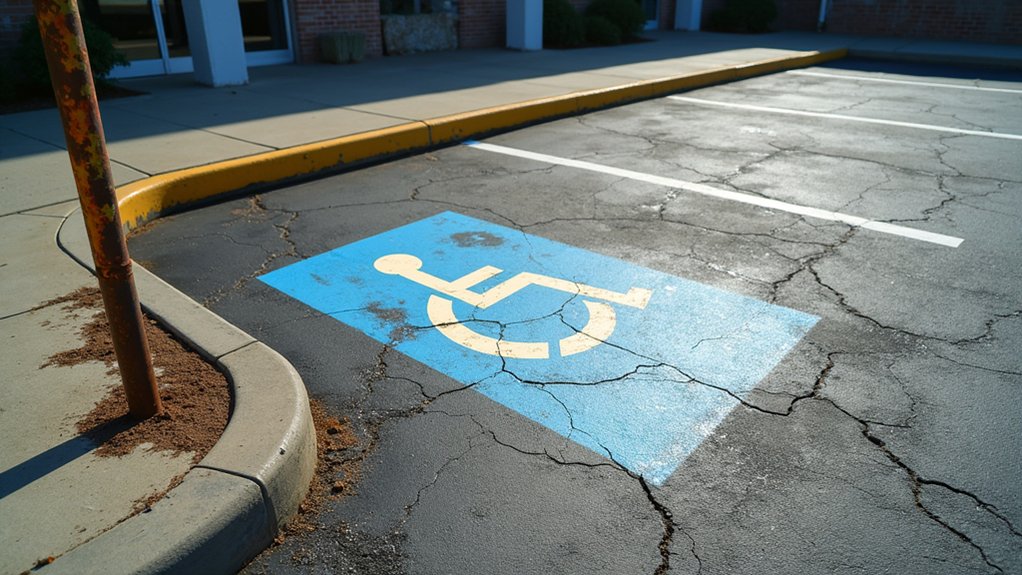
Faded ADA markings fail compliance because they no longer meet the visibility standard inspectors rely on to verify compliance. Your access aisle stripes and the International Symbol of Accessibility must remain clearly visible, and faded ADA markings won’t pass an annual inspection when a tape measure and visual check can’t confirm boundaries. Aisle markings must stay visible so inspectors can verify the aisle matches the adjacent space in length and level. If your painted ISA symbol or aisle borders wash out, you’ve lost the marked separation federal standards require. You can’t verify dimensions, 96 inches for standard spaces, 132 for van-accessible, when the lines aren’t readable. Quarterly inspections should flag fading before it triggers a violation. Repaint your markings as the final retrofit step, after sign installation completes.
How does cracked or heaved pavement create hazards
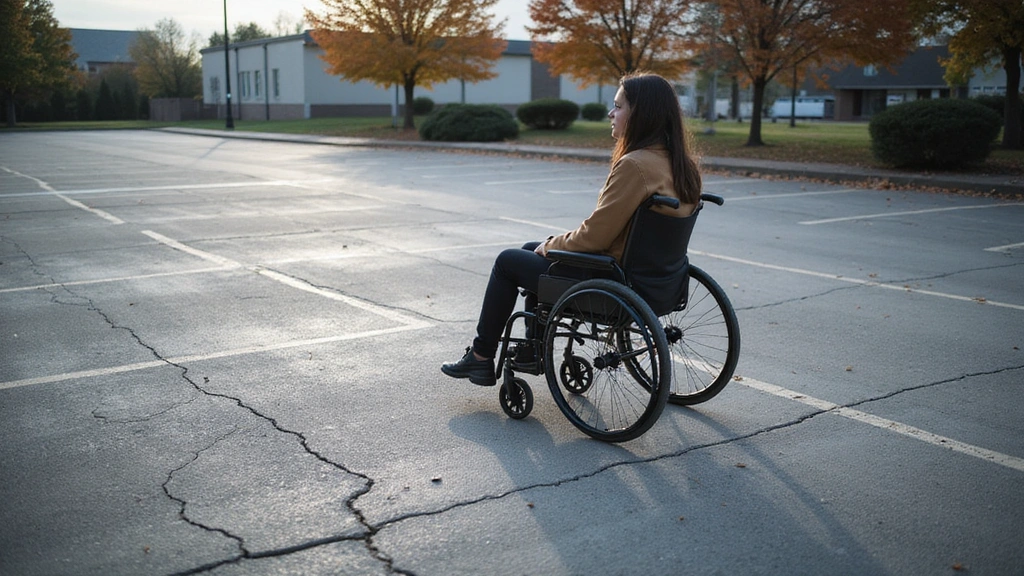
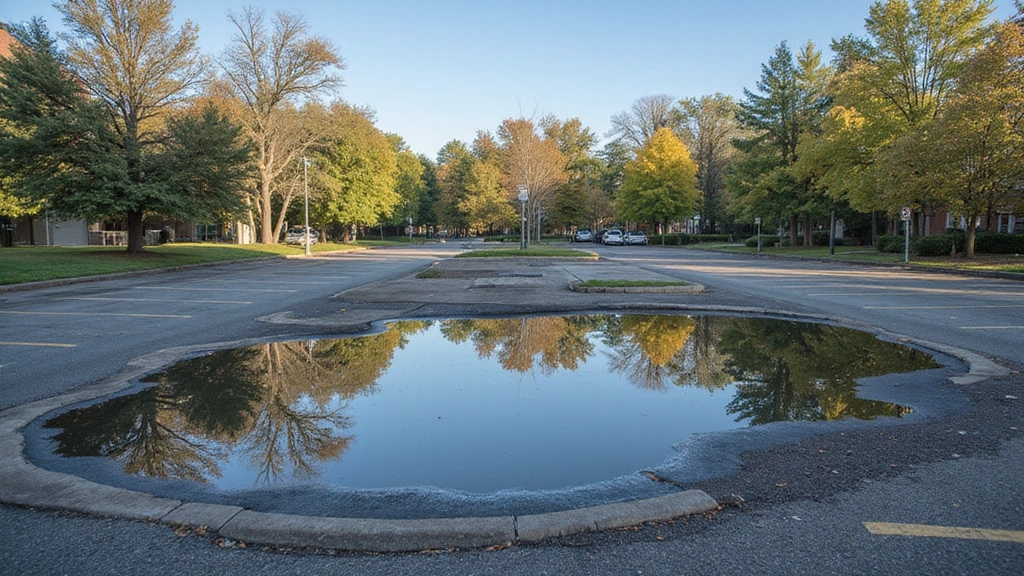
Cracked or heaved pavement destroys the level, stable surface your accessible spaces require. When frost, root growth, or settling lifts your asphalt, you lose the smooth, virtually level surface the code demands. Your slope can’t exceed 1:48 (2.08%) in any direction, and a single heaved section pushes you past that threshold instantly. Cracks catch caster wheels and crutch tips, turning damaged accessible parking into a fall hazard during loading and unloading. Firm, stable, slip-resistant surfaces aren’t optional, they’re the baseline for safe mobility device use. Remember, pre-1991 lots aren’t grandfathered. Once you alter the area, you must retrofit. Survey the slope and dimensions first, then repave before you repaint markings and reset your signage.
Which access aisle and slope problems are most common
The most common access aisle and slope problems are surfaces that exceed the 1:48 (2.08%) maximum, aisles that fall short of the 60-inch minimum width, aisles that no longer match the adjacent space’s length and level, and faded striping that leaves boundaries invisible to drivers. Access aisles take the most abuse from daily traffic, so they’re where you’ll spot the majority of your slope and dimension failures. Over time, settling pavement pushes your surface slope past the 1:48 (2.08%) maximum, creating hazards for wheelchair users during loading.
| Common Problem | Required Standard |
|---|---|
| Excessive cross slope | 1:48 (2.08%) maximum |
| Narrowed aisle width | 60 inches minimum |
| Mismatched aisle length | Equal to parking space |
| Faded aisle markings | Visible, verified annually |
Measure each aisle carefully; small deviations quickly become compliance violations.
When does ADA parking striping need to be redone
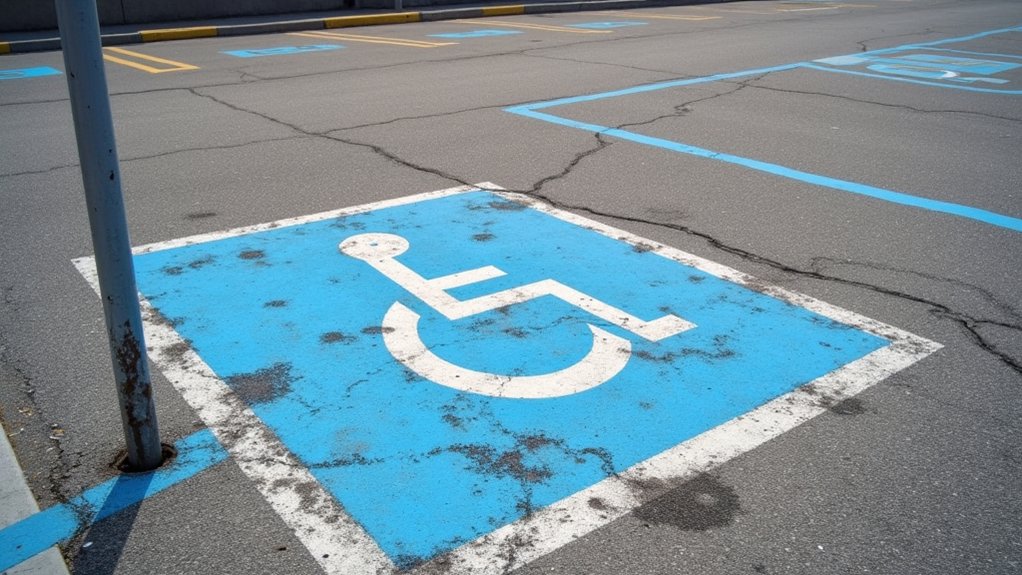
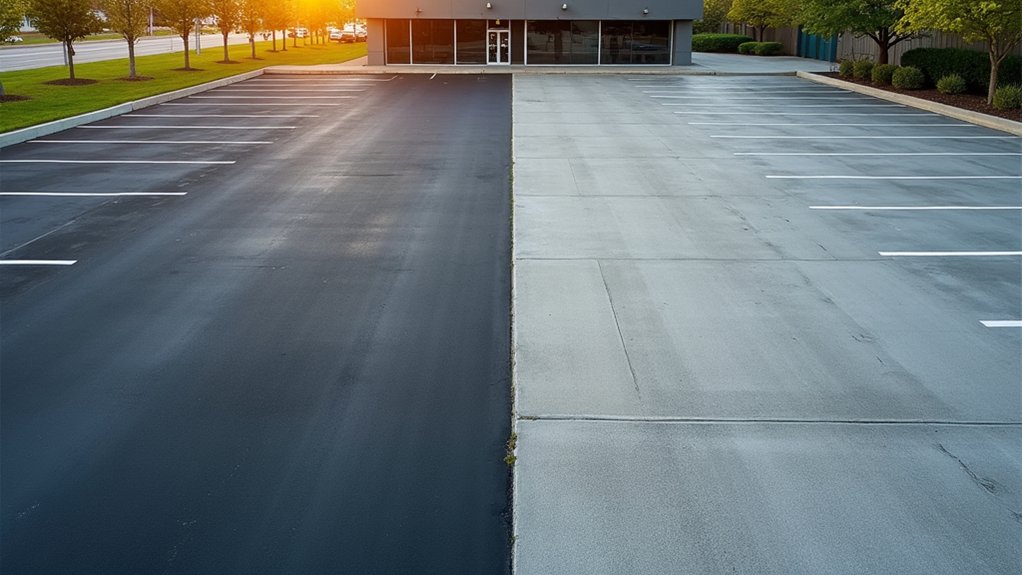
Your ADA parking striping needs redoing whenever aisle markings, boundary lines, or the ISA symbol fade below clear visibility during annual inspections. If you can’t verify aisle dimensions with a tape measure because markings have worn away, you’re out of compliance. Redo striping when you retrofit spaces, since pavement markings for the access aisle and ISA symbol should be painted as the final step after sign installation. You’ll also restripe when alterations trigger path-of-travel upgrades or when quarterly checks reveal faded, obscured lines. Confirm each access aisle maintains the same length and level as its adjacent space, and photograph every restriped space with a date stamp for documentation.
How do you decide which fixes come first
Prioritize parking lot accessibility upgrades that eliminate direct hazards first: correct any surface exceeding the 1:48 (2.08%) slope limit, then stabilize firm, slip-resistant surfaces for loading. Begin by surveying existing slope and dimensions, since surface conditions govern safety. Next, address space and aisle deficiencies. Verify the 96-inch standard width, 132-inch van width, and 60-inch aisle before touching anything else. Then tackle signage: mount panels at 60 inches, confirm ISA symbols, van-accessible plaques, and California’s “Minimum Fine $250” language. Save pavement markings for the ISA symbol and access aisle as the final step, painting them after posts stand permanently. Photograph each space with a date stamp to document your sequence.
How does V&F Paving restore ADA compliance
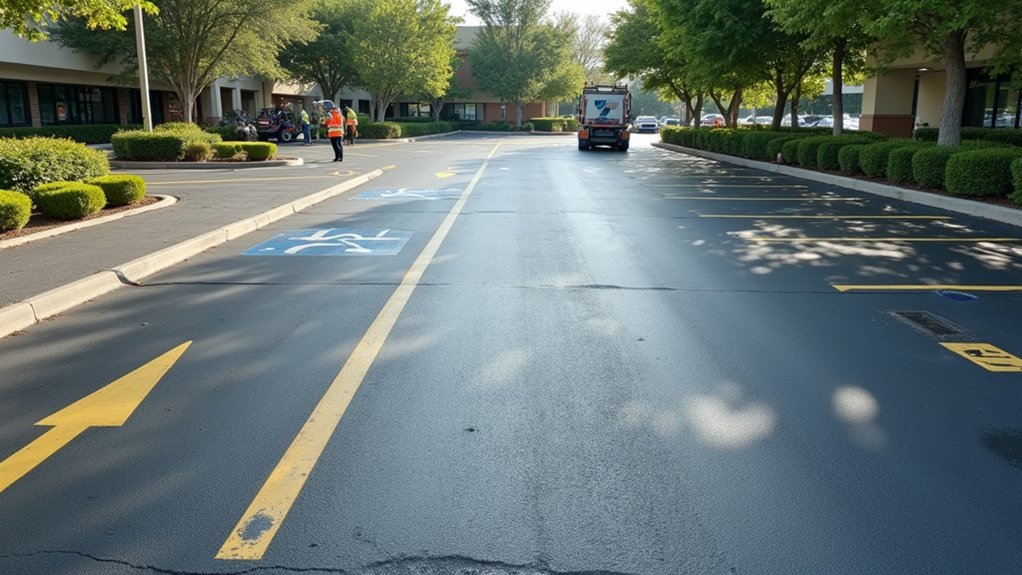
V&F Paving restores ADA compliance by working the retrofit sequence in the order your lot’s conditions demand. We start by surveying your existing slope and dimensions, confirming surfaces stay within the 1:48 (2.08%) maximum and that access aisles match the adjacent space’s length and level. Next, we identify spaces needing conversion, then correct widths, 96 inches for standard, 132 inches for van-accessible, alongside 60-inch aisles. We install permanent posts at the 60-inch mounting height, adding ISA panels, van-accessible plaques, and the “Minimum Fine $250” notice per CBC Section 11B-502.6. Repainting handicap parking comes last: we apply pavement markings for the access aisle and ISA symbol after sign installation. We photograph each space with a date stamp documenting the sign, plaque, aisle, and route.
Bring Your Lot Back Up to Standard
Once your lot starts showing these signs, waiting only widens the gap between what you have and what code requires, and every season of freeze and thaw makes the fix bigger. V&F Paving has handled ADA retrofits, resurfacing, restriping, and signage for Connecticut businesses since 1994, across Hamden, New Haven, Stamford, Danbury, and Fairfield County. We survey your slopes and dimensions first, correct the surface and spaces in the right order, and finish with clean, compliant striping and signage so your lot passes inspection and works for everyone who parks in it. Call (203) 624-2449 for a free evaluation of what your lot actually needs.
Frequently Asked Questions
How much does it cost to bring a parking lot up to ADA compliance?
It depends heavily on what’s failing. Restriping and repainting accessible markings is the least expensive fix, often running a few hundred to around a thousand dollars for a typical lot. Signage replacement adds a modest per-sign cost. The expense climbs when the pavement itself is the problem, since correcting slopes, fixing heaved sections, or resurfacing runs by the square foot and involves real grading work. The only way to get an accurate number is a survey of your actual conditions, because a striping-and-signage fix and a full surface correction are very different projects.
Can I just repaint the accessible spaces instead of repaving?
YOnly if the surface underneath is still sound. Paint won’t bond properly to cracked, crumbling, or deteriorating asphalt, so restriping over a failing surface wastes money and the markings won’t last. More importantly, if the problem is slope or a heaved section rather than just faded paint, fresh striping doesn’t fix the underlying violation at all. The pavement has to be stable and within slope tolerance first. That’s why the surface always gets surveyed and corrected before any markings go down.
Does resurfacing my lot affect ADA compliance?
Yes, and this catches a lot of owners off guard. Adding a new layer of asphalt raises the surface, which shrinks curb heights and can change ramp and accessible-space transitions that were compliant before the overlay. A lot that met standards yesterday can fall out of compliance the moment it’s resurfaced if the transitions aren’t accounted for. On top of that, any resurfacing or restriping project triggers an obligation to bring the accessible spaces up to current code, so it’s best to plan the ADA work into the resurfacing from the start rather than discover the problem after.
How long does an ADA parking upgrade take, and will I have to close the lot?
Most upgrades are faster than owners expect. A restriping and signage job can often be done in a day, with markings ready for traffic within a couple of hours of painting. Resurfacing is a bigger undertaking, typically a one-to-three-day project with the lot needing 24 to 48 hours before vehicles return, depending on cure time and weather. For larger properties, the work can be phased so part of the lot stays open while the rest is corrected, which keeps your business running during the project.
How long will fresh ADA striping actually last before it needs redoing?
It depends on the material and your traffic. Standard traffic paint is the cheaper option upfront but generally needs redoing every one to two years, sooner in high-traffic lots or harsh winters. Thermoplastic costs more to install but bonds harder and can last three to five years or more, which often makes it cheaper per year for busy commercial lots. Whichever you choose, access aisle markings and the ISA symbol have to stay clearly visible to remain compliant, so plan on periodic restriping as ongoing upkeep rather than a one-time fix.