




Building a new lot? You’ll need full ADA compliance in nearly all cases, including accessible spaces and van-accessible parking. Expanding an existing facility counts as an addition, triggering new construction standards without alteration allowances. For existing lots, upgrades kick in only when your work qualifies as an alteration—like mill-and-overlay resurfacing or layout reconfiguration. Maintenance such as sealcoating or pothole patching won’t trigger obligations. Keep going to see exactly where your project lands.
Key Takeaways
- New parking lots almost always require full ADA upgrades, including accessible spaces and van-accessible parking, with very few exceptions.
- Existing lots require upgrades only when work qualifies as an alteration, such as mill-and-overlay resurfacing or layout reconfiguration.
- Maintenance activities like pothole patching, crack sealing, and sealcoating do not trigger ADA obligations or path-of-travel upgrades.
- Expanding gross floor area or facility height counts as an addition, triggering full new construction compliance without alteration cost allowances.
- Older existing lots still require readily achievable barrier removal, like restriping spaces and adding compliant signage, even absent alterations.
When are ADA upgrades required for new versus existing lots

ADA upgrades are required for new lots in nearly all cases and for existing lots only when your work qualifies as an alteration. If you’re building a new lot, you must meet minimum ADA standards, including accessible spaces and ADA van parking requirements, with very few exceptions. Expanding gross floor area or facility height counts as an addition, triggering full new construction compliance without alteration allowances.
For existing lots, upgrades hinge on whether your work qualifies as an alteration. Resurfacing through mill and overlay, or reconfiguring your layout, triggers mandatory compliance. However, maintenance activities such as patching potholes, crack sealing, or sealcoating don’t trigger obligations or path-of-travel upgrades.
You’ll also lose safe harbor when altering a lot, potentially requiring more van-accessible spaces under the 2010 Standards’ one-in-six ratio rather than the older one-in-eight.
What triggers full compliance in new construction
Full ADA compliance is triggered when you build a new parking facility or expand an existing one, with very few exceptions. Any project that increases gross floor area or facility height counts as an addition, and additions must meet all new construction standards without alteration allowances. You can’t rely on the path-of-travel cost caps that apply to alterations. Every new parking facility requires accessible spaces, calculated per the minimum space requirements for its total count. The van accessible parking requirements are stricter under the 2010 Standards: at least one of every six accessible spaces must be van-accessible, providing 96-inch width plus a 96-inch access aisle for 16 feet total. If your site has multiple facilities, you’ll calculate accessible spaces separately for each one.
How do ADA alterations and renovations trigger new rules

ADA alterations trigger new compliance rules when work affects the usability of your lot, activating mandatory upgrades. The word “alteration” carries specific regulatory weight under ADA rules. ADA alterations include resurfacing through mill and overlay, and reconfiguring your parking layout. Maintenance activities don’t carry the same obligation. The distinction protects you from unnecessary costs and unexpected liability.
| Work Type | Classification | Triggers Upgrade |
|---|---|---|
| Mill and overlay | Alteration | Yes |
| Layout reconfiguration | Alteration | Yes |
| Pothole patching | Maintenance | No |
| Sealcoating | Maintenance | No |
An alteration requires you to provide an accessible path of travel to the affected primary function area. However, path-of-travel improvements can’t exceed 20% of your total alteration cost, capping your disproportionate expenditures.
What is readily achievable ADA barrier removal
Readily achievable barrier removal is a standard governing older lots that predate current ADA requirements. You’re obligated to remove access barriers when doing so is easily accomplishable without significant difficulty or expense. This ongoing duty applies even absent any alteration, targeting non-compliant conditions in existing facilities.
For parking lots, you’ll evaluate whether corrective work qualifies as readily achievable barrier removal based on cost, feasibility, and site constraints:
- Restriping existing spaces to meet 96-inch width and access-aisle requirements
- Adding or replacing compliant signage with the International Symbol of Accessibility
- Regrading surfaces exceeding the 2.08% slope maximum where feasible
- Upgrading non-compliant 1991-standard lots to 2010 standards when practical
- Providing van-accessible spaces with proper 96-inch aisles and clearance signage
Prioritize low-cost, high-impact corrections first.
How do temporary lots stay compliant during a project
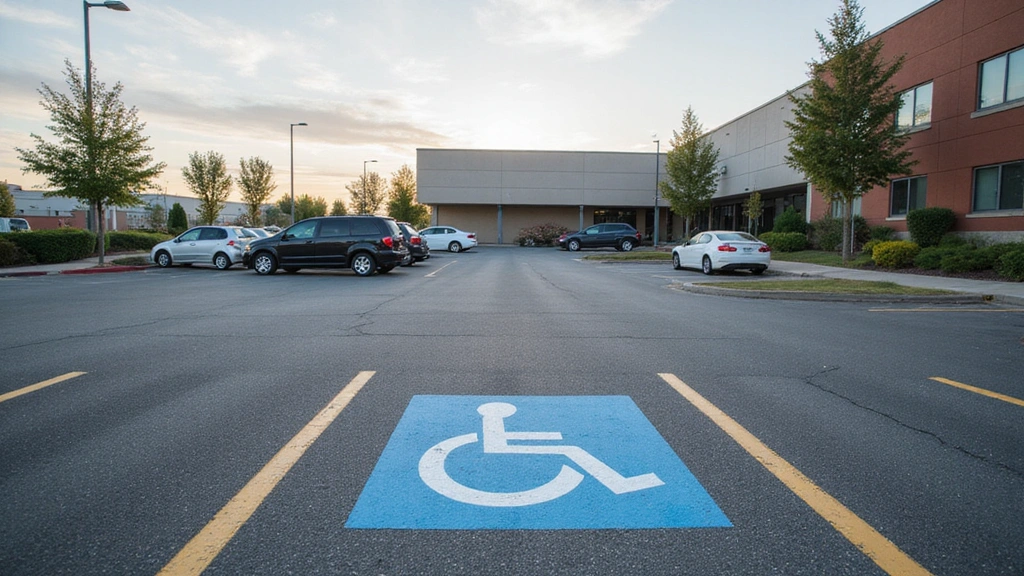
Temporary lots stay compliant during a project by meeting the same ADA accessibility requirements as permanent lots, since they don’t get a pass simply because they’re provisional. When you provide ADA parking during construction, you must maintain the minimum accessible space counts based on the lot’s total capacity, at least one accessible space for lots under 25 spaces. You’ll need van-accessible spaces at one per every six accessible spaces, with proper 96-inch widths and access aisles. Surface slope can’t exceed 2.08% in any direction, even on temporary paving. You must mark access aisles to discourage parking and post signage displaying the International Symbol of Accessibility. Additionally, you’re required to provide an accessible path of travel from the temporary spaces to the primary function area.
How do you plan upgrades into a renovation budget
Plan ADA upgrades into a renovation budget by identifying whether your project qualifies as an alteration or an addition, since that classification determines your compliance obligations and lets you allocate costs accurately. Resurfacing and reconfiguration trigger alteration obligations, while sealcoating and pothole patching don’t. For ADA renovations tied to a primary function area, remember the path-of-travel improvements can’t exceed 20% of total alteration cost.
- Confirm whether resurfacing, reconfiguration, or additions apply to your scope
- Budget path-of-travel upgrades up to the 20% disproportionality cap
- Account for lost safe harbor requiring updated van-accessible ratios
- Include signage, slope corrections, and access aisle striping costs
- Verify California’s CBC 11B-202.4 cumulative valuation trigger for multiple alterations
Precise classification prevents costly compliance surprises.
How does V&F Paving manage compliance on any project
V&F Paving manages compliance by first classifying your project as maintenance, an alteration, or an addition, since that determination dictates which ADA standards apply. If your work is sealcoating, pothole patching, or crack sealing, we treat it as maintenance and won’t trigger path-of-travel obligations. When your project involves mill and overlay or layout reconfiguration, we classify it as an alteration and evaluate safe harbor status, ADA barrier removal requirements, and van-accessible ratios under the 2010 Standards. For additions expanding floor area or height, we apply full new construction standards without alteration allowances. We verify space widths, access aisle dimensions, 2.08% maximum slopes, and signage. We also calculate your required accessible counts per facility and cap path-of-travel improvements at 20% of alteration cost.
Know Where Your Project Stands Before You Break Ground
Whether your project triggers full ADA compliance or none at all comes down to how the work is classified, and getting that wrong is what leads to failed inspections, correction notices, and blown budgets. V&F Paving has handled new lot construction, resurfacing, reconfiguration, and maintenance for Connecticut businesses since 1994, across Hamden, New Haven, Stamford, Danbury, and Fairfield County. We classify your project correctly up front, tell you plainly what compliance work it does or doesn’t require, and scope any needed accessible upgrades into the plan from the start so there are no surprises mid-project. Call (203) 624-2449 for a free assessment of your project and what it requires.
Frequently Asked Questions
Does restriping or sealcoating my lot trigger ADA compliance?
Under the Department of Justice’s reading, restriping, sealcoating, and resurfacing can all trigger an obligation to bring accessible spaces up to current standards, because these projects are relatively inexpensive and correcting the spaces at the same time is considered readily achievable. Simple surface patching generally doesn’t. The line between routine maintenance and a compliance-triggering alteration isn’t always obvious, so before you assume a project is exempt, it’s worth confirming the classification. Building the accessible work into the scope from the start is cheaper than a correction later.
If I hire a contractor and the finished lot isn’t compliant, who’s liable?
You are, as the property owner or manager. Hiring a contractor to do the work does not transfer the legal responsibility for compliance. If the completed lot falls short of ADA standards, it’s the owner who faces the fines and lawsuits, not the paving crew. That’s exactly why it matters to work with a contractor who understands the compliance triggers and builds the accessible requirements into the job correctly, rather than one who simply paves and stripes whatever’s already there without accounting for the standards.
What is “safe harbor,” and how do I know if I have it?
Safe harbor means that if your accessible parking already complied with the 1991 ADA standards as of March 2012, you generally don’t have to upgrade it to the newer 2010 standards, until you alter the lot for some other reason. For example, an older lot striped to the previous one-in-eight van ratio can stay as-is under safe harbor. But the moment you restripe or resurface, that protection drops for the affected elements and you have to meet the current one-in-six van ratio. Safe harbor only holds as long as you leave the lot alone.
How do I tell whether my project is “maintenance” or an “alteration”?
The test is whether the work affects the usability of the lot. Patching a pothole or sealing cracks preserves what’s already there and generally counts as maintenance. Milling and overlaying the surface or reconfiguring the layout changes the lot in a way that counts as an alteration and triggers compliance. The trouble is that some projects sit in a gray zone, and the classification carries real cost consequences. When it’s unclear, the safest move is to confirm with your local authority having jurisdiction before the work starts rather than after a correction notice arrives.
We’re only adding a few spaces to our existing lot. Does that count as new construction?
Adding parking is generally treated as an addition, which is held to new construction standards for the new spaces rather than the more lenient alteration allowances. So the spaces you add have to be fully compliant, and depending on the scope, the work can also trigger obligations for the accessible route serving them. A small expansion can carry more compliance weight than owners expect, so it’s worth scoping the accessible requirements before construction rather than discovering them when the project is inspected.