
Your asphalt parking lot’s cost depends on what’s underneath, how thick you pave, and what your quote includes. New lots typically run $2 to $7 per square foot. Light-duty lots use about 3 inches of asphalt. Heavy-duty lots need 4 to 6 inches, and each added inch costs $0.50 to $1.00 per square foot. Base depth, soil, drainage, and lot size shift your price further. Below, you’ll see how each factor shapes your final number.
Key Takeaways
- Asphalt thickness drives cost, with each additional inch adding roughly $0.50 to $1.00 per square foot.
- Heavier traffic loads require thicker asphalt and a stronger aggregate base, such as six or more inches of stone.
- Soil condition, drainage, stone depth, removal work, and haul distances all shift base and sub-base preparation costs.
- Larger lots raise total cost but lower per-square-foot pricing, since fixed mobilization costs spread over more area.
- Quote scope varies, so compare itemized bids covering area, thickness, base depth, removal, striping, and drainage work.
What determines the cost of an asphalt parking lot
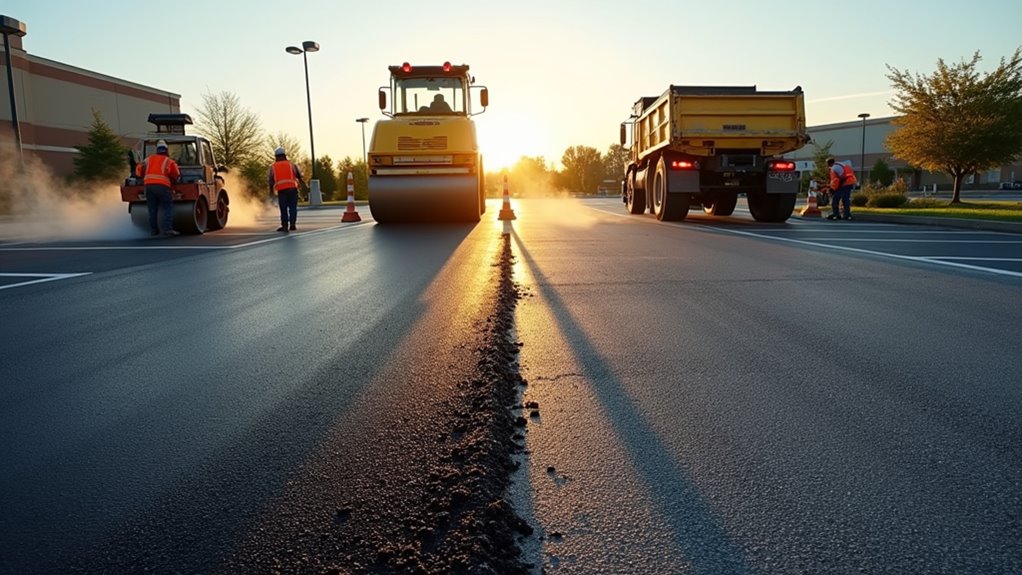
The cost of an asphalt parking lot is determined by what’s underneath, how thick you build it, and what the quote includes, with most new lots costing $2 to $7 per square foot.
Estimates of how much to asphalt a parking lot should use total paved area, not parking spaces, since drive aisles and loading zones add square footage. Soft or poorly drained soil may need extra excavation and stone base. Heavy truck traffic needs 4 to 6 inches of asphalt, not 3, and each added inch runs about $0.50 to $1.00 per square foot.
For existing pavement, asphalt parking lot repair cost depends on condition. Overlays run $1 to $3 per square foot, and full replacement reaches $4 to $10. To compare the cost of asphalt parking lot bids, confirm area, thickness, base preparation, and striping.
How do the main cost factors break down
Materials and labor make up the core of the price on most quotes, with materials often at $1 to $2.50 per square foot and labor at $1.50 to $2. Base preparation, thickness, and extras are layered on top.
| Cost Factor | Typical Cost per Sq. Ft. |
|---|---|
| Materials and labor | $2.50 to $4.50 |
| Each added inch of asphalt | $0.50 to $1.00 |
| Sealcoating | $0.15 to $0.35 |
Site conditions shift these numbers. If your soil is soft or poorly drained, you’ll pay for extra excavation, stabilization, or aggregate base. Heavy-duty lots need 4 to 6 inches of asphalt versus roughly 3 for passenger cars. Full replacement runs $4 to $10 per square foot, while resurfacing a sound lot costs $1 to $3. Small jobs carry higher unit costs because mobilization spreads over less area. Confirm every bid states thickness, base depth, and striping.
How does asphalt thickness change the parking lot price
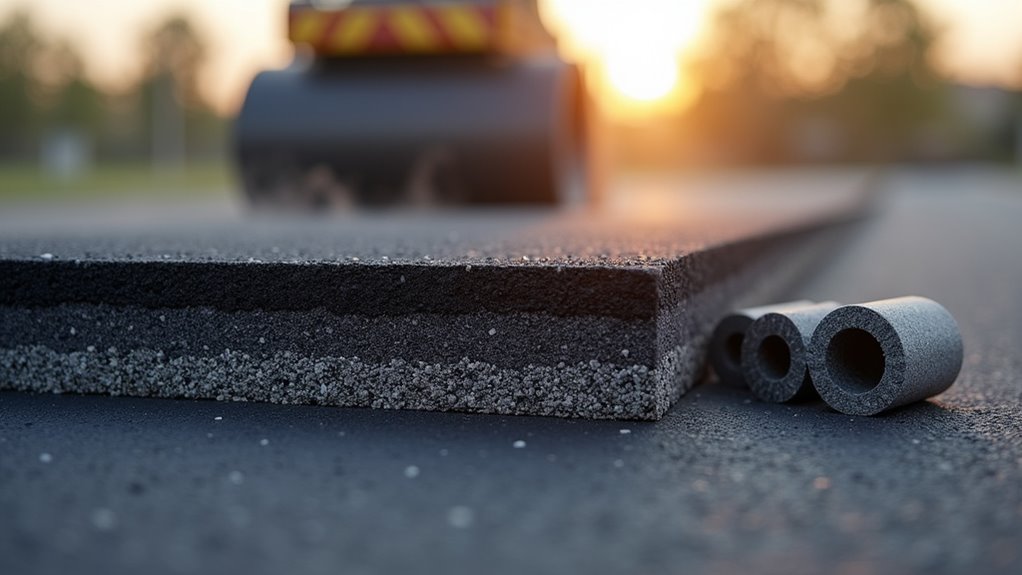
Thicker asphalt raises your parking lot price, and thickness is one of the biggest levers on your paving cost, since every added inch increases material tonnage and placement work.
Light-duty lots for passenger cars typically use about 3 inches of asphalt, while heavy-duty lots handling trucks or industrial traffic need 4 to 6 inches. Each additional inch adds roughly $0.50 to $1.00 per square foot. On a 20,000-square-foot lot, going from 3 to 5 inches could add $20,000 to $40,000.
Thickness doesn’t work alone. Heavier loads also demand a stronger aggregate base, such as 6 inches of stone or more, which raises excavation and material costs.
Don’t underbuild to save money. Pavement that’s too thin for your traffic fails early. Specify thickness for expected vehicle loads, and make sure every bid states both asphalt and base depths.
How does the base and sub-base drive cost
The base and sub-base drive cost through soil condition, drainage, stone depth, removal work, and haul distance, and they can swing your budget as much as surface thickness does. If your soil’s weak or wet, you’ll pay to fix it first, before any asphalt goes down.
- Soft or unstable soil may need extra excavation and stabilization.
- Poor drainage can require more aggregate base work.
- A typical new lot uses 6 inches of stone under 3 inches of asphalt, so base depth drives material quantities.
- Removing failed pavement and rebuilding the base costs more than overlaying sound pavement.
- Longer hauls for stone and equipment raise freight costs.
Ask every bidder to state clearly base depth, stabilization work, and removal scope so you’re comparing equal foundations, not just matching surface prices.
How do size and site prep change the total
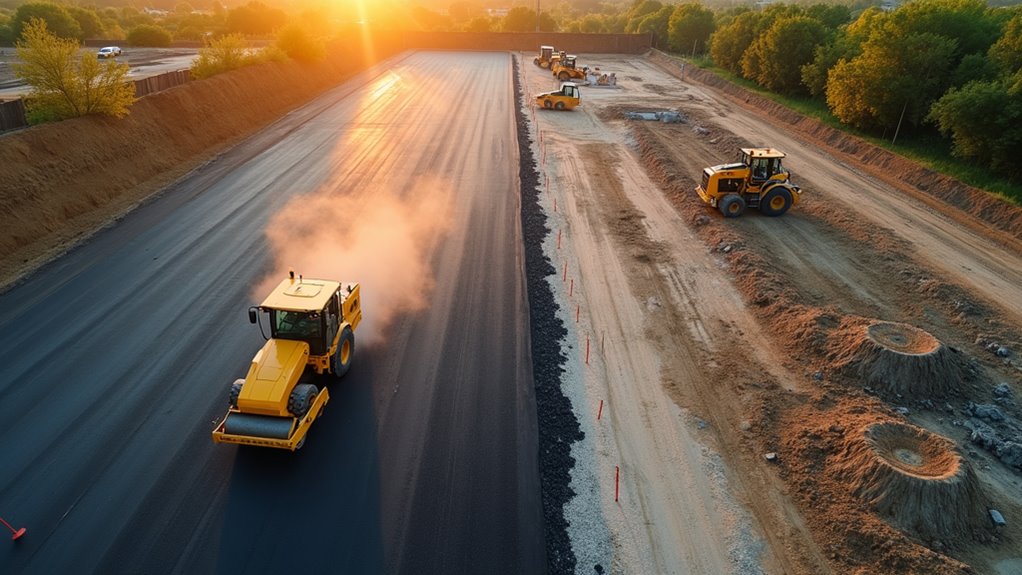
Larger lots raise the total but often lower the per-square-foot price, while site prep needs such as soil work, pavement removal, and difficult access add to the total. Mobilization and setup costs stay roughly fixed, so your lot’s size changes the per-square-foot price as much as the total.
Small jobs spread those costs over less area, so you’ll often pay more per square foot, while larger projects benefit from economies of scale. A 10,000-square-foot lot at $2.50 to $4.50 per square foot runs $25,000 to $45,000. A 30,000-square-foot lot at $3 to $7 runs $90,000 to $210,000.
Measure total paved area, not parking spaces, since drive aisles, access lanes, and loading zones add quantity. Islands, multiple entrances, and tight work areas raise complexity. Soft or poorly drained soil may need excavation or stabilization, and failed pavement may require milling, patching, or full-depth replacement. Long hauls and difficult access add freight costs. Get bids on the same measured scope and prep.
How do drainage and striping add to the bill
Drainage and striping add to your bill either as extra line items or as costs that quietly fall outside the quoted scope.
Full commercial builds with drainage, curbing, and lighting can run $4.50 to $12 per square foot, versus $2 to $7 for basic paving. Confirm exactly what each contractor includes when comparing bids.
- Drainage: Poorly drained soil may need extra excavation, stabilization, or aggregate base before paving.
- Curbing and lighting: These add-ons push your project toward full-build pricing.
- Striping: Some quotes include it; others don’t, so verify it’s listed.
- Sealcoating: Budget roughly $0.15 to $0.35 per square foot every 2 to 5 years.
- Repairs: Routine crack sealing and prompt pothole fixes help your lot reach 15 to 25 years.
Request itemized line items for each extra so you can spot omissions and compare contractors on identical scope.
How do you estimate the cost of your parking lot
Estimate your parking lot cost by measuring your total paved area and multiplying it by a realistic per-square-foot rate, since square footage drives every parking-lot estimate. Include drive aisles, access lanes, and loading zones in that measurement, not just parking spaces. New paving typically runs $2 to $7 per square foot, so a 10,000-square-foot lot at $2.50 to $4.50 costs roughly $25,000 to $45,000. If you’re resurfacing a sound existing lot, budget $1 to $3 per square foot. Full removal and replacement can reach $4 to $10. Then adjust for your conditions. Add $0.50 to $1.00 per square foot for each extra inch of asphalt, and plan for base work if your soil drains poorly. Finally, request bids that list the same area, asphalt and base thicknesses, and removal scope, and that state whether striping is included.
Get a Parking Lot Estimate Based on Your Site
V&F Paving provides commercial asphalt paving services for property owners planning new parking lots, expansions, repairs, and replacement projects. The final cost depends on your lot size, traffic demands, asphalt and base thickness, soil, drainage, access, and the work included in the paving scope. Call (203) 624-2449 to discuss your project and get an estimate.
Frequently Asked Questions
How Long Does an Asphalt Parking Lot Typically Last With Proper Maintenance?
With proper maintenance, you can expect your asphalt parking lot to last about 15 to 25 years. You’ll extend that lifespan by sealcoating every 2 to 5 years at roughly $0.15 to $0.35 per square foot. You should also seal cracks and fix potholes promptly so damage doesn’t spread. Plan to resurface after roughly 15 to 20 years at $1 to $3 per square foot, which you’ll find far cheaper than full removal and replacement at $4 to $10 per square foot.
How Often Should an Asphalt Parking Lot Be Sealcoated?
You should sealcoat your asphalt parking lot every 2 to 5 years, depending on its condition and your maintenance plan. At $0.15 to $0.35 per square foot, you’d spend about $1,500 to $3,500 sealcoating a 10,000-square-foot lot. Pair it with routine crack sealing and prompt pothole repairs, and you’ll slow deterioration before it worsens. That upkeep helps your lot reach 15 to 20 years before you’ll need resurfacing at $1 to $3 per square foot, which costs far more than sealcoating.
When Should a Parking Lot Be Resurfaced Instead of Fully Replaced?
Resurface your lot when the existing pavement and base are still sound and damage stays near the surface. If the base has failed or soils are unstable, you’ll need full removal and replacement, because an overlay won’t fix what’s underneath. Resurfacing typically costs $1 to $3 per square foot, while replacement runs $4 to $10. Have qualified contractors assess the pavement’s condition first, and you’ll avoid paying for an overlay that fails too early.
Why Do Crack Sealing and Pothole Repairs Matter for Asphalt Lots?
Crack sealing and prompt pothole repairs let you stop damage before it worsens. If you leave small defects open, deterioration can spread, and you may lose the option of a $1 to $3 per-square-foot resurfacing and face costlier milling, patching, or $4 to $10 full replacement instead. Pair prompt repairs with sealcoating every 2 to 5 years at roughly $0.15 to $0.35 per square foot, and you’ll help your lot reach its expected 15 to 25-year lifespan.
What Should You Check When Comparing Parking Lot Paving Bids?
Check that every bid uses the same measured paving area, asphalt thickness, base depth, and preparation scope. Confirm whether you’re getting an overlay, mill-and-overlay, or full removal and replacement, since pricing varies sharply. Verify that subgrade work, compaction, and striping are included. Ask how regional material, freight, and labor rates affect pricing. If you skip these checks, you’ll compare mismatched scopes instead of true costs.