
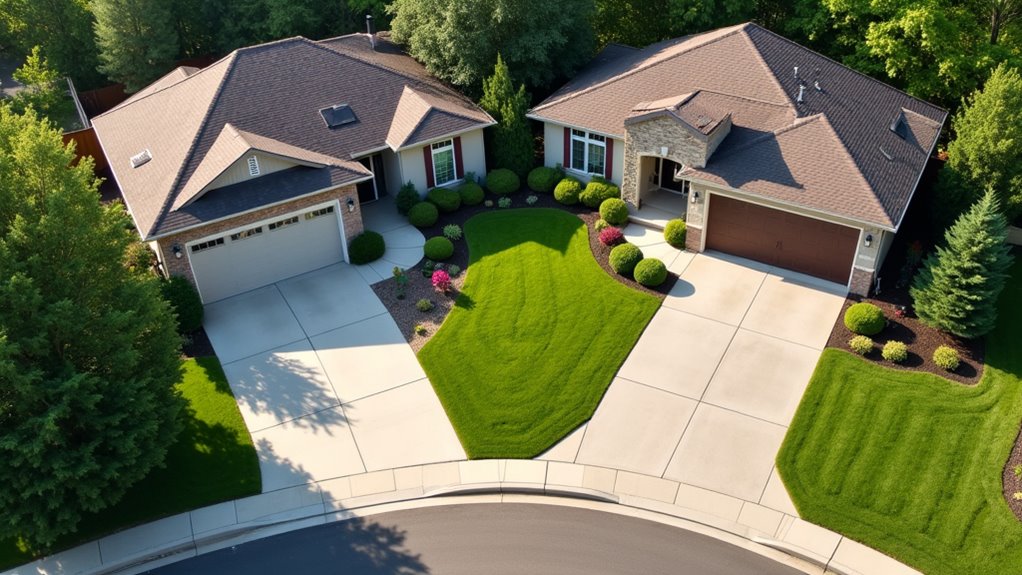
An asphalt overlay bonds a new wearing surface to your existing pavement, preserving the underlying base and structure you’ve already got. Full removal strips everything down to subgrade and rebuilds each layer from scratch. You’ll choose overlay when your base remains structurally sound and can still handle load-bearing requirements. Full removal becomes necessary when foundation failure—like alligator cracking or subbase erosion—compromises structural integrity. Understanding what triggers each approach helps you avoid costly mistakes.
Overlay or Full Replacement: How to Decide?
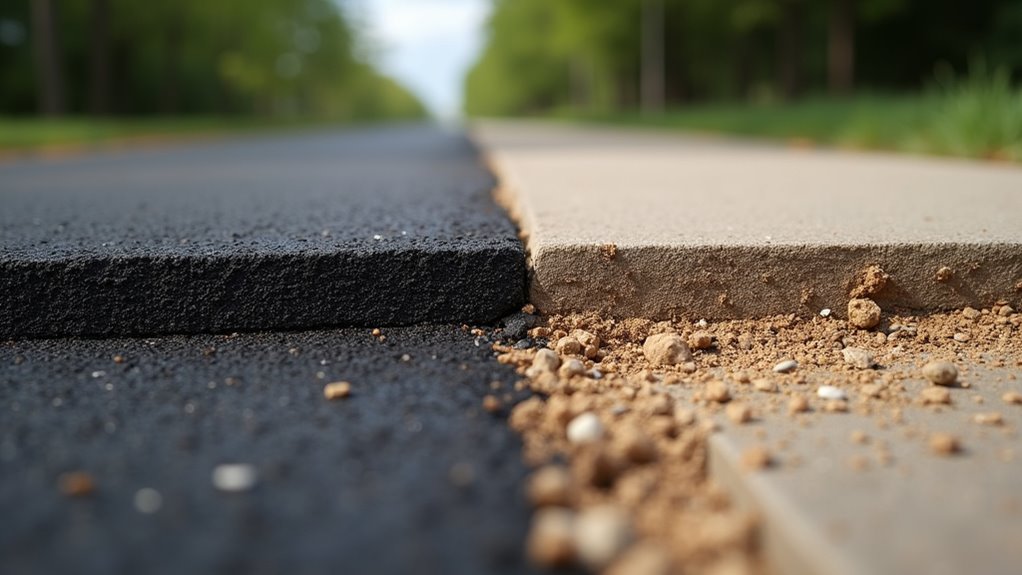
Several critical factors determine whether your pavement project calls for an asphalt overlay or complete removal and replacement. When evaluating asphalt overlay vs full removal, you’ll need to assess your existing base stability, structural integrity, and load-bearing requirements.
If your pavement shows only surface-level damage—minor cracking, oxidation, or shallow potholes—an overlay delivers cost-effective results. You’ll save 30-50% upfront while completing the project in one to two days. The overlay process involves cleaning the existing surface, addressing any structural issues, and applying the new asphalt layer.
However, when you’re dealing with drainage failures, subgrade instability, or extensive structural compromise, the pavement tear-out process steps become necessary. Full replacement corrects elevation problems and eliminates weak spots entirely. This approach meets code requirements for load transfer and provides 15-30 years of service life versus 8-15 years for overlays.
When Foundation Damage Rules Out Asphalt Overlay
When your pavement exhibits widespread alligator cracking—that distinctive reptile-skin pattern spreading across the surface—you’re seeing evidence of base failure that no overlay can correct.
Alligator cracking signals deep structural failure—no surface solution can fix what’s broken beneath your pavement.
Major potholes and sunken areas confirm subbase erosion weak base conditions requiring excavation. These voids collapse under traffic loads, and any overlay applied over compromised foundations fails rapidly. Per AASHTO pavement design guidelines, structural integrity depends on stable base layers supporting load transfer. A weak foundation causes asphalt to settle and break up easily, making overlay an ineffective solution.
Standing water indicates drainage deficiencies demanding regrading—something overlay cannot achieve. Water infiltration erodes subbase material, accelerating deterioration beneath new surfaces.
Full-depth reclamation asphalt becomes necessary when multiple prior overlays have exceeded thickness limits or when soft soil shifting destabilizes the foundation. You’ll need professional evaluation to confirm whether your base can support additional loading or requires complete reconstruction from the subgrade upward.
What Surface Damage Can Overlay Actually Fix?
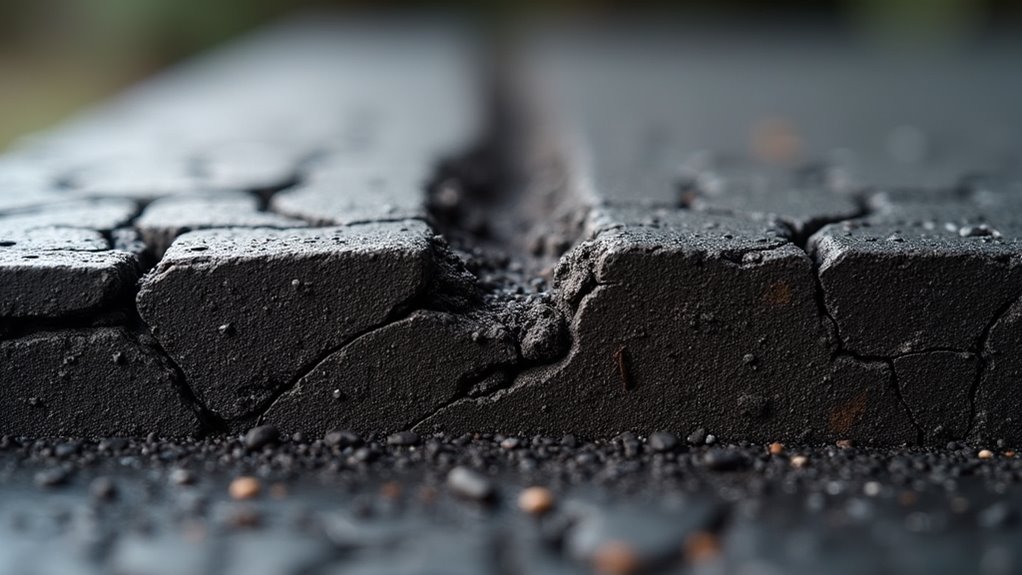
You can address surface-level distress with overlay when structural integrity remains intact below the wearing course. Minor cracking, oxidation, shallow potholes, and moderate raveling respond well to overlay treatment because these defects haven’t compromised load-bearing capacity or subgrade stability. The overlay process involves a milling machine removing up to 3 inches of existing pavement before new asphalt courses are placed. However, you’ll need to evaluate damage coverage limits—once surface deterioration exceeds approximately 25-30% of total pavement area or shows interconnected crack patterns, overlay effectiveness diminishes considerably.
Minor Cracking and Oxidation
Although surface oxidation and minor cracking might appear purely cosmetic, these conditions directly impact pavement serviceability and long-term structural performance. UV exposure and oxygen cause binder hardening, reducing flexibility and increasing crack propagation risk. You’ll notice oxidized surfaces display a faded gray color and dry texture.
Overlay thickness standards asphalt specifications typically require minimum lifts of 1.5 inches for structural benefit over oxidized surfaces. Thin overlays effectively seal hairline and transverse cracks when you’ve confirmed base integrity remains intact. However, overlay bonding failure risks increase greatly when you apply new material over severely oxidized pavement without proper surface preparation.
You should address minor cracks under ½-inch with crack sealants before overlay installation. Rubberized sealant works best for active cracks that expand and contract seasonally, ensuring long-term bond integrity.
Surface Potholes and Wear
Surface potholes signal active pavement distress, but overlay can address this damage effectively if you’ve confirmed the underlying base remains structurally sound. When you’re dealing with shallow potholes on pavements rated good to fair, asphalt overlay provides a viable rehabilitation strategy. The process involves milling defective areas, cleaning the existing surface, and applying surface course asphalt application to restore structural integrity.
Your preparation phase must include patching depressed areas to match surrounding pavement grades before overlay placement. Preheating the existing surface enhances bonding and reduces reflective cracking potential. This approach delivers 12-15 year life expectancy while saving $6-10 in future repairs per $1 invested. However, if potholes extend into compromised base layers, you’ll need full removal to address subgrade instability rather than surface treatment alone.
Damage Coverage Limits
Determining whether overlay addresses your pavement’s damage requires understanding the specific failure modes asphalt surfacing can correct. You’re limited to minor cracking—hairline, linear, or shallow fatigue patterns that haven’t penetrated your base layer. Rut depths must stay under half an inch, and depressions require stable underlying material for proper leveling. Determining whether overlay addresses your pavement’s damage requires understanding the specific failure modes asphalt surfacing can correct. As part of smart asphalt driveway maintenance tips, you’re limited to minor cracking—hairline, linear, or shallow fatigue patterns that haven’t penetrated your base layer. Rut depths must stay under half an inch, and depressions require stable underlying material for proper leveling.
Your subbase condition dictates everything. Overlay works when you’ve got structurally sound foundations without erosion, shifting, or softening. Once base failure occurs, you’ll need sub-base rebuilding methods rather than surface treatment. Pavement structural reinforcement methods through overlay only succeed on surfaces 15–20 years old with minimal prior repairs.
Drainage must function properly—no pooling, adequate slope, limited water intrusion. Exceeding these parameters means full removal becomes your only code-compliant option.
Why Cracks Reflect Through Overlays Over Time
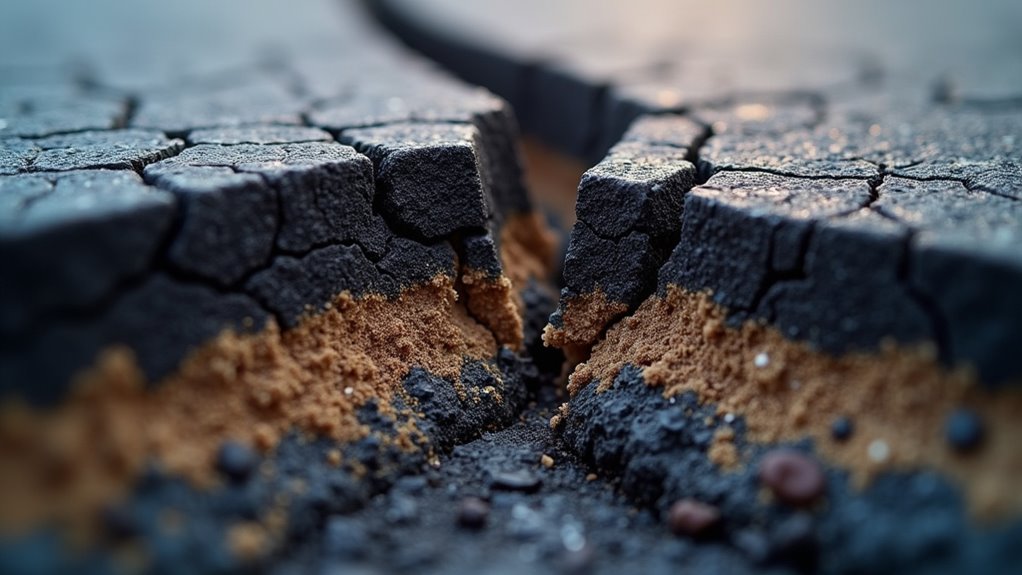
When you place an asphalt overlay over existing pavement, the underlying structure doesn’t stop moving—it transfers stress directly upward through your new surface layer. Temperature cycling and thermal cracking effects drive expansion and contraction in the base pavement, creating differential movement across existing cracks and joints. This movement transmits stress vertically through your overlay, producing reflection cracks directly above underlying damage points.
Understanding pavement structural upgrade differences helps you anticipate this failure mode. Each inch of overlay typically delays reflection cracking by only one year when temperature-related stress is the primary driver. Rigid pavement slabs beneath flexible overlays experience thermal and moisture-induced movement that accelerates under traffic loading. Without proper crack treatment before installation, existing damage becomes a predetermined failure pathway through your new surface.
Lifespan Comparison: 8–15 Years Vs 15–30 Years
Because overlay and full replacement address fundamentally different structural conditions, their service life projections diverge greatly—8 to 15 years versus 15 to 30 years respectively.
When you choose overlay, you’re extending pavement life while retaining existing base limitations. Your surface gains 8 to 15 years under ideal conditions—stable subgrade, light traffic loads, and consistent sealcoating every 2 to 3 years. Heavy truck routes typically reduce this to 7 to 12 years.
A structural pavement rebuild through full removal delivers 15 to 30 years of service. This pavement reconstruction procedure eliminates compromised layers, allowing proper subgrade stabilization and drainage correction. You’re addressing load transfer deficiencies that overlays can’t resolve.
Maintenance impacts both methods considerably. Routine crack sealing and sealcoating extend overlay life by 30 to 40 percent, while thorough upkeep pushes full replacements toward the 30-year threshold.
When Overlay’s Lower Cost Becomes More Expensive
Overlay’s initial 30-50% cost advantage—$2-$5 per square foot versus $5-$12 for full replacement—erodes rapidly when you’re working with compromised base conditions. When structural load transfer pavement mechanisms fail beneath your overlay, you’ll face premature cracking and repeated interventions that compound expenses.
Overlay savings disappear when base conditions fail—premature cracking turns budget wins into compounding long-term costs.
A weak subgrade won’t meet base compaction standards, regardless of surface treatment. You’re fundamentally layering new asphalt over deteriorating infrastructure. Within three to five years, reflective cracking emerges, requiring patch repairs or complete re-overlay. asphalt resurfacing benefits for homeowners include improving curb appeal and increasing property value. Additionally, a well-executed resurfacing project can extend the lifespan of your driveway, reducing the need for frequent repairs. Ultimately, investing in quality resurfacing is a proactive step towards maintaining the integrity of your home’s exterior.
Consider the math: two overlays at $4 per square foot plus interim repairs exceed single full replacement costs. Poor drainage compounds deterioration rates, accelerating failure cycles.
Full removal allows subgrade stabilization and proper base reconstruction. You’ll achieve code-compliant compaction densities and restore load distribution capacity—preventing the cascading failures that transform overlay’s budget advantage into long-term liability.
Environmental Impact of Each Asphalt Option
When you choose between overlay and full removal, you’re making a decision that directly affects material waste generation, energy consumption, and regulatory compliance. Full removal demands significant aggregate mining and produces higher greenhouse gas emissions from heating new materials, while overlay methods preserve existing structural layers and reduce virgin resource extraction. Understanding these environmental trade-offs helps you meet sustainability requirements and minimize your project’s ecological footprint under current EPA standards.
Material Waste Comparison
Although both asphalt methods generate construction waste, the volume differs extensively based on structural approach. When you choose overlay, you’ll preserve existing pavement layers, reducing landfill-bound materials by up to 60%. Your asphalt milling operation removes only the deteriorated surface, generating minimal debris while maintaining structural integrity beneath.
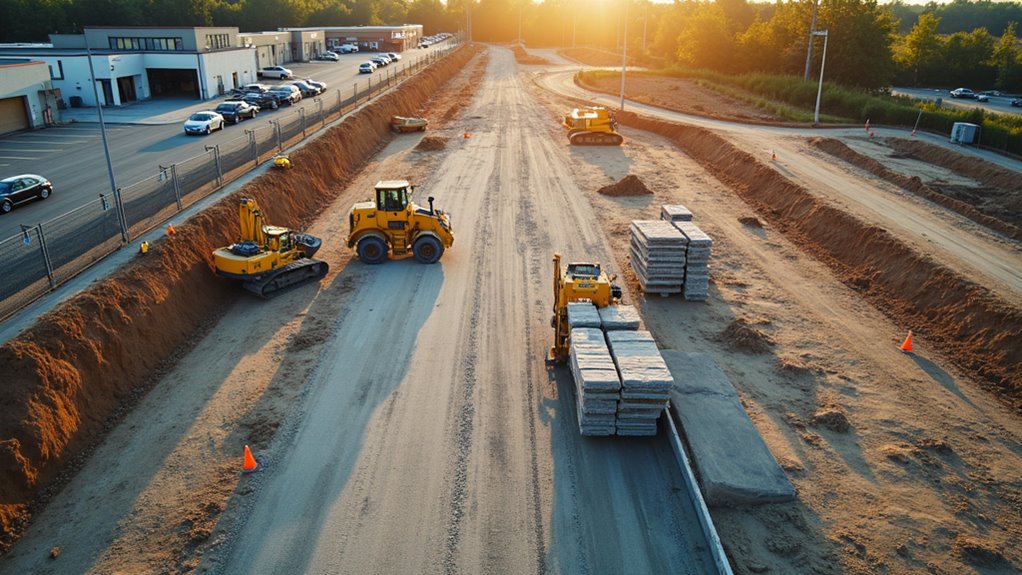
Full removal requires pavement removal machinery types capable of extracting entire pavement sections down to subgrade. You’re looking at enormously higher waste output—old base materials, compromised asphalt, and excavated subgrade all require disposal or processing.
Overlays produce 30-50% less material demand overall. You can incorporate reclaimed asphalt pavement into both methods, but overlay’s inherent preservation approach delivers superior waste reduction. Environmental assessments often mandate waste management plans for full replacement projects due to disposal volume concerns.
Energy Consumption Differences
Energy demands separate these two methods at every construction phase. When you choose overlay, you’re adding pavement lift thickness guidelines that require proper tack coat bonding asphalt application between layers. This process consumes significant energy—aggregate heating alone uses up to 97% of total asphalt production energy.
Full removal demands substantially more resources. Traditional pavement overhauls consume 2.5 times the total lifecycle energy compared to advanced maintenance alternatives. Your milling operations generate energy costs primarily from recycled material transportation.
You can reduce consumption through strategic material choices. Incorporating 30% RAP in your overlay decreases lifecycle energy. Using 60% ABR mixes cuts energy by 20.9% compared to virgin materials. Cold mix asphalt technologies further minimize construction-stage energy demands. Each method’s energy footprint depends on your material specifications, haul distances, and maintenance scheduling.
Sustainability and Regulations
Beyond energy metrics, sustainability considerations and regulatory frameworks shape your asphalt rehabilitation decisions. Overlays minimize excavation depth requirements asphalt specifications demand, preserving existing base structures while reducing material consumption by up to 50%. You’ll generate considerably less construction waste since no full demolition occurs.
When drainage correction base layer work becomes necessary, full replacement triggers additional permitting requirements. Many jurisdictions mandate environmental impact assessments for complete tear-outs, potentially delaying your project timeline.
- Overlays incorporate recycled asphalt pavement (RAP) content, meeting sustainability benchmarks while maintaining structural integrity
- Full replacements require disposal logistics for removed materials, increasing landfill contributions
- Permeable overlay options support stormwater management compliance under local environmental codes
You’ll find overlays align with green building standards more readily, though severe structural damage necessitates replacement despite higher environmental costs.
Five Signs Your Pavement Needs Full Replacement
Five critical warning signs indicate when your pavement has deteriorated beyond overlay candidacy and requires full-depth removal per ASTM D6433 pavement condition assessment standards.
Alligator cracking spanning more than 25% of your surface indicates base failure requiring complete binder course installation. Recurring potholes that return after repairs signal foundation compromise that overlays can’t address.
Standing water demonstrates slope failure necessitating proper asphalt grading and leveling process reconstruction. Severe oxidation with brittle, gray surfaces shows binder degradation beyond surface treatment solutions. An effective asphalt pavement evaluation should assess not only surface conditions but also subsurface integrity to ensure long-term performance. Incorporating new technology allows for more accurate assessments, reducing the likelihood of future issues that could lead to costly repairs. Regular maintenance based on these evaluations can extend the lifespan of the pavement and reduce overall expenses.
Base deformation—buckling, rippling, or deep depressions—confirms subgrade instability. You’ll notice loose pavement sections shifting under load.
When these conditions combine, structural integrity falls below minimum load-bearing thresholds. Full removal enables proper base correction and lasting performance restoration.
Frequently Asked Questions
How Thick Should an Asphalt Overlay Be for Commercial Parking Lots?
You’ll typically need a 1.5-2 inch asphalt overlay for commercial parking lots. However, you should increase thickness to 2-3 inches if you’re dealing with high-traffic areas or poor base conditions. When you’re planning overlays for truck loading zones or entry/exit points, you’ll want to go even thicker to handle concentrated wheel loads. Always verify your existing pavement’s structural integrity before overlaying—it directly impacts your new surface’s performance and longevity.
Can Asphalt Overlay Be Applied During Cold Weather Conditions?
You can apply asphalt overlay in cold weather, but you’ll face significant challenges. Hot mix asphalt requires temperatures above 50°F for proper bonding and compaction. Between 40-50°F, you’ll need modified techniques like thinner lifts and increased roller passes. Below 40°F, you’re limited to emergency repairs only. Rapid cooling prevents adequate compaction, creating air voids that compromise load transfer and structural integrity. Always verify ground isn’t frozen before proceeding.
What Equipment Is Used During Full Asphalt Removal Projects?
You’ll deploy cold planers like the SCM2000-8S with tungsten carbide teeth to mill existing surfaces. For structural tear-out, you’ll use excavators fitted with multi-rippers that generate 8.5 times standard bucket force, or slab removal attachments like the Slab Crab. Dump trucks—end dump, bottom dump, or live bottom configurations—haul milled RAP material. Backhoes, motor graders, and road reclaimers handle subgrade stabilization and base correction work.
How Long Must Traffic Stay off Newly Installed Asphalt Overlay?
You’ll need to keep standard vehicles off newly installed asphalt overlay for 48-72 hours minimum, with residential driveways requiring the full 72-hour window. Heavy trucks and commercial equipment demand a 14+ day restriction to prevent wheelpath rutting and structural damage. Weather impacts these timelines—optimal curing occurs at 70-80°F, while cooler or humid conditions can extend waiting periods to 7 days. Full structural strength develops over 6-12 months.
Does Full Replacement Require Permits in Most Municipalities?
Yes, you’ll typically need permits for full driveway replacement in most municipalities. When you’re tearing out and rebuilding structural layers, you’re affecting grading, drainage patterns, and load-bearing capacity—all code-regulated elements. You’ll submit site plans showing dimensions and materials, pay applicable fees, and schedule inspections at key construction stages. Contact your local building department directly, as requirements vary remarkably by jurisdiction, with cities like Los Angeles and Dallas mandating specific permit types.