
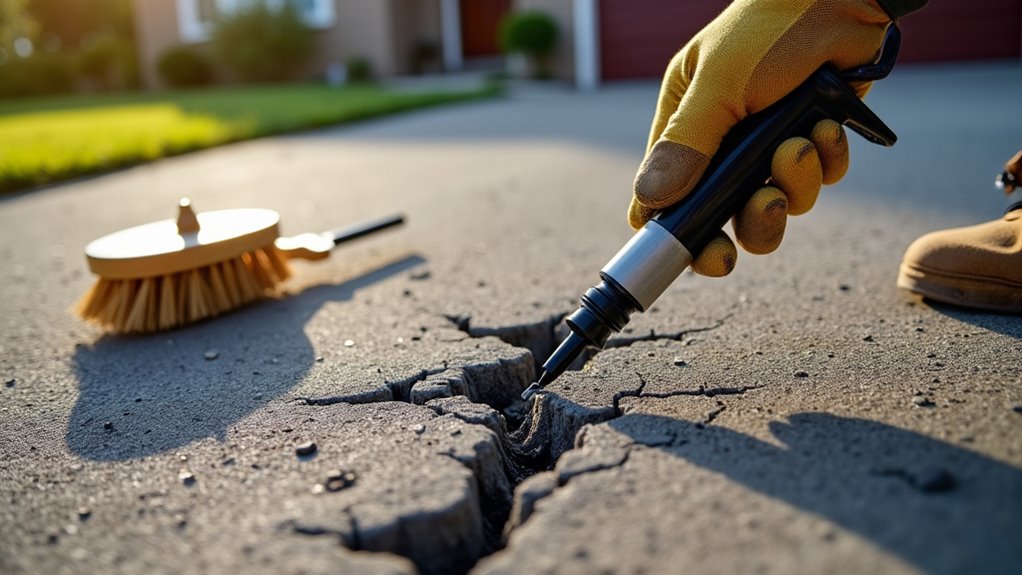
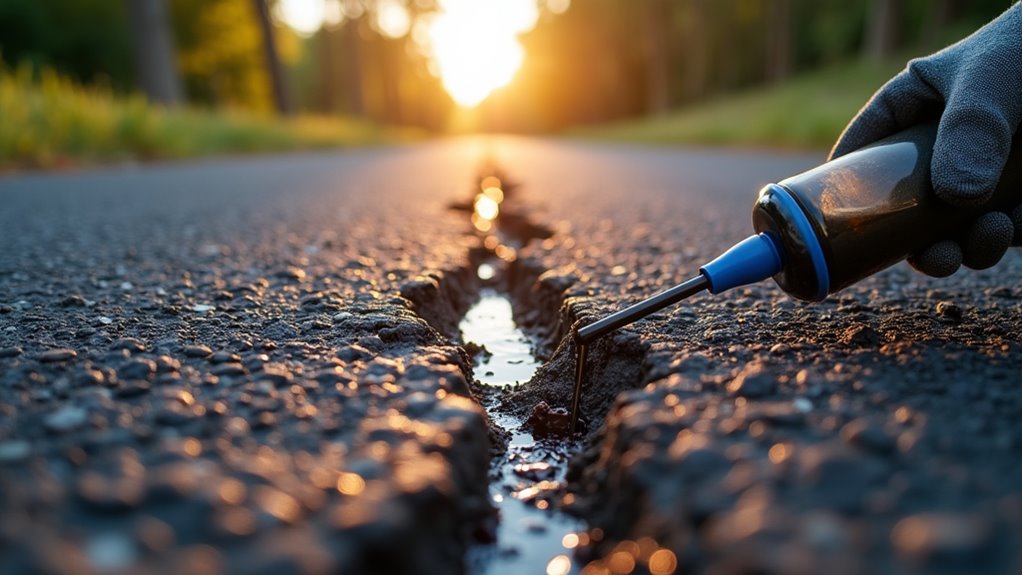


Surface wear affects only your driveway’s upper layer—you’ll notice fading color, hairline cracks, and rough texture from UV oxidation. Structural failure originates in the base or subgrade, showing alligator cracking patterns, rutting deeper than 1/2 inch, and standing water in depressions. This distinction matters because surface wear responds to sealcoating and patching, while structural compromise requires full excavation and replacement. Understanding each failure type’s warning signs helps you choose the right repair approach.
Surface Wear vs Structural Failure: The Key Difference
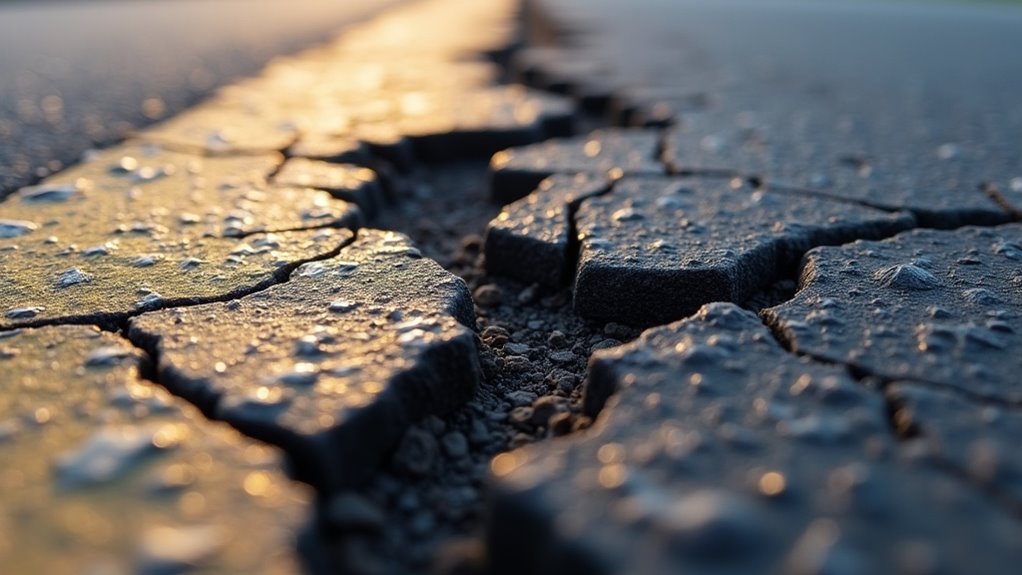
When you notice your asphalt driveway deteriorating, you’re observing one of two distinct failure mechanisms: surface wear or structural failure. Surface wear affects only the pavement’s upper layer, resulting from UV exposure, oxidation, and environmental stress. You’ll recognize it through fading color, raveling, and hairline cracks that don’t penetrate the base. When you notice your asphalt driveway deteriorating, you’re observing one of two distinct failure mechanisms: surface wear or structural failure. If you’re evaluating when to replace asphalt driveway surfaces, distinguishing between these conditions is critical. Surface wear affects only the pavement’s upper layer, resulting from UV exposure, oxidation, and environmental stress. You’ll recognize it through fading color, raveling, and hairline cracks that don’t penetrate the base.
Structural failure originates in the base or subgrade, compromising your driveway’s load-bearing capacity. This condition produces deep fissures, rutting, and interconnected cracking patterns that signal foundation compromise. Water infiltration and heavy vehicle loads typically drive this deterioration. Poor drainage is often a contributing factor, as moisture infiltration weakens the base layers of the asphalt.
The distinction matters for repair decisions. Surface wear responds to sealcoating and resurfacing treatments. Structural failure demands full excavation and replacement. Identifying which mechanism you’re facing determines whether you’ll invest in maintenance or complete reconstruction.
Driveway Cracks That Are Cosmetic vs Ones That Warn You
Although every crack in your asphalt driveway signals some form of stress, not all cracks threaten structural integrity. Understanding surface wear vs structural failure asphalt distinctions helps you prioritize repairs effectively.
Cosmetic cracks typically measure less than a quarter-inch wide, remain shallow in the surface layer, and result from curing shrinkage or minor settlement. These don’t compromise load-bearing capacity. Cosmetic cracks are a common occurrence and do not necessarily require immediate intervention.
Small, shallow cracks under a quarter-inch wide are cosmetic issues—not structural threats requiring immediate action.
Structural distress indicators driveway owners must recognize include:
- Cracks wider than a quarter-inch with visible spreading
- Vertical or horizontal displacement along crack edges
- Alligator patterns indicating subgrade failure
- Cracks near load-bearing areas with uneven surface shifts
When you spot interconnected patterns resembling reptile skin, your foundation can’t support vehicle weight. This signals base compromise requiring professional assessment—not simple crack filling. Early identification prevents costly structural repairs.
How to Spot Rutting, Depressions, and Base Collapse
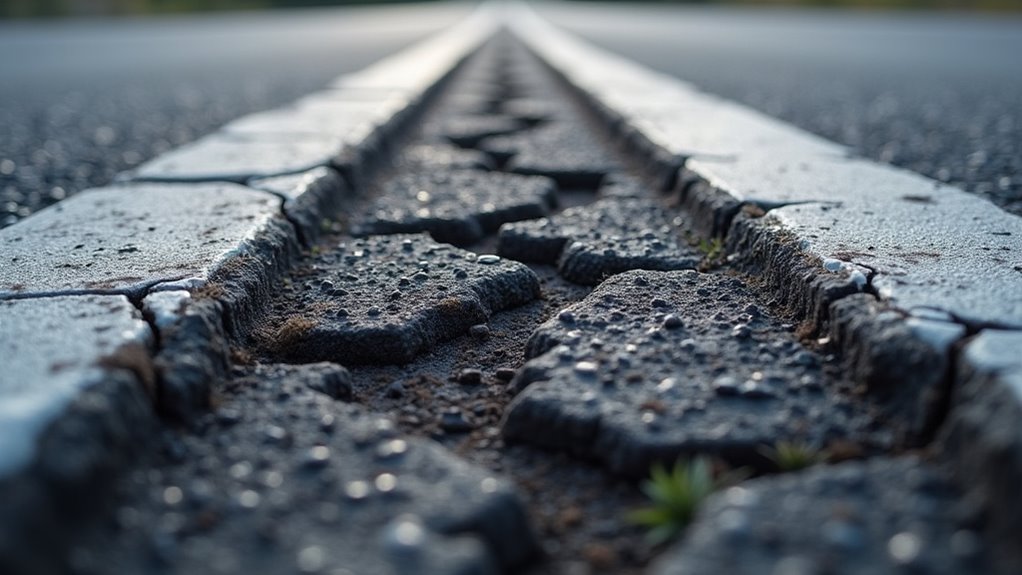
You can identify wheel path damage by examining your driveway for longitudinal depressions that align consistently with tire tracks, measuring any ruts exceeding 1/2 inch in depth as indicators of structural concern. Base failure presents differently than surface wear—look for rapid deepening of depressions, accompanying alligator cracking patterns, and areas where material has pushed laterally under repeated loading. Test suspected weak zones by probing edges for sponginess or filling low spots with water to reveal pooling that confirms subgrade instability beneath your asphalt surface. Severe rutting can create hazardous hydroplaning conditions during wet weather, making timely identification and repair essential for safety.
Identifying Wheel Path Damage
Wheel path damage shows up most prominently where tires make repeated contact with your driveway surface, creating visible evidence of structural stress beneath the asphalt layer.
You’ll notice rutting damage patterns as longitudinal depressions running parallel to traffic direction. These channel-like grooves deepen with each vehicle pass, indicating subgrade consolidation or inadequate base compaction. Wheel path damage spots reveal themselves through several distinct indicators:
- Sunken tracks measuring 1/2 inch or deeper under tire contact areas
- Bowl-shaped depressions holding standing water after rain
- Rough, jagged raveling texture concentrated in travel lanes
- Edge cracking surrounding depressed zones
When you identify these patterns early, you’re detecting structural failure originating below the surface layer. Heavy vehicle traffic accelerates compression, while moisture infiltration compounds base weakness, creating progressive deterioration requiring load-bearing assessment.
Signs of Base Failure
Base failure extends beyond isolated wheel path deterioration to affect your driveway’s entire structural integrity. You’ll recognize pavement instability classification indicators through sunken, raised, or wavy sections where base layers have shifted or weakened. Iowa’s freeze-thaw cycles accelerate soil movement, creating uneven surfaces that compromise load-bearing capacity.
Structural support loss pavement manifests as alligator cracking—interconnected patterns resembling reptile skin that signal foundation compromise. Unlike surface wear, this deterioration originates in subgrade layers and can’t be patched effectively. You’ll notice water pooling in depressions where compaction has failed, accelerating base erosion.
When multiple potholes develop across your driveway, you’re observing widespread base deterioration rather than localized damage. These conditions require full-depth replacement or complete resurfacing since the foundation no longer meets structural performance standards.
What Asphalt Surface Wear Looks Like on Driveways
Surface wear on asphalt driveways manifests through distinct visual and textural indicators that signal binder degradation and aggregate exposure. You’ll notice pavement oxidation damage transforms dark black surfaces to gray, indicating UV degradation asphalt surface binders have broken down. This compromises the protective layer’s integrity.
Key surface wear indicators you should monitor:
- Color fading: Gray discoloration exposes aggregate and signals brittle conditions
- Hairline fractures: Small cracks from freeze-thaw cycles allow water infiltration
- Rough texture: Coarse, gravel-like feel indicates dried-out, inflexible asphalt
- Raveling: Loose stones and missing pieces show binder-aggregate separation
When you detect these conditions early, sealcoating can prevent expansion. Standing water on uneven surfaces accelerates deterioration, softening the pavement beneath. You’ll find high-traffic zones exhibit raveling first, exposing underlying layers to accelerated wear patterns.
What Structural Driveway Failure Looks Like
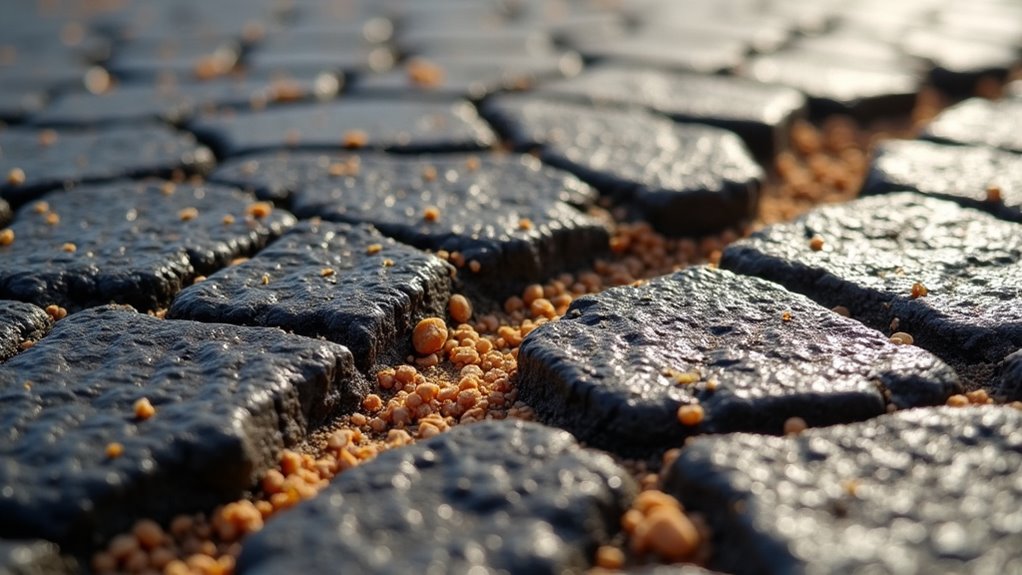
When structural failure occurs beneath your driveway, you’ll see damage patterns that surface treatments can’t fix. Alligator cracking—those interconnected fissures resembling reptile skin—indicates base layer failure in up to 75% of residential cases. Edge cracking develops where lateral support has failed, often from vehicles parking too close to unsupported margins.
| Failure Type | Root Cause | Load Impact |
|---|---|---|
| Alligator Cracking | Base layer failure | Exceeds design load capacity |
| Edge Cracking | Insufficient lateral support | Concentrated edge loading |
| Heaving/Rutting | Subgrade instability | Repeated axle load stress |
You’ll notice rutting creates linear depressions in wheel paths, signaling subgrade weakness or insufficient pavement thickness per AASHTO standards. These failures compromise load-bearing performance and require full-depth reconstruction rather than surface patching.
How Water Turns Minor Driveway Cracks Into Major Damage
Once water penetrates hairline cracks in your asphalt surface, it initiates a progressive failure sequence that compromises pavement integrity far beyond the visible damage. The water infiltration process erodes underlying support layers, weakening your driveway’s load-bearing capacity. Standing water accelerates sub-base instability, creating conditions for structural collapse.
Water doesn’t just sit on damaged asphalt—it actively destroys your driveway’s foundation from within.
Freeze-thaw cycle effects amplify this degradation substantially. When trapped water freezes, it expands by 9% volume, widening existing cracks and breaking aggregate bonds.
Key failure indicators you’ll observe:
- Alligatoring patterns from repeated moisture exposure and surface shrinkage
- Asphalt pumping where saturated material pushes through cracks, forming surface bumps
- Edge raveling as water saturation unravels driveway borders
- Pothole formation from eroded sub-base and drainage system failures
Without proper drainage intervention, minor cracks escalate into complete pavement failure.
How Sun, Heat, and Heavy Vehicles Weaken Asphalt
The sun’s ultraviolet radiation attacks your asphalt’s binder through oxidation, a chemical process that hardens and embrittles the flexible compounds holding aggregate together. UV ray exposure accelerates this degradation, with conventional asphalt surfaces reaching temperatures up to 152°F at mid-day. This oxidation process intensifies in regions where temperatures regularly exceed 90 degrees Fahrenheit.
Heat-induced softening creates a secondary failure mechanism. As temperatures rise, your pavement loses rigidity and becomes susceptible to rutting under vehicle loads. Heavy vehicles turning on heated surfaces create deformation patterns that worsen progressively. The thermal cycling between expansion and contraction generates cracks that compromise structural integrity.
When heavy vehicles traverse thermally weakened pavement, the combined stress accelerates deterioration. Voids form beneath the surface and eventually collapse, producing potholes that threaten both vehicles and pedestrians.
When Bad Installation Causes Early Driveway Failure
Even before environmental stressors take their toll, poor installation practices can doom your driveway to premature failure. When contractors skip critical steps, you’ll experience subgrade failure driveway issues that manifest as settlement, cracking, and rutting within months rather than years.
Structural integrity loss asphalt problems stem from these common installation defects:
- Inadequate base compaction — Weak subgrade compaction creates uneven settlement and load-induced cracking that compromises your entire pavement structure.
- Insufficient asphalt thickness — Undersized layers exceed structural capacity, causing fatigue cracking and premature rutting.
- Poor drainage integration — Without proper slope and edge drains, water accumulates and accelerates base deterioration.
- Improper compaction during paving — Low-density spots become weak points that fail under normal traffic loads.
You can’t overcome installation deficiencies with maintenance alone.
Surface Wear Fixes: Sealcoating, Patching, Resurfacing
When surface wear hasn’t yet compromised your driveway’s structural capacity, you’ve got three proven repair strategies that restore pavement performance without full replacement.
Sealcoating addresses early-stage surface abrasion pavement damage by blocking UV oxidation and creating waterproof barriers. Applied every 2-3 years, it extends driveway lifespan to 20-30 years while reducing lifecycle costs by 65-75%. You’ll pay approximately $0.39 per square foot over 12 years versus $1.76 unsealed.
Patching targets localized defects before asphalt material fatigue breakdown progresses to structural failure. It stabilizes base layers and prevents water infiltration that accelerates deterioration. Patching targets localized defects before asphalt material fatigue breakdown progresses to structural failure. Understanding asphalt overlay vs replacement helps determine when localized repairs are sufficient versus when more extensive work is justified. It stabilizes base layers and prevents water infiltration that accelerates deterioration.
Resurfacing provides a new overlay when surface wear becomes extensive. This cost-effective alternative to full replacement restores uniform functionality and enhances durability against ongoing traffic and environmental stresses while maintaining load-bearing capacity. resurfacing vs rehabilitation presents two distinct approaches to surface maintenance. While resurfacing is ideal for surfaces with less extensive damage, rehabilitation involves repairing the underlying structure to address deeper issues and prolong the life of the asset. Choosing the right method ensures optimal performance and cost efficiency based on the specific condition of the surface.
Signs You Need a Complete Driveway Replacement
When you notice extensive alligator cracking spreading across your driveway’s surface, you’re observing classic interconnected fracture patterns that indicate foundation-level structural compromise rather than simple surface wear. Deep rutting throughout the pavement confirms that your base layer can no longer distribute vehicle loads according to standard load-bearing requirements. Multiple base layer failures mean repairs won’t hold, and you’ll need complete removal and reconstruction to restore proper structural integrity.
Extensive Alligator Cracking Present
Alligator cracking represents a definitive structural failure that extends beyond the asphalt surface into the base and subgrade layers beneath your driveway. This deep fatigue cracking asphalt pattern signals load-bearing capacity loss pavement that sealcoating or surface treatments can’t address.
You’ll recognize this damage by its distinctive characteristics:
- Interconnected cracks forming multi-sided polygonal patterns resembling reptile scales
- Spongy feel or loose pieces when you walk across affected areas
- Concentration near entrances, turns, or spots where vehicles stop repeatedly
- Progressive spreading that allows water infiltration into foundation layers
When you observe extensive alligator cracking spanning several feet or more, you’re facing base layer compromise. Standard repair protocols require removing damaged asphalt, reconstructing the subgrade, and installing properly compacted new pavement.
Deep Rutting Throughout Surface
Deep rutting throughout your driveway’s surface indicates another form of structural failure that demands full replacement rather than surface repair. These permanent longitudinal depressions form in wheel paths where repeated traffic loading causes subgrade weakening beneath the pavement structure. You’ll notice rutting formation most clearly after rainfall when water pools in the troughs.
According to FHWA data, depths exceeding 0.5 inches classify as severe rutting, affecting over 6% of U.S. pavements. When you observe this deformation pattern, your base layers have failed under load stress. The subgrade has likely weakened from saturation, poor initial compaction, or inadequate thickness for current traffic demands.
Surface overlays won’t resolve structural rutting. You’ll need complete removal and base reconstruction since the load-bearing foundation can’t sustain continued service without extensive rehabilitation.
Multiple Base Layer Failures
Multiple base layer failures manifest through distinct distress patterns that collectively signal irreversible structural compromise beneath your driveway’s surface. When you observe multiple indicators simultaneously, you’re dealing with systemic foundation erosion asphalt driveway owners can’t address through surface treatments alone.
Moisture-related pavement failure accelerates when water infiltrates compromised base layers, creating interconnected deterioration patterns:
- Alligator cracking networks indicate your base layer has lost load-bearing capacity through repeated freeze-thaw cycling
- Multiple potholes confirm systemic subbase failure where soft, spongy areas have developed voids
- Standing water exceeding 24 hours demonstrates drainage failure actively weakening your foundation
- Pumping action reveals water has penetrated deep into base materials, forcing mud to the surface under traffic loads
These combined failures require complete removal and reconstruction—not patching.
Frequently Asked Questions
How Long Does a Properly Installed Asphalt Driveway Typically Last?
You can expect a properly installed asphalt driveway to last 15 to 25 years, with well-maintained surfaces reaching 20 to 30 years. Your driveway’s longevity depends on achieving full 3-inch hot mix asphalt thickness, proper excavation, and adequate base compaction per industry standards. If you’re maintaining light residential traffic loads and following a sealcoating schedule every 3 to 5 years, you’ll maximize structural performance and potentially exceed 30 years of service life.
Can Tree Roots Cause Structural Failure in Asphalt Driveways?
Yes, tree roots can cause structural failure in your asphalt driveway. When roots expand beneath the pavement, they exert upward pressure that compromises load-bearing capacity. You’ll notice deep fissures, heaving, and widespread instability—classic indicators of base-layer compromise. Compacted soil forces roots horizontally, directing pressure toward your pavement’s weakest points. If you don’t address root intrusion early, damage progresses from surface cracking to full structural failure requiring complete base reconstruction.
Does Driveway Color Indicate Surface Wear or Structural Problems?
Driveway color changes primarily indicate surface wear rather than structural problems. When you notice fading from black to gray, you’re observing UV-induced photo-oxidation affecting only the upper pavement layer. This binder degradation reduces aggregate adhesion and increases brittleness. However, you shouldn’t dismiss color changes as purely cosmetic—they signal weakening surface integrity that enables water infiltration. If fading accompanies cracking or rutting, you’re likely seeing surface wear progressing toward structural compromise.
How Often Should Asphalt Driveways Be Professionally Inspected?
You should schedule professional inspections annually for most residential driveways. However, you’ll need to adjust this baseline based on specific conditions. In UV-intense climates like Central Texas, maintain strict annual assessments. If your driveway experiences heavy vehicle loads or frequent turning movements, shorten intervals to 12–18 months. Low-traffic, shaded driveways in moderate climates can extend to longer intervals, provided you’re conducting monthly self-inspections to catch developing issues.
Will Homeowners Insurance Cover Structural Driveway Failure Repairs?
Your homeowners insurance won’t cover structural driveway failure repairs. Insurers classify base and subgrade deterioration—including deep fissures, rutting, and load-bearing compromise—as maintenance responsibilities rather than insurable events. Standard policies explicitly exclude subsurface issues like soil shifting, settling, and earth movement that typically cause structural failure. Coverage applies only to sudden, accidental damage from covered perils such as falling trees during storms, not gradual structural degradation affecting pavement performance.